







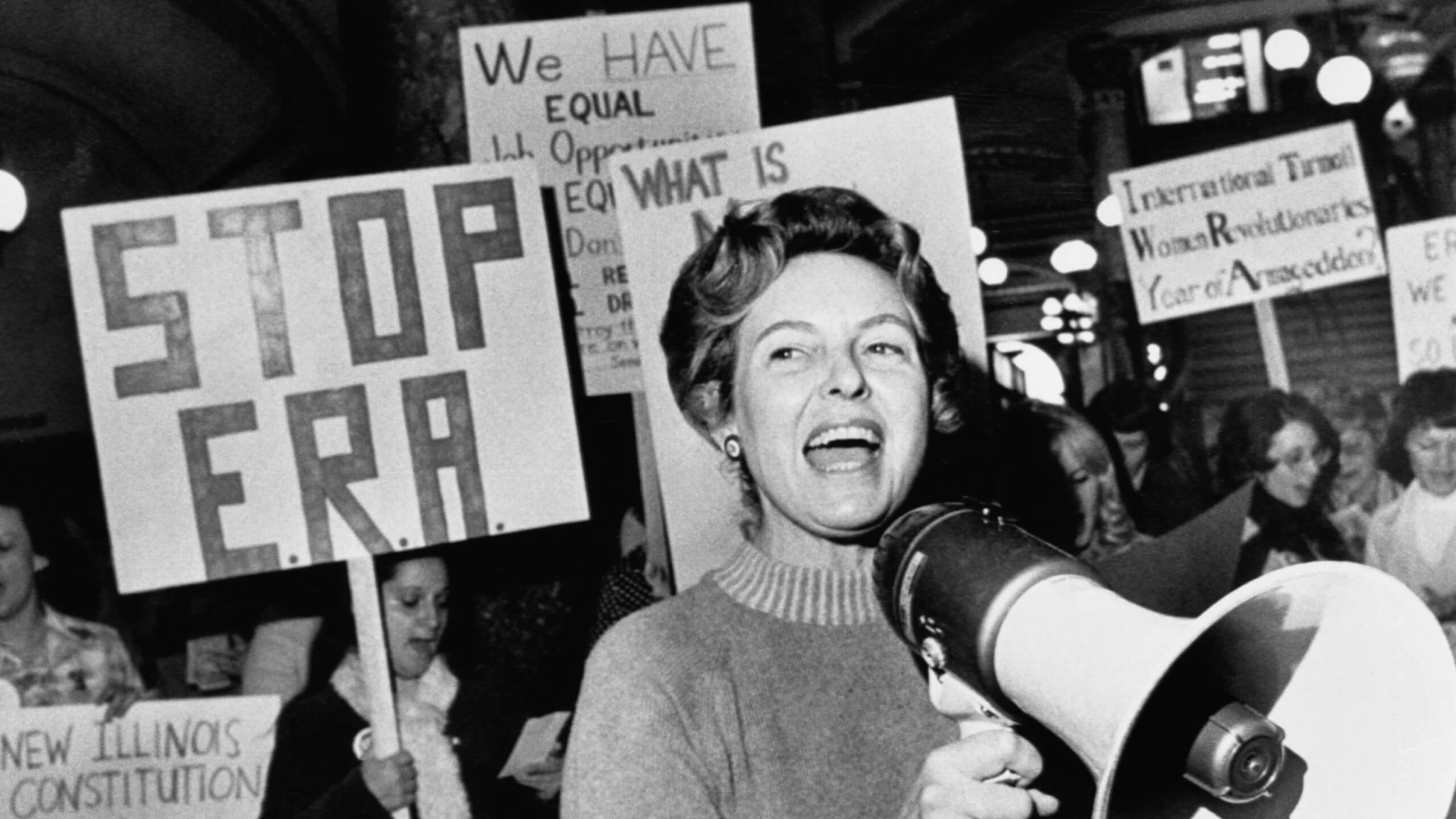
In conducting research for my upcoming book about American culture, I came across the controversial figure of Phyllis Schlafly. I remember her as someone my mother liked, as she was exactly the demographic Phyllis tried to reach: a Christian homemaker. I vaguely remembered the controversy surrounding the Equal Rights Amendment growing up, and the argument that while its supporters claimed they wanted “equal rights for women,” its detractors believed it would strip women of certain protections and privileges, such as exemption from the draft. I don’t remember all the particulars, other than seeing ERA NOW signs and STOP ERA signs in roughly equal proportion. Then, like so many cultural battles of the era, it faded from memory.
Read more Title IX’s Failed Experiment: Why Accommodating Sex Differences Beats Engineered Parity
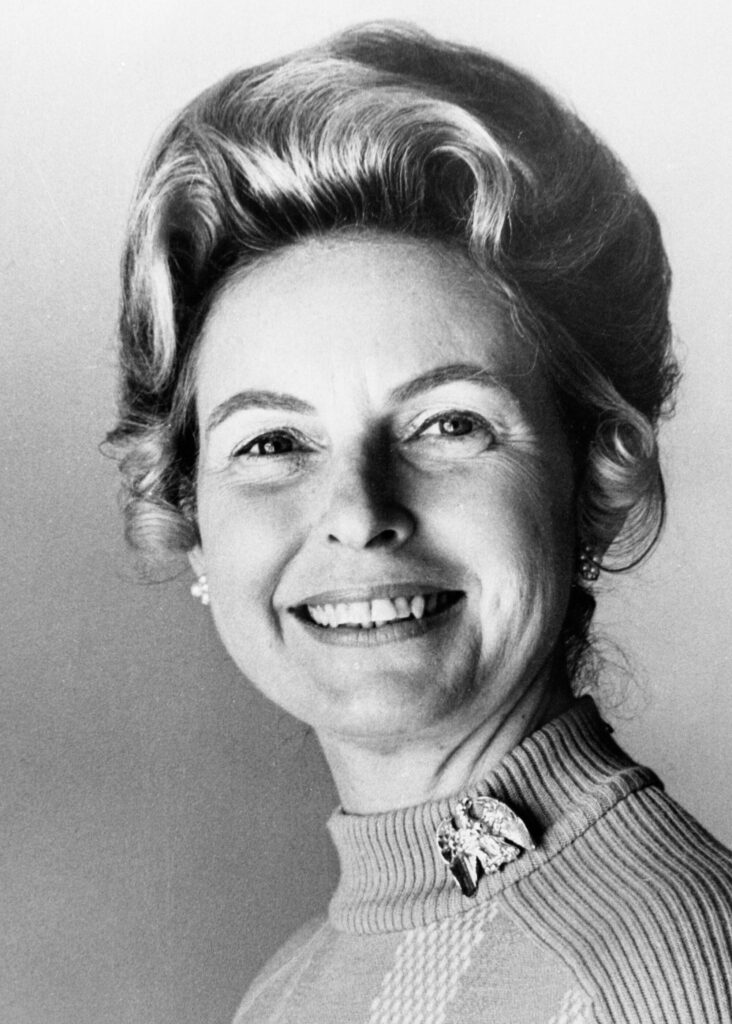
Portrait of Phyllis Scholarly. (Photo by Bettmann Archive/Getty Images)
About five or six years ago, her memory was revived through the miniseries Mrs. America, starring Cate Blanchett as Schlafly. This was during COVID, and while I was working, I remember my wife and daughter being glued to the series and finding it extremely well done. Although I couldn’t devote much attention to it, what I did see portrayed Schlafly as highly articulate, if somewhat overly ambitious and calculating. Because I lived through the period when she was a national figure, the portrayal struck me as colder than the woman I remembered.
Apparently, I was not alone in that assessment. Schlafly’s daughter Anne criticized the series, arguing that it portrayed her mother as more calculating and personally ambitious than she was in real life. She was especially critical of the depiction of her parents’ marriage. According to Anne, the portrayal of her father Fred as resentful, controlling, and threatened by his wife’s success was simply false. Her father, she argued, was one of her mother’s greatest supporters and took pride in her accomplishments.
In reading Donald Critchlow’s biography of Schlafly, probably one of the best sources on her life and work, one doesn’t have to read very far to realize Anne was correct. Hollywood, which generally views traditional marriage with suspicion, was never going to allow one of the principal opponents of post-modern feminism to appear on screen as happily married. Yet one quickly discovers that Fred Schlafly not only supported his wife’s entry into politics but actively encouraged it.
Feminist apologists often scratch their heads when they encounter someone like Schlafly. It’s the same old story. Leftists generally assume that anyone with sophistication, intelligence, or culture must naturally lean left. Marriage and children are depicted as a trap unless the wife’s knee is firmly ensconced on her husband’s neck. The truth was quite different. Fred Schlafly had no interest in running for Congress himself. When local Republicans approached him, he declined and encouraged Phyllis to run instead.
At the time, Phyllis was a 27-year-old housewife with a child, and the idea that someone proud of being a homemaker would run for Congress fascinated the press. Reporters, not always known for their depth of thought, became obsessed with the image of this Phi Beta Kappa graduate with a master’s degree from Radcliffe who was simultaneously a wife, mother, and congressional candidate. Photos of her grocery shopping, cooking breakfast, ironing clothes, and discussing politics made national headlines. It certainly didn’t hurt that she was articulate, attractive, and unusually intelligent. Her husband Fred was a somewhat older and highly successful lawyer who shared her Catholic faith and anti-communist convictions. Contrary to the depiction in the miniseries, the Schlaflys were a genuine partnership.
Although she lost to five-term incumbent Melvin Price in a heavily Democratic district, she made her mark. During the decade that followed, she organized conservative networks among women’s groups, civic organizations, and patriotic associations. She served in leadership roles within the Illinois Federation of Republican Women and became a frequent speaker, including delivering a famous address before the Illinois General Assembly that earned repeated standing ovations.
The road to the Illinois General Assembly had not been easy. Schlafly grew up in St. Louis during the Great Depression. Born in 1924 into a middle-class family, she experienced firsthand the economic devastation of the era. Her father, Bruce, lost his job as a machinist and struggled to find consistent work for nearly a decade. The family moved frequently and never owned a home.
So her mother, Odile, went to work to save the family. Because they could not afford tuition, Odile offered to catalog the library at the local Catholic girls’ school in exchange for free education for her daughters. In effect, she added an extra workday to an already exhausting six-day work schedule in order to put her daughters through school.
Phyllis later received a scholarship to a local Catholic college, but after one year, chose to leave and work her way through Washington University because she believed it offered greater academic rigor. She attended college during the height of World War II, and the only job that fit her schedule was as a ballistics gunner and ammunition tester at a munitions plant. So she attended classes during the day and tested weapons at night while helping support the war effort. It is difficult not to love her just for this. After graduating at the top of her class, she earned a scholarship to Radcliffe, where she studied political science. In many ways, Phyllis inherited her mother’s determination, brilliance, discipline, and deep faith in God, family, and hard work.
Now we come to the usual complaint about Schlafly, other than the fact that she was not a Marxist feminist in the style of today—or even the 1970s. Even those attempting to be “fair” to her often lapse into the same condescending refrain: “She was so intelligent and ambitious, yet she wanted to deny rights to women. Such a paradox.” Or: “She left the home but wanted to trap all other women inside it.”
By now, these observations are so trite and thoughtless they hardly merit serious attention. Successful women are not automatically resented by their husbands, nor do women necessarily have to choose between family and professional accomplishment. Women do not need to sacrifice their children in order to achieve success any more than men do.
But beyond that, it is important to understand why Schlafly left the home and encouraged other women to become politically active. She believed it was an emergency. Schlafly entered politics because she believed the family itself was under attack. She referred to Franklin Roosevelt’s New Deal as “an invasion of the home.” To her, the expanding administrative state threatened to replace the family as the central institution of American life. In her mind, the leftist encroachment into the home through government dependency and bureaucratic management required mothers and grandmothers across America to step onto the battlefield in defense of the family and the American way of life. For Phyllis, this was no different than mom, granny, and the two girls grabbing muskets to chase away the bandits. Phyllis Schlafly was, in many respects, the ultimate American frontier woman.
Schlafly was Ronald Reagan before Ronald Reagan. In fact, she helped make Reagan possible. She understood what was happening to the American family long before most Republicans did. She saw the biggest menace not only in growing communist influence but also in the East Coast Republicans who were happy to make a deal with the devil in order to hold themselves in power. In other words, she not only presaged Ronald Reagan, but she saw the threat of establishment Republicans like Bush and Cheney long before anyone else did. She was bitterly opposed to endless wars and the military-industrial complex, as well as the welfare state—and referred to the military draft as an incursion into the home.
But, like her parents, who were no fans of FDR, she was highly suspicious of the direction the country started with the New Deal. Prior to that government overreach, prior to the imposition of the federal income tax—which she believed eroded the autonomy of the family—the family was the primary unit of American life. Families cared for elderly relatives, churches organized charity, local communities aided one another, and parents remained responsible for the moral and spiritual formation of their children. There was accountability to family, community, church, and neighborhood.
But once the state became the provider, protector, educator, and moral authority through armies of self-appointed experts, the family inevitably weakened. Programs such as Social Security and expanding welfare systems gradually created permanent dependency structures. Americans were slowly losing habits of self-reliance, local responsibility, and voluntary charity. The family, once the building block of society, was increasingly supplanted by bureaucratic systems managed by self-appointed experts with clipboards.
Feminists were not trailblazers in Schlafly’s eyes. They were participants in a broader ideological movement that failed to understand the importance of the family as the final barrier between the individual and the centralized state. Schlafly understood where many of these ideas originated: in the writings of Karl Marx and Friedrich Engels, both of whom viewed the traditional family as an obstacle to revolutionary transformation. If the family could be weakened—if women could be convinced that marriage was oppression, children were burdens, and domestic life was humiliation—then society would become increasingly dependent upon bureaucratic institutions for identity, meaning, and stability.
To Schlafly, the family was never merely a private arrangement. It was the central institution through which morality, memory, culture, and continuity were transmitted across generations.
Phyllis knew that the feminist argument that conservatives oppose opportunities for women is false. Schlafly, her mother, her father, and her husband all believed women should have educational opportunities, professional opportunities, legal protections, and meaningful participation in society. But what Schlafly saw emerging within feminism was something very different. She believed modern culture increasingly devalued motherhood, family formation, sacrifice, and the uniquely feminine influence within the home. Once that influence disappeared, she feared the moral center of the country would rot.
To say she was prescient is an understatement. Schlafly could hardly have been more accurate about the condition of the modern West unless she had traveled forward in time. Children have increasingly become an afterthought. Loneliness and alienation are no longer occasional pathologies but defining characteristics of modern life. Mental health struggles are widespread. Children are increasingly shaped not by parents and communities, but by institutions, bureaucracies, algorithms, and the technological empires they carry in their hands. People barely even make eye contact anymore. They argue endlessly with strangers on their phone and look at pictures of cats.
But perhaps Schlafly’s greatest insight was this: women traded away a profound form of civilizational power. They exchanged the ability to shape the culture of families, neighborhoods, communities, and future generations for peripheral participation in bureaucratic and corporate systems that neither know nor love them. Modern ideology snookered women to surrender deep and lasting influence for managerial status inside institutions built by technocrats.
The feminists are right about one thing. The contributions of women throughout history rarely receive the gratitude they deserve because female influence is often subtle, relational, and civilizational rather than theatrical or publicly celebrated. Every man in a successful marriage understands that it is often the wife and mother who shapes the moral atmosphere, culture, memory, and aesthetic life of the family, while the husband’s role is often to protect and preserve.
Phyllis Schlafly understood that this was not weakness, but power. She understood that traditional femininity was the driving force behind the success of civilization. Her own life projected confidence, intelligence, humor, and formidable intellectual discipline. For those of us who understand the true nature of power, she exemplified that traditional femininity, subtle influence, and intellectual seriousness are not contradictions. They are the marks of a truly liberated woman.
Read more Declassified 2020 Election Docs Provide Key Intel Withheld From ‘Flawed’ January 2021 IC Assessment
* * *
This content was originally published at the Abstract Truth Substack