







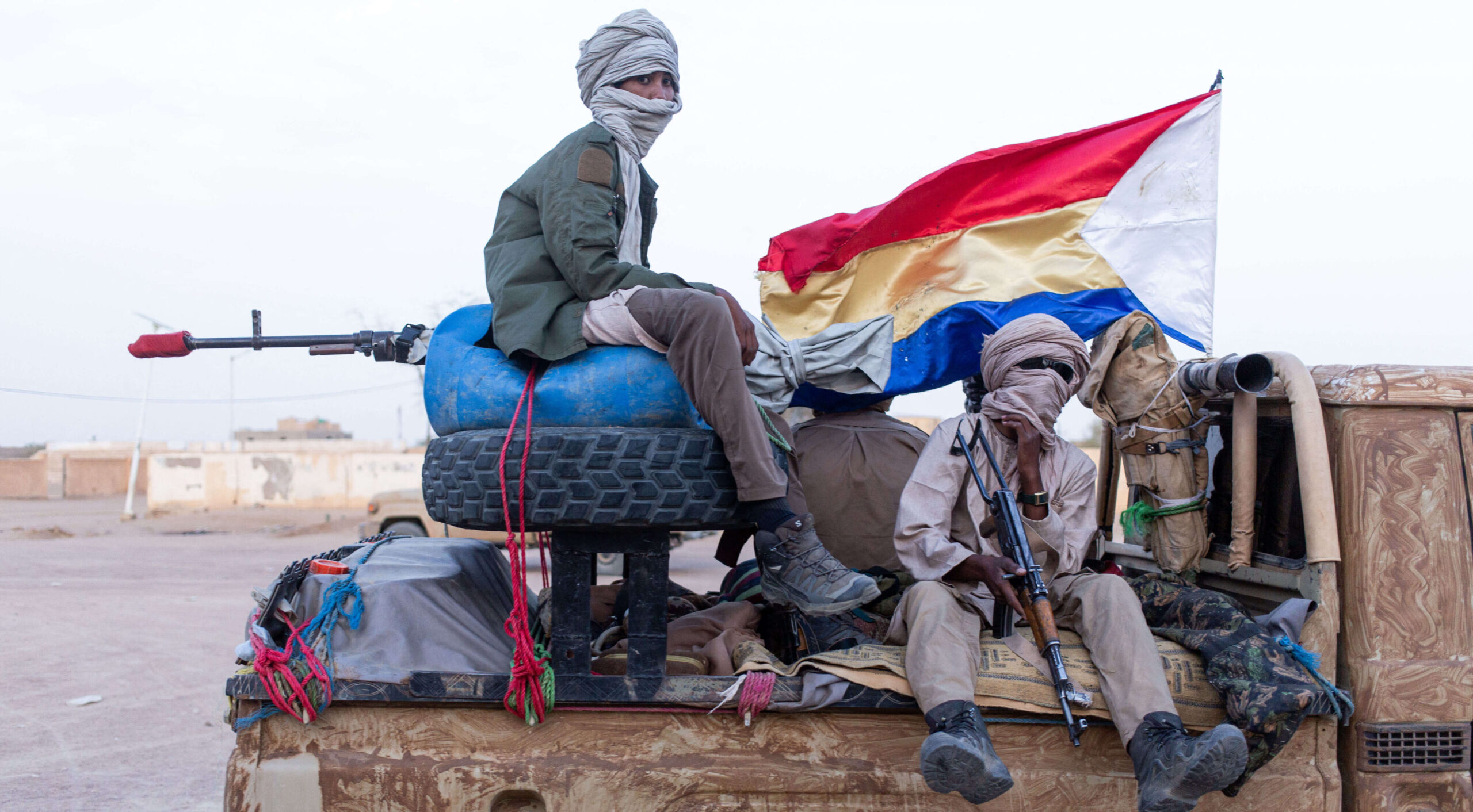
“The conditions are grueling. Temperatures regularly soar above 110 degrees Fahrenheit during the day, then drop sharply overnight. Water is scarce, and the dust and sand get everywhere. But at least they are working above ground. This elite group of Ukrainian drone operators has spent years hunting Russians from dugouts in Ukraine. They are still doing the same—but in the desert in northern Mali.”
Read more America’s Libertarians Cause More Harm Than Good
According to a new report from CNN, Ukrainian drone specialists are now being deployed to Africa to fight a hidden war against Russian soldiers, not just in Mali but also in Sudan and Libya. At present, the number of Ukrainians in Africa is small—CNN says there are just 15 in Mali—but if their numbers grow, as they’re likely to, so will the damage to Russia’s vital economic interests. Maybe these intrepid warriors will help bring the war back home, now in its fifth bloody year, to an end.
CNN spoke to a drone operator embedded with the Azawad Liberation Front in Mali, which is currently fighting about 2,000 Russian troops propping up the military regime of Assimi Goïta.
“I coordinate their operations remotely,” he told CNN.
“The signal from their drone comes to me over the internet, and I immediately tell them via radio what to do and where to fly.
“They go out on missions, then return to me, and we go over every detail of their actions. I don’t go out to the front lines myself—that was a direct order from my superiors.”
Soldiers are now traveling from Chad, Niger, and Burkina Faso to Mali to receive training from the Ukrainians there, CNN reports.
The purpose of the mission is twofold. First, the Ukrainians want to undermine the idea that Russia is a reliable ally in the region, with everything that entails for the war in Europe and Russia’s chance of winning it. Second, they want to test their newly developed equipment under totally different conditions so they can improve it and develop new tactics.
Drones have come to be the most important technology in the war in Ukraine, claiming the lion’s share of thousands of casualties each month. Both sides are making millions of drones each year and deploying them in a range of missions, from long-range strikes on infrastructure to reconnaissance and assassinations on the battlefield and behind enemy lines. Video footage from drones has become one of the main propaganda tools of the war, a reminder that no one is safe anywhere and that massive numbers of soldiers and expensive equipment like main battle tanks count for far less than they once did. Ukraine has become a hub for cutting-edge drone warfare, drawing combatants from around the world—and even cartel members from South America, as I wrote for American Greatness recently—to learn the very latest ways to maximize damage at minimum cost. The Ukrainians are only too happy to market themselves as the world experts in drone warfare—which they are—and to share their knowledge when it benefits them.
Conditions in Africa, and the kind of war being fought, are very different from the morass in the Donbas.
“Dust and heat cause equipment to fail faster. Filters, cooling, electronics protection, batteries … everything works differently (and) requires serious adaptation,” a Ukrainian intelligence source explained.
“In Ukraine, it’s high-intensity, massive strikes, constant pressure. Here it’s more of a maneuverable war over large territories, ambushes, route control, working in small groups and depending on knowledge of the terrain.”
The first suggestion that Ukrainians were in Mali came two years ago, when Azawad ambushed and killed a large number of Russian Wagner Group fighters near the border with Algeria. A spokesman for Ukraine’s Defense Intelligence said his country had provided the rebels with “necessary intelligence,” which led the regimes in Mali, Niger, and Burkina Faso—all Russian allies—to file a complaint at the UN that Ukraine was sponsoring terrorists.
Earlier this year, Ukrainians were also involved in the capture of the strategic town of Kidal, in the north of Mali. Azawad linked up with al-Qaeda militants and launched a simultaneous strike against Russian troops in the town, forcing them to retreat. Russia’s Defense Ministry accused “Ukrainian and European mercenary instructors” of training the rebels for the attack.
By all accounts, Ukrainian drones played a key role in the victory at Kidal. The rebels have “rudimentary” equipment and show little discipline. What they lack in tech and training, they make up for in enthusiasm. But there’s no question this is a relationship of “convenience, not necessarily conviction.”
“Culture and religion are different, but when you are being attacked by the same idiots, ideological differences fade into the background,” said the Ukrainian intelligence source.
The enemy of my enemy is my friend.
In the last decade, Russia has emerged as a powerful new player in Africa, especially the resource-rich but acutely unstable Sahel region, below the Sahara. There are now as many as 5,000 Russian troops dotted across a number of different countries, from east to west. In exchange for military support, ranging from close protection and training to direct combat roles, Russia receives access to a wealth of resources that can be used to keep the war machine grinding slowly through the rich black chernozem mud of Ukraine.
The new African model was established by the Wagner Group, a private military company founded by longtime Putin ally Yevgeny Prigozhin. Wagner entered Sudan first, in 2017, to train Sudanese government forces in exchange for gold-mining concessions. The next year, they were in the Central African Republic, first providing training and then fighting alongside government forces in exchange for rights to gold, diamonds, and timber. Since then, Russian forces have taken up residence in Libya, Burkina Faso, and Niger. In 2023, after Prigozhin’s abortive coup and subsequent murder, Wagner was merged into the conventional armed forces, and the Africa Corps—a name to conjure with—was established to continue the work.
Read more Trump Says Assassination Attempt in Butler, PA in July 2024 Was ‘All a Democrat Plot’
Space has been created for the Russians by the dramatic and sudden withdrawal of European, especially French, power in the region. Between 2022 and mid-2025, a domino-like series of coups and reversals saw France lose almost all of its long-established military bases in West and Central Africa, including bases in Mali, Burkina Faso, Niger, Chad, Ivory Coast, and Senegal. The new regimes simply told the French to leave, and they did. Françafrique—France’s lingering domination of its former colonial possessions in Africa—has now all but unraveled and been replaced by Russafrique. In many places, like Mali, for instance, Russian forces entered practically the same day the French left. It’s hard to see this as a coincidence.
How much money is Russia making from its African operations? The most frequently cited estimate comes from the 2023 “,” which claimed that more than $2.5 billion in gold had been extracted from the Central African Republic, Mali, and Sudan since the invasion of Ukraine in February 2022—or about $114 million a month.
However much money Russia is making, it’s a lot, and it’s needed. Africa now functions as “the Kremlin’s alternative treasury.” Because Russia is blocked from the global financial system, the country has had to turn to gold bullion to finance the war. Russia’s reserves hit a record $310 billion in December last year. Gold is now regularly exchanged for weapons or for cash to buy equipment from allies, including Iran and North Korea. For example, Russia’s Yelabuga drone factory paid the Iranian manufacturer Sahara Thunder about $104 million for 6,000 Shahed drones and other equipment, mostly using gold bars. An elaborate network of shell companies, cut-outs, and go-betweens, from Africa to the Middle East and Turkey, helps Russia to process the gold in various ways and plow it into guns, missiles, drones, other equipment, and mercenaries.
But what it all comes back to is direct control of resources in Africa—not just gold, but diamonds, uranium, manganese, oil, and timber—and the use of extreme violence to maintain that control. Russian forces in Africa have already become notorious for their brutality: torture, murders, and massacres. In one outstanding instance, Wagner forces are alleged to have murdered as many as 500 civilians in the town of Moura, Mali, and buried them in mass graves between March 27 and 31, 2022. The military regimes the Russians support are no less brutal; violence brought them to power and could easily bring about their undoing.
In June, President Zelensky announced a new “influence” mission that would directly target Russia’s economic infrastructure, striking targets deep inside Russia that were previously off-limits for one reason or another. That means oil refineries and terminals, factories, and even domestic commercial infrastructure, such as warehouses used by Russia’s Amazon-equivalent Wildberries. Strikes have taken place across the length and breadth of Russia. Ukraine has attacked an oil refinery in Siberia, 1,550 miles from the Russian border, as well as refineries and terminals around the capital, Moscow, and second city, St. Petersburg. The attacks have disrupted flights, led to fuel shortages that have seen angry motorists queueing for hours, and prevented Russia from benefiting fully from ongoing disruptions to the flow of oil in the Middle East. An artillery factory on the Volga, nearly 600 miles from the border, was also targeted with Ukraine’s new Flamingo cruise missile.
“Every Russian defense facility that serves the war against Ukraine is a just target,” President Zelensky wrote on X.
“The reach of Ukraine’s long-range weapons continues to expand. And it is precisely our pressure, day after day, that lays the groundwork for a dignified peace in the end.”
The response from Russia has been furious. Putin has accused Ukraine of “opening Pandora’s Box” and promised tit for tat.
“The Kyiv regime set out to damage our economy. What did it do? It opened this Pandora’s box itself. Well then, expect a response targeting your most sensitive economic sectors,” Putin said.
Moscow has sent swarms of drones and hundreds of missiles, including terrifying “unstoppable” hypersonic missiles, at Ukraine. There have been attempts to assassinate senior members of the Ukrainian military and intelligence services. Ukraine’s energy grid and agriculture are now fair game. Previously, both sides had agreed not to target grain exports on the Black Sea, but Russia stepped away from the deal in 2023, although Russia had not, until now, attacked grain shipments with any real determination.
Ukraine’s wheat can now be replaced with Russian exports, of which there are plenty, Putin said. More grain might well be a way for Russia to secure even greater access to natural resources in Africa. Eritrea on imports of Russian and Ukrainian wheat, and more than a dozen African countries—Egypt, Benin, Madagascar, the Democratic Republic of the Congo, Senegal, and Mauritania, among them—depend on the two adversaries for between 50 percent and 80 percent of their grain imports.
Four years of stalemate and hundreds of thousands, if not millions, of casualties have pushed both sides to adapt and improvise just to survive. Drone warfare is just one highly refined, high-profile example of this process of constant change. Russia is suffering tens of thousands of casualties a month. In July, according to Ukraine, 42,860 Russian soldiers were killed or wounded. Total Russian casualties are now estimated at 1.5 million. In response, Putin has mined Africa for another resource besides gold: manpower. Soldiers from at least 36 different African nations have fought on the Russian side, many having been lured with false promises of good pay and a better life. Putin has also turned to his isolated Stalinist ally in the Far East. Ten thousand North Koreans were deployed to Ukraine in late 2024. They suffered atrocious casualties and became addicted to porn after being allowed access to the internet for the very first time. There are reports that 50,000 more could soon reach the frontline.
With this new proxy war in Africa, the global dimensions of the war in Ukraine could not be clearer. They’ve always existed, of course, right from the start. The war in Ukraine itself is a proxy war between Russia and the West, something both sides have always recognized even if they’ve struggled to accept the consequences fully. Calling it World War III or IV might seem a little dramatic at this stage, especially since the devastation is still contained to a small area of the Eurasian landmass, but the longer the conflict draws on, and the further it spreads, the greater the possibility of dramatic escalation. Africa’s gold is no less important to the Kremlin than the oil and gas of Siberia and will be no less fiercely defended if it comes under real threat.
But Ukraine seems determined to pursue Russia to the ends of the earth, if need be. Wherever there are Russians, there will be Ukrainians fighting them.
Or, as Kyrylo Budanov, the head of Zelensky’s presidential office, put it, “from Russia to Africa, in a suit and in camouflage.”