

The modern left has become a factory for producing little tin gods: figures whose records cannot carry the legends built around them but who are shielded by the institutions that built them. Rudyard Kipling popularized the phrase in his 1886 Departmental Ditties, mocking colonial officials who strutted like deities over petty jurisdictions. The little tin god is self-important and imperious, demands deference out of proportion to his real authority, and somehow never answers for anything, no matter how outrageous or egregious. The tin is the giveaway: polished to look like gold, hollow when you tap it.
Read more Morning Greatness: Ninth Circuit Holds Emergency Hearing on California’s Illegal Voters
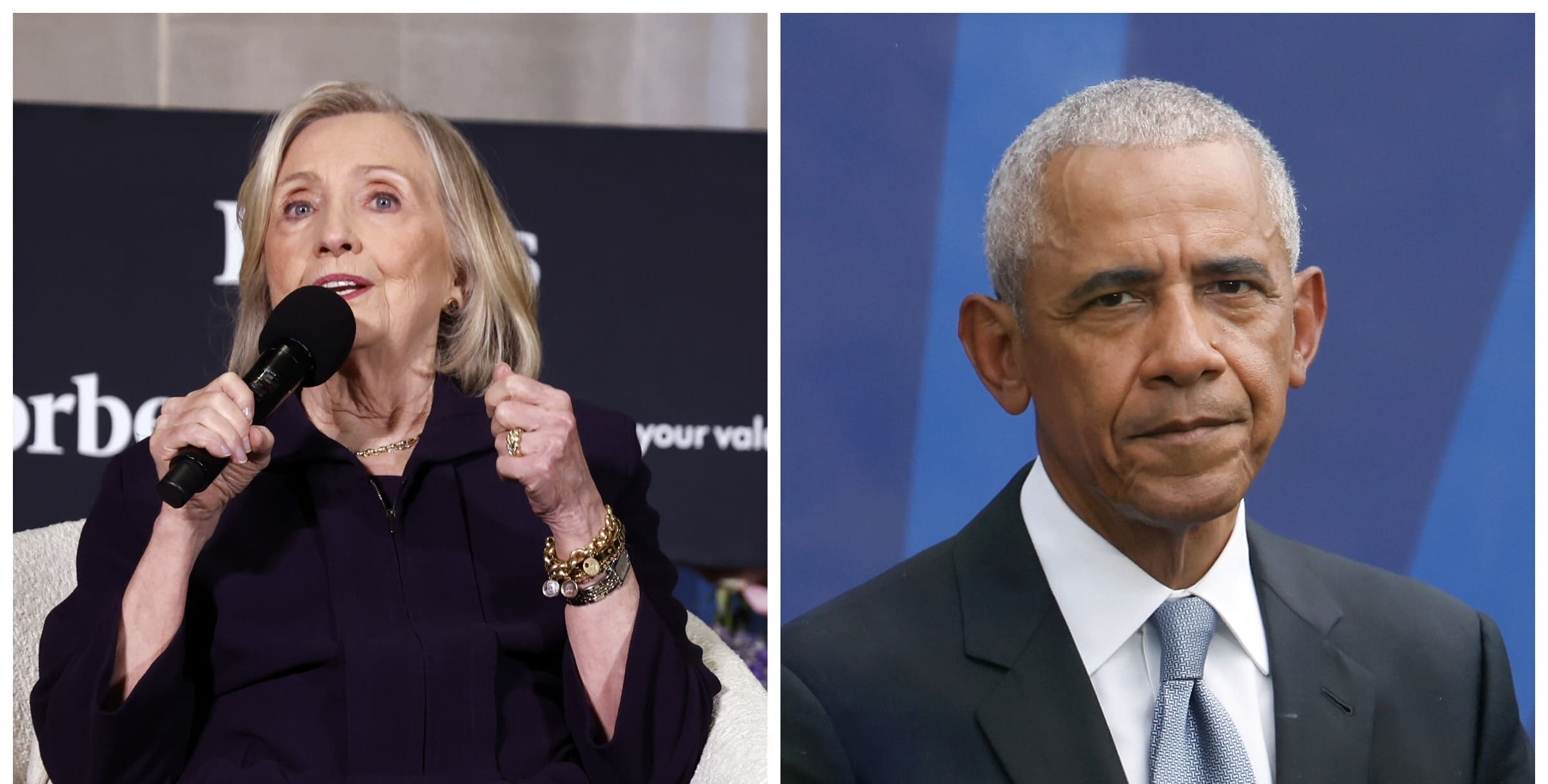
The Democrat Party, its allied media, and the transnational class that gathers in Davos and Brussels take politicians and functionaries whose backgrounds do not support the narrative, build the narrative anyway, and defend it against every inconvenient fact. Five cases on two continents show the pattern: Hillary Clinton, Barack Obama, Anthony Fauci, Volodymyr Zelensky, and Emmanuel Macron. Their records differ; the template does not.
THE TEMPLATE
The career of a little tin god runs through recognizable stages:
- Build the myth. A compliant press supplies the halo: the brilliant lawyer, the transformational orator, “America’s doctor,” the comedian-turned-Churchill, and the boy-wonder banker who would remake Europe.
- Bury the past. Anything that contradicts the legend is dismissed as old news, a smear, or a conspiracy theory.
- Advance the agenda. Centralized health care, permissive immigration, climate mandates, transnational governance—goals voters rarely approve when asked directly about them.
- Govern around the people. When legislatures balk, reach for the decree, the executive actions, the constitutional shortcut, or the emergency power.
- Treat dissent as heresy. Critics are not merely wrong; they are “anti-science,” “disinformation,” “pro-Russian,” or “deplorable.”
- Escape accountability. Investigations end without charges, inspectors general find “inappropriate criteria” but no culprits, and when all else fails, a pardon arrives before anyone is charged.
- Collect the payday. After “public service” come the speaking fees, book advances, streaming deals, prizes, and foundation money—sums that dwarf a lifetime of government salary.
- Reign from offstage. Out of office, the tin god becomes a kingmaker, lecturing the party and the public while holding no office at all.
Not every figure hits every step. What is striking is how many hit most of them.
HILLARY CLINTON: THE UNTOUCHABLE
No figure in modern American politics better illustrates step six. In July 2016, FBI Director James Comey announced that 110 emails in 52 chains on Clinton’s private server contained information that was classified at the time it was sent, including eight email chains at the Top Secret level, and that she and her aides had been “extremely careless” with highly sensitive material. He then recommended no charges.
Days later, he told the House Oversight Committee that her conduct was the definition of carelessness and negligence while insisting that prosecuting it would be a double standard. For the cleared service member or contractor who routinely handles classified information, the double standard runs the other way: careless handling of classified material on an unauthorized system ends careers and sometimes brings prosecution and jail sentences.
The pattern began long before. In 1978–79, as Bill Clinton rose in Arkansas, Hillary turned a $1,000 commodities take into nearly $100,000 in ten months. The trades were guided by Jim Blair, a lawyer for Tyson Foods, which later received state loans and favorable rulings under Governor Clinton. When the trades were finally discovered, the Clinton White House first claimed she made the trades herself. The compliant press “moved on.”
That fraud was an early indication of her lifelong quest for money regardless of source. Between 2001 and the launch of her 2016 presidential campaign, the Clintons collected about $153 million for 729 speeches, averaging more than $210,000 apiece, including roughly $7.7 million from Wall Street audiences. While she ran the State Department, Bill Clinton was paid at least $50 million for appearances between 2009 and 2012. Governments, banks, and corporations with businesses before the department were paying her household while she ran it. Whatever one calls that, it is not the economics of an ordinary civil servant.
Then came the Russia hoax. Through their law firm, Perkins Coie, the Clinton campaign and the DNC paid more than $1 million to Fusion GPS, which hired former British spy Christopher Steele to compile the dossier the FBI later used to obtain surveillance warrants on a Trump campaign aide. The payments were booked as “legal expenses,” and the Federal Election Commission fined both the Clinton campaign and the DNC for misreporting them. Special Counsel John Durham found that U.S. intelligence received a report in July 2016 that Clinton had approved a plan to tie Trump to Russia to distract from her email scandal, and he faulted the FBI for “ignoring” it.
Clinton has never stopped selling the story. A decade later, she still tells interviewers that Trump is enamored of Vladimir Putin and wants to rule as he does, and in a February 2026 BBC interview she insisted, over the correspondent’s correction, that Trump had never criticized the Russian leader.
On policy, the 1993-94 “Hillarycare” task force, run largely behind closed doors, sought a federally managed system of regional health alliances and employer mandates. Voters rejected it. Its architecture resurfaces 16 years later as Obama’s misnamed Affordable Care Act, the next way station on the left’s road to government-run medicine.
Clinton’s narcissism and sense of entitlement ran through all of it, down to dismissing half of her opponent’s voters as a “basket of deplorables” during the 2016 campaign.
BARACK OBAMA: THE PEN, THE PHONE, AND THE PAYDAY
Obama’s myth was built before his record. He accepted the 2008 nomination in front of Greek columns in Denver, and earlier that June he hailed his clinching of the nomination as the moment “the rise of the oceans began to slow.” The compliant press largely took the grandiosity at face value and showed little curiosity about the gaps and composites in Obama’s biography, which he had largely written himself. Parts of it remain contested to this day.
Read more Thanks Again, Obama
In office, when Congress refused to follow his lead on left-wing policies, he governed alone. “I’ve got a pen, and I’ve got a phone,” he told reporters before his January 2014 Cabinet meeting, promising executive orders and administrative actions in place of legislation. He already created Deferred Action for Childhood Arrivals (DACA) by executive action in 2012 after repeatedly saying he lacked the authority to act alone on immigration, and later unilateral moves extended to gun control and wages.
The courts pushed back. In NLRB v. Noel Canning, the Supreme Court ruled 9-0 that his 2012 recess appointments were invalid because the Senate was not in recess. The broader Deferred Action for Parents of Americans and Lawful Permanent Residents (DAPA) amnesty was blocked in court and never took effect.
Then there was weaponization of the federal government against his political foes. The Treasury inspector general found in 2013 that the IRS had routed every 501(c)(4) application with “tea party,” “patriot,” or “9/12” in its name to special review, which delayed conservative groups’ activities through the 2012 election cycle. No senior official was ever prosecuted, and no political price was ever paid by the Obama White House thanks to the legacy media’s assistance.
The tin showed up most abroad. Obama declared chemical weapons use in Syria to be a red line in 2012. When the Assad regime killed more than a thousand people with sarin gas near Damascus in August 2013, he called off strikes at the last minute and accepted a Russian-brokered disarmament deal. Critics argue Putin read the signal; Crimea was annexed six months later. Obama had dismissed Russia as a mere “regional power,” and his Iran deal was concluded as an executive agreement rather than a Senate-ratified treaty.
Obama was the most polarizing president in U.S. history. He averaged 83 percent approval among Democrats and 13 percent among Republicans, a 70-point gap that easily beat the previous record of 61 points under George W. Bush. A president elected to heal the country left it more divided by party than any before him, aided by his own interjections into racially charged incidents, including his 2012 comments that “If I had a son, he’d look like Trayvon” Martin. Gallup found in 2016 that 46 percent of Americans said relations had worsened during his presidency.
Then the payday. The Obamas signed a joint Penguin Random House book deal reported at more than $65 million plus a Netflix production deal. His net worth is now estimated around $70 million, including an $11.7 million Martha’s Vineyard estate. None of it is illegal, and all of it trades on an office he held for eight years at $400,000 a year. Nor has he left the stage. He remains the Party’s offstage kingmaker, phoning insurgent candidates, making appearances with them, and telling Democrats how to behave while holding no office at all.
Then the monument to himself. The Obama Presidential Center opened in Chicago’s Jackson Park in June 2026, and the Obama foundation just revised its cost to roughly $1 billion, making it the most expensive presidential center in American history and putting its cost at more than triple the original $300 million estimate. It sits on public parkland, which the foundation has controlled for nearly a century in exchange for $10 (!), and it is not even a true presidential library, as the National Archives keeps his records. Taxpayers covered another $123 million in infrastructure around the site, while the foundation deposited just $1 million of a promised $470 million reserve meant to protect taxpayers if the project falters.
Where did the money go? The foundation has never published an itemized budget. Its filings list the project as a single “construction in progress” entry, and its explanations for the overrun amount to categories like “scope changes” and “project management.” Since only the foundation knows for sure, it is fair to wonder how much of that billion flowed to consultants, favored firms, and well-paid loyalists rather than into concrete and stone, especially when the minority subcontractors who actually built the place say they are still owed millions. A “gift” to the South Side, its namesake calls it.
CONCLUDING THOUGHTS
Here ends Part One of this article. Still to go are the sordid tales of three other little tin gods: Anthony Fauci, Volodymyr Zelensky, and Emmanuel Macron. There are, of course, many others who fit the bill.
Read more What the Latest No Kings No Show Told Me