






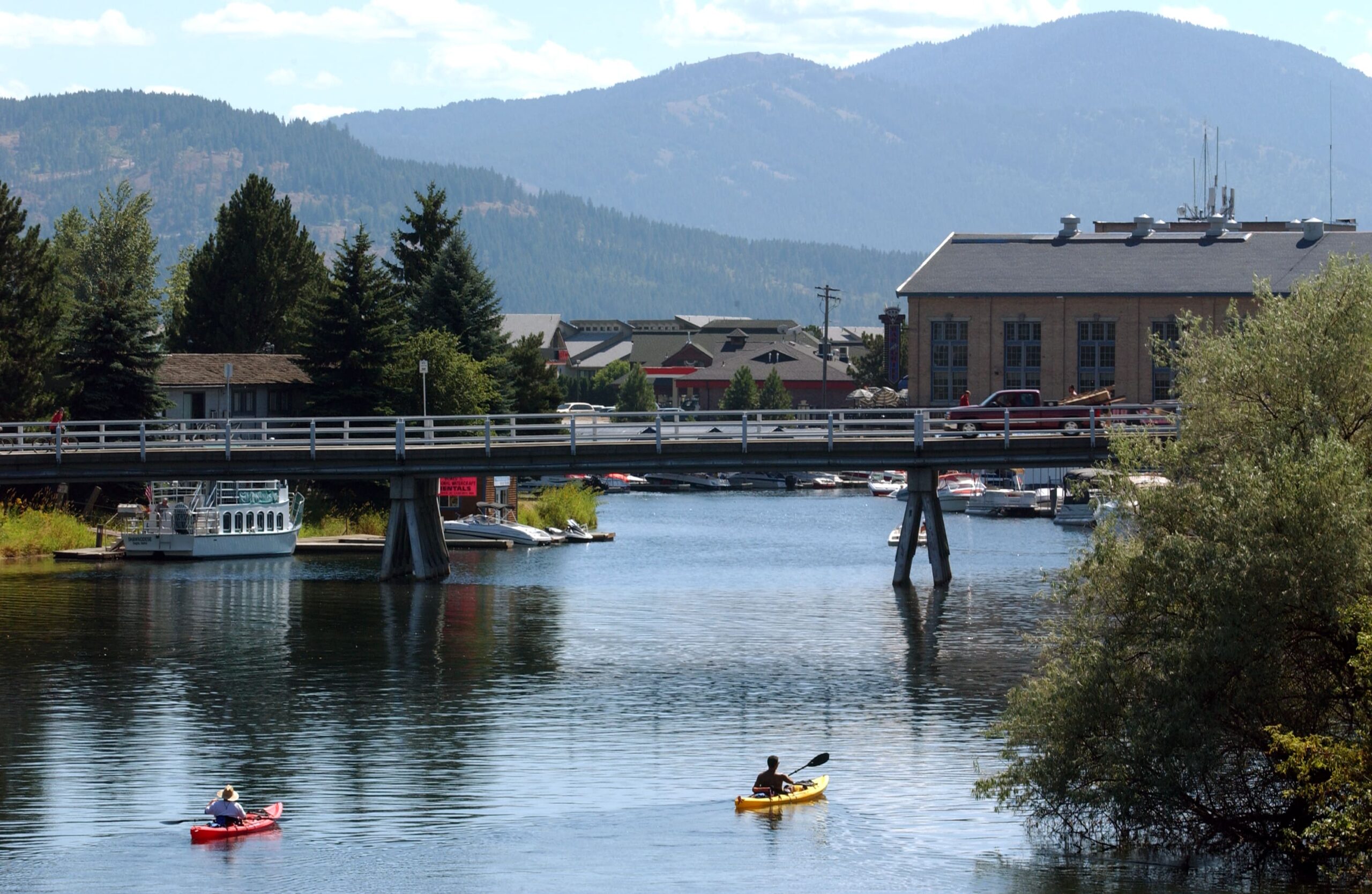
Sandpoint, Idaho, is one of those beautiful American towns that seems perpetually in danger of being discovered by the usual unwelcome flock of people from California. Situated on Lake Pend Oreille and surrounded by mountains, it has a charming downtown, a remarkable natural setting, and the sort of small-town atmosphere that makes people want to abandon whatever overpriced metropolitan disaster they presently inhabit—and that they helped create. Unfortunately, once enough of these people arrive, they tend to demand the same amenities, conveniences, and developments that made the places they left so expensive and unpleasant in the first place.
Read more Thoughts About Ilhan What’s-Her-Name
I met Jeremy Grimm, the brilliant and relatively young mayor of Sandpoint, at the Bluebird café and bakery on First Avenue. The coffee and baked goods were delicious, and the clientele was an interesting mixture of the usual progressive types with piercings and other accessories of modern self-expression, along with Mennonite ladies who apparently understood that good baked goods transcend political differences. It was a rather amusing introduction to a town that has become something of a political mixture, with traditional conservatives, progressives, libertarians, and newcomers who have brought their own ideas about how the place ought to be run.
Mayor Grimm is not some talentless dweeb who decided to run for small-town mayor because he couldn’t find anything more productive to do. He is a professionally trained urban planner, economic development strategist, and administrator who has spent years working in municipal government and private enterprise. He served as planning director in Buffalo, Wyoming, and later as Sandpoint’s planning and community development director, developing an understanding of local government that is considerably more sophisticated than what one ordinarily encounters among elected officials. He was elected mayor in a three-way contest with approximately 53 percent of the vote, and his political approach has emphasized bringing together the various factions of a town that is neither uniformly conservative nor uniformly progressive. He’s the kind of political leader that we wish we all had.
Grimm explained that Sandpoint has experienced many of the political divisions that have become familiar throughout America. Traditional conservatives tend to believe that city government should concern itself with matters such as snow removal, public safety, roads, and collecting the garbage, while more progressive residents often want municipal government to become involved in broader social and environmental causes. These disagreements can become quite heated, particularly when newcomers arrive with the apparent conviction that the people who have lived in town for generations have been doing everything incorrectly.
But during our conversation, Grimm made an observation that I found particularly interesting. Despite their ideological differences, the far left and the far right in Sandpoint actually agree on a number of issues, including organic food, vaccine skepticism, and opposition to development that threatens the character of the town. These are not necessarily positions shared by every conservative or progressive, but they illustrate something that our national political discourse seems determined to ignore: people can arrive at the same practical conclusion for entirely different philosophical reasons.
Think about the absurdity of our present political situation. A progressive who believes that a conservative is a dangerous reactionary and a conservative who regards the progressive as a complete lunatic would likely find themselves standing shoulder to shoulder at a city council meeting, demanding that some developer not be permitted to destroy their hometown. They may disagree about abortion, immigration, religion, and virtually every cultural controversy that has occupied the national media for the past decade. But they agree that they don’t want Sandpoint transformed into an overpriced vacation playground for rich Californians, complete with Lululemon, Banana Republic, and a multilevel parking garage standing where the local movie theater once stood.
And what struck me was that this agreement is not insignificant. It concerns the actual lives of the people who lived in the town, the ability of their children to afford homes, the survival of local businesses, and the preservation of the traditions that made Sandpoint a community rather than simply another real estate investment. These are matters on which people should cooperate without having to resolve every other disagreement they might have about politics, religion, or the future of Western civilization.
In the time I spent with Mayor Grimm, I came away with the impression that because of his decision not to run for re-election, Sandpoint was losing an unusually capable public official. But what interested me most was not simply his understanding of urban planning or economic development. It was his recognition that a town divided by national political issues might nevertheless be united by the practical interests of the people who actually live there. And as I began thinking about what he had told me, I realized that there was some rather ancient wisdom that might help us rescue our democracy from the professional politicians who have managed to turn Americans against one another while maintaining their own power.
What Tocqueville Understood
Alexis de Tocqueville encountered an altogether different reality when he came to America in 1831. Americans disagreed about religion, politics, slavery, economic policy, and just about everything else. But they had figured out something that escapes us today: you don’t have to agree with your neighbor about everything to work with him on something. They formed associations to build schools, establish charitable institutions, improve their towns, fight alcoholism, and promote political reform. They understood that a common objective was sufficient reason to cooperate, even if they couldn’t stand each other’s opinions on other matters.
It’s possible that Americans were smarter in those days. But more than likely they were less distracted, less blind, and less arrogant, and considerably less obsessed with proving that everyone who disagreed with them was an idiot. They understood something that we seem to have forgotten: democracy doesn’t require agreement on every issue. It requires the ability to work together despite disagreement and the willingness to recognize that the person who disagrees with you about one thing may nevertheless be your strongest ally when it comes to something else.
Tocqueville was fascinated by the American habit of forming political and civic associations. When Americans encountered a problem, they did not necessarily sit around waiting for the government to solve it. They gathered their neighbors, organized themselves, raised money, exerted political pressure, and attempted to accomplish something. Tocqueville understood that this was one of the great strengths of American democracy, because ordinary citizens acting individually possessed relatively little power, while citizens acting collectively could challenge government, influence public policy, and accomplish things that none of them could achieve alone.
He later described the science of association as the mother of all sciences in democratic countries. It was an extraordinary observation, because Tocqueville understood that the survival of democracy depended upon more than elections, constitutions, and the formal machinery of government. It depended upon the ability of ordinary citizens to organize themselves independently of the political establishment, to pursue common objectives, and to resist the concentration of power in the hands of a relatively small number of people.
Of course, nineteenth-century America was hardly a paradise of tolerance and enlightened cooperation. We know that. Slavery, religious prejudice, discrimination, and political conflict were very much part of the American landscape, and some associations were organized around causes that we would find reprehensible today. But Tocqueville’s observation was not that Americans were morally superior to everyone else. We can see that by looking at the people sleeping on the streets in our cities while we go about our business.
But our ancestors had developed a practical means of exercising power through cooperation, and this habit helped prevent democratic government from becoming little more than another form of centralized authority. Unfortunately, our inability to do this today has resulted in precisely the opposite of what our democracy stands for.
What Tocqueville understood, and what our modern political establishment would prefer that we forget, is that the real power of a democracy does not necessarily reside in the politicians who occupy public office. It resides in the ability of citizens to organize themselves, act collectively, and hold those politicians accountable. Once the electorate loses that ability, elections become little more than periodic opportunities to replace one collection of professional politicians with another, while the underlying system remains substantially unchanged.
When Political Identity Replaced Political Action
Somewhere along the way, we substituted political identity for political action. We no longer ask our neighbors what we can accomplish together. Instead, we ask whether they have the correct opinions on abortion, guns, immigration, climate change, religion, gender, and whatever the outrage of the day happens to be. And if our neighbor provides even one wrong answer, the conversation ends. We retreat to our respective political camps, cease communicating, and accomplish literally nothing other than congratulating ourselves on our moral superiority.
Read more Two Former FBI Officials Charged with Lying to Congress about Hunter Biden Investigations
The entrenched political class, meanwhile, remains comfortably in power. While we are busy arguing about whether someone should be permitted to fly a pride flag, whether a particular politician is a fascist, or whether our neighbor’s opinions make him morally unfit for polite society, the people in Washington and our state capitals continue spending money, rewarding their supporters, protecting their privileges, and avoiding any meaningful accountability. It is a remarkable arrangement in which the electorate has voluntarily surrendered much of its collective power in exchange for the opportunity to despise one another.
The absurdity of all this becomes obvious when we consider the nature of the country itself. We have hundreds of millions of people whose families came from virtually every country on earth, representing every conceivable religion, culture, tradition, and political philosophy. The idea that all these people are somehow going to reach unanimity on every important moral, social, and cultural issue is not merely unrealistic. It is lunacy, and it is certainly not the objective of a free society. A society in which everyone is expected to think alike is not an American ideal. It is much closer to the sort of ideological conformity one might associate with Maoist China. It’s not even desirable.
Yet this is precisely the standard we increasingly impose upon one another. A conservative cannot cooperate with a progressive unless the progressive first renounces every objectionable opinion, and the progressive cannot cooperate with the conservative unless the conservative first demonstrates an acceptable degree of enlightenment on every issue that happens to be the order of the day. In the meantime, the schools deteriorate, the budgets remain out of control, public corruption continues, and the ordinary citizen becomes increasingly powerless to influence the government that supposedly exists to serve him.
I am not suggesting that people abandon their convictions or pretend that questions involving human life, individual liberty, and fundamental rights are unimportant. I am suggesting something considerably more practical: that disagreement on those questions should not automatically prevent cooperation on other matters where common interests exist. A person does not have to agree with my views about abortion to join me in demanding honest government, and I do not have to agree with his views about climate change to work with him to prevent a developer from destroying our town.
The goal of political association is not to create a society of human robots who agree on every issue. It is to isolate those issues on which agreement is possible and organize citizens to accomplish something about them. That might mean reforming a school district, opposing an irresponsible development project, demanding transparency in government spending, or insisting that public officials who engage in corruption actually suffer some consequences. It may not sound as glamorous as saving democracy through another presidential election, but it has the distinct advantage of giving ordinary citizens something useful to do besides screaming at one another. And we just might accomplish something constructive in the meantime.
The Soul of Sandpoint
In Sandpoint, the issue is particularly immediate because the town faces the same pressures that have transformed so many communities throughout Idaho, Montana, and Wyoming. Wealthy newcomers arrive, property values increase, developers recognize an opportunity, and before long the people who grew up in town discover that they can no longer afford to live there. The local businesses that once served the community begin disappearing, replaced by overpriced urban-style restaurants, yoga studios, and your usual panoply of nightmare chain stores. Eventually, the town becomes an attractive collection of buildings inhabited by people who have relatively little connection to the traditions that once held the community together. The town is effectively a walking corpse.
This is an all-too-familiar American story, and it is one that I have been thinking about throughout my travels. The soul of a town is not simply its buildings, its scenery, or its collection of charming shops. It is the traditions, relationships, habits, and shared understandings that bind its residents together and give the place a recognizable identity. A town can change its physical appearance, welcome newcomers, and accommodate economic development without necessarily losing that identity. But the decisions must be the conscious decisions of the townspeople, not the result of decisions made under duress. When the traditions and civic relationships disappear, the town dies, even if the buildings remain standing and the real estate becomes more valuable than ever.
This is precisely why the political divisions in Sandpoint are so interesting. A conservative who wants to preserve the town’s traditions and a progressive who wants to protect its environment may have very different reasons for opposing the same development. One may be concerned about preserving the character of the downtown, while the other worries about traffic, open space, or the environmental consequences of uncontrolled growth. But both may agree that their children ought to be able to afford a home in the place where they grew up, and that the future of Sandpoint should not be determined exclusively by developers and wealthy outsiders.
These people of Sandpoint do not have to agree on abortion, religion, immigration, or the latest controversy involving gender identity to recognize that they have a common interest in protecting their community. Nor do they have to agree about every proposed solution. Some development will be necessary, and reasonable people will disagree about zoning, density, taxes, and the appropriate role of government. But those disagreements can be addressed through the ordinary process of political association, negotiation, and compromise, rather than through the absurd proposition that people with different political identities are incapable of working together.
The residents of Sandpoint will ultimately have to decide what kind of town they want to preserve and what kind of growth they are willing to accept. They can allow their national political disagreements to divide them into competing factions, leaving developers and organized interests to shape the town’s future, or they can identify the things they have in common and organize themselves around those objectives. The choice is not between progress and stagnation. It is between a community that exercises some control over its own future and one that allows that future to be determined by people whose principal interest may be the amount of money they can make from it.
Taking Our Democracy Back
Sandpoint is a microcosm of where we stand as a country. Americans disagree about practically everything, but there are nevertheless important areas in which common interests exist. Most of us want safe neighborhoods, decent schools, affordable housing, honest government, responsible public spending, and elected officials who do not regard public office as a lifetime entitlement. We may disagree about the best way to accomplish these things, but surely those disagreements should provide the basis for serious political discussion rather than another excuse to retreat into our ideological bunkers.
Regardless of larger issues, we can form political associations organized around term limits, restrictions on lobbying, government transparency, election administration, public corruption, or the quality of local schools. These are issues on which people from different political backgrounds might find substantial common ground, even if they disagree about particular proposals. A progressive who believes that corporate money has corrupted politics and a conservative who believes that career politicians have become unaccountable may have different explanations for the problem, but both might be willing to support reforms that reduce the influence of entrenched interests.
The same is true at the local level, where citizens can often see the consequences of government decisions with their own eyes. They know whether their streets are safe, whether their schools are functioning, whether their taxes are being wasted, and whether the people running their town are acting in the public interest. They do not need a national political party to explain these things to them, and they certainly do not need permission from Washington to organize themselves and demand something better. Americans never cared much about what Washington thought in 1831; I don’t expect that we care all that much these days either.
Tocqueville understood this nearly two centuries ago. The remarkable thing isn’t that Americans once knew how to do it, but that we have become so politically sophisticated, so thoroughly educated in the art of being offended, and so absolutely certain of our own moral superiority that we have forgotten something our ancestors understood instinctively.
It may be too late, or it may not. But in whatever time we have left, we ought to begin asking our neighbors what we can agree upon and how we can work together to make progress in those areas. An electorate that organizes itself, cooperates across ideological lines, and holds politicians accountable is probably the last thing that the swamp in Washington and our state capitals wants to see. And that’s precisely why we should give it to them.
Read more ICE Arrests Thursday Include First Degree Murderer, Multiple Sexual Predators