









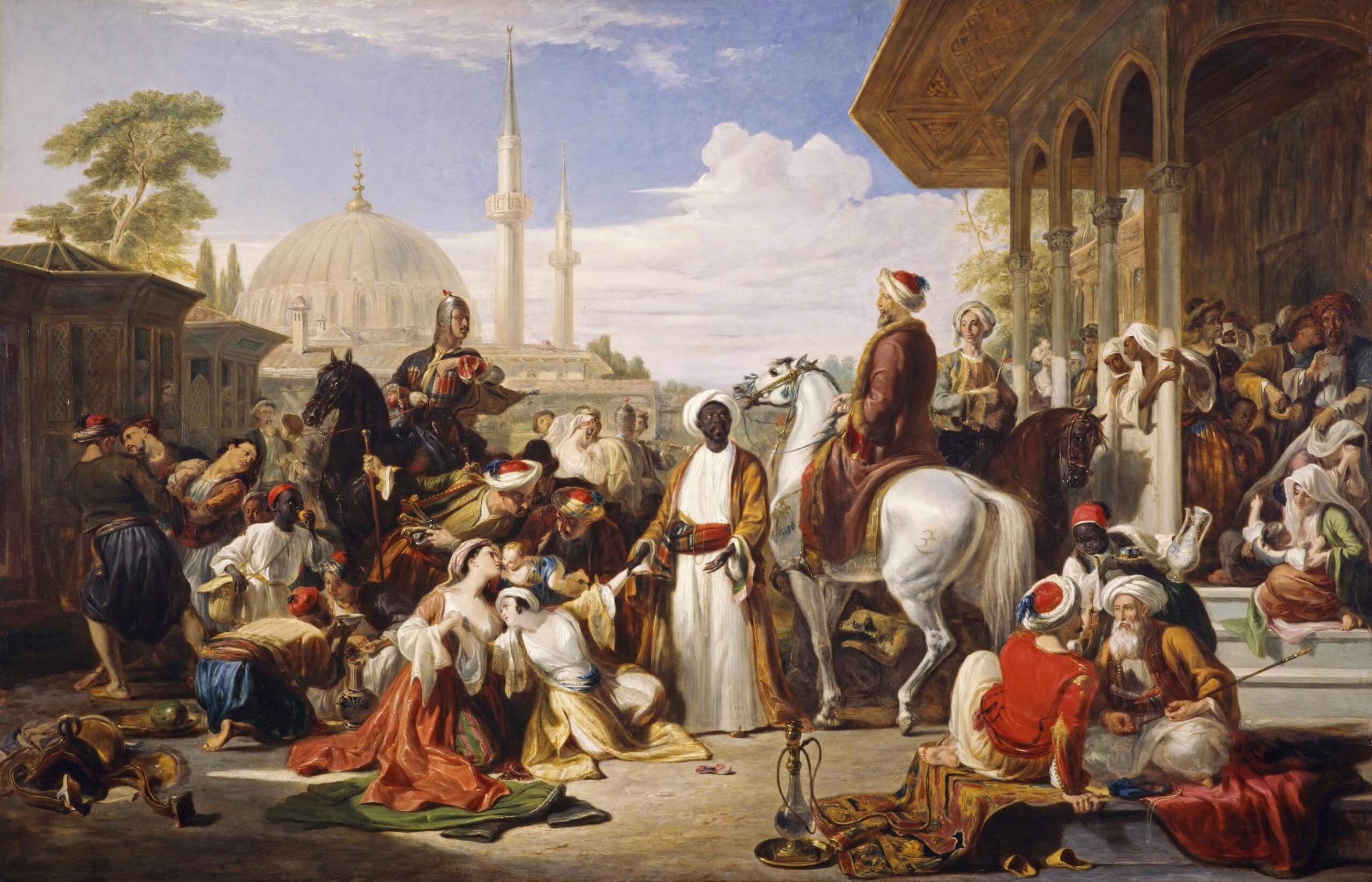
On March 26, the United Nations passed a resolution declaring the transatlantic slave trade the greatest crime against humanity in history. The sentiment behind such a declaration is not difficult to understand; however, sentiment is not scholarship. A resolution dressed in the language of historical judgment demands to be evaluated as history. To rank one slave trade above all others as the supreme crime against humanity requires comparative data across the major slave trades that existed, and this literature does not exist in any form that would support such a conclusion. What the historical record does confirm, abundantly and in uncomfortable detail, is that slavery was a truly global institution, practiced across centuries, continents, religions, and cultures, with brutalities that bear comparison to anything documented in the Atlantic record. The Black Sea region alone, across a period stretching from the early medieval era through the eighteenth century, furnishes sufficient evidence to challenge the resolution on purely empirical grounds.
Read more Why Aren’t the Feminists Worried about Black on White Femicide?
Declaring any single historical crime the greatest of its kind carries an implicit burden of proof that politicians rarely acknowledge, but historians cannot ignore. Across the centuries between 1400 and 1900, the transatlantic trade accounted for approximately 65.8% of documented African slave exports, with the trans-Saharan trade accounting for a further 19.9%, the Red Sea trade for 8.3%, and the Indian Ocean trade for 6.0%. Narrowing the focus to the nineteenth century alone, the proportions shift, but the plurality of routes remains: the transatlantic share falls to 61.9%, while the other three routes together account for the remaining 38.1% of documented exports. And these figures capture only the African export dimension of a global slave economy. They say nothing about the internal slave trades of Asia and Eastern Europe, the slave markets of the Black Sea, or the centuries of raiding and captive-taking that fed those markets long before any European vessel reached the West African coast.
The honest conclusion is not that one trade was greatest, but that the institution of slavery manifested in so many forms, across so many societies, that singling out any one expression of it as uniquely supreme is an act of political selection rather than historical reasoning. What follows is an examination of the Black Sea slave trade, one of history’s most extensively documented yet frequently overlooked systems of human exploitation, which demonstrates precisely why the UN resolution is historically untenable.
Tracing the origins of Black Sea slavery requires going back well before the Ottoman period, to a landscape of almost continuous predatory raiding in which virtually every power, settled or nomadic, Christian or Muslim, participated as both perpetrator and victim. As far back as the ninth century, the Magyars conducted systematic attacks on coastal Slavic communities, funneling the people they captured to the Byzantine port of Kerch, where they were exchanged for luxury textiles and other goods. Slavic communities were simultaneously targeted by Rus’ traders, who moved their captives toward Khazar and Bulgar trading centers further along the river systems. The Rus‘, however, were far from passive victims in this system. Their raiding was opportunistic and geographically expansive, and in 943 they launched a particularly devastating assault along the southern Caspian coastline, seizing populations that would under ordinary circumstances have been positioned on the buying rather than the selling side of the slave market.
What makes the Black Sea case particularly revealing is how thoroughly the violence turned inward as well as outward. By the twelfth century, as the political coherence of Kievan Rus’ began to fracture, Rus’ princes were enslaving the subjects of rival princes in the course of their domestic power struggles. The line between warfare and slave-raiding was, in this context, essentially nonexistent. Nor were the Rus’ alone in this habit. Their occasional confederates, the Polovtsy, conducted slave-taking operations against their own Turkic neighbors with equal regularity.
Towering over all of these earlier slavers, however, were the Mongols of the thirteenth century, whose conquests transformed the scale and reach of Black Sea slavery entirely. The Armenian chronicler Kirakos Gandzakets’i left a vivid personal account of what capture by a Mongol force actually felt like. He and a group of villagers had taken refuge in a cave, hiding from a Mongol unit that had swept through the region, but after several days without food or water in the intense summer heat, their endurance collapsed entirely. It was not military defeat that brought them out but the slow agony of thirst and starvation, and when they finally descended from their hiding place, they did so, in Kirakos’s own words, trembling like lambs among wolves, fully expecting to be killed. Instead they were confined, forced to march for several days to the main Mongol encampment, and then distributed among their captors according to whatever utility each prisoner was judged to possess.
The Mongols were notably systematic in identifying and extracting value from educated captives: those capable of writing and reading were absorbed directly into administrative functions, while craftsmen, physicians, astronomers, and musicians were dispatched to imperial cities, where enslaved artisans from different cultural backgrounds were brought together to develop new techniques and produce distinctive luxury goods for distribution by the khans.
Shifting forward in time to the period following the Ottoman Conquest of 1475, the Crimean Tatars elevated what had been episodic raiding into something approaching an organized economic system. Virtually all written accounts from the period agree that raiding neighboring territories and selling the captives taken during those campaigns constituted the primary source of income for the Crimean Khanate. The economy of an entire political entity was thus structurally dependent on the continuous enslavement of outsiders, a dependency that created relentless incentives to raid regardless of diplomatic circumstances.
The operational sophistication of these campaigns is striking. Tatar forces typically began preparing three or four weeks before a planned raid, dispatching experienced soldiers ahead of the main force to gather intelligence on the targeted territory. Winter was deliberately chosen as the raiding season, since frozen ground and iced-over waterways neutralized the defensive advantages of marshes and rivers that might otherwise impede pursuit. Once inside enemy territory, Tatar cavalry avoided pitched engagements, moving with exceptional speed between settlements and prioritizing the seizure of as many people and as much portable wealth as possible before withdrawing.
The numbers involved defy easy comprehension. Conservative scholarly estimates suggest that between 150,000 and 200,000 captives were taken to the Crimea in just the first half of the seventeenth century, with roughly 100,000 of those seized in the decade between 1607 and 1617. In a single spring campaign in 1655, some 52,000 people were seized from Ukraine and southern Russia (The Black Sea and the Slave Trade, p. 223). Decades later, the 1758 raid on Moldavia yielded approximately 40,000 captives, while a 1769 incursion into southern Russia and Ukraine produced around 20,000 captives, of whom the Crimean Khan Kırım Giray personally received one-tenth as his customary share.
Drawing these human floods together were the maritime towns of the Crimean peninsula, above all the port of Caffa, which functioned as the commercial nerve center of the entire regional slave economy. The importance of Caffa as a slave-trading hub grew substantially in the thirteenth and fourteenth centuries following the establishment of a Genoese colony there, and the market expanded dramatically after the Ottoman conquest of 1475 brought new administrative infrastructure to the trade [The Black Sea and the Slave Trade, p. 212, 215]. By some estimates, over 30,000 enslaved people passed through Caffa’s markets in a single period during the sixteenth century, prompting one contemporary visitor to write with undisguised revulsion that the city might be called a heathen giant feeding on human blood.
The physical experience of being sold in Caffa was degrading by deliberate design. Buyers required sellers to strip enslaved people entirely, dress them in a simple felt cloak, and then walk them back and forth so that potential purchasers could assess their physical condition and identify any defects. The seller was additionally required to guarantee a refund if a slave died of pestilence within sixty days of purchase, a contractual provision that treated human beings as perishable merchandise with a warranty period. A second major market operated at the port of Gözleve, where hundreds of young men and women were reportedly put up for sale every single day. The inland market at Karasubazar offered yet another venue, described by an Ottoman traveler as a scene of unbearable anguish, families torn apart, parents separated from children, the air filled with weeping and cries for help.
Crucially, this trade was not the exclusive province of Muslim buyers. Christians and Jews participated actively in the slave markets of the Ottoman Crimea. One French diplomatic source noted that both groups purchased enslaved people. Indeed, according to one account, the slave trade in Istanbul was at one point run almost exclusively by a guild of 2000 Jewish merchants. The notion that the slave trade was simply something done by one civilization to another dissolves entirely under scrutiny: it was a commercial system that drew buyers, sellers, and intermediaries from across every religious and ethnic community present in the region.
Parallel to the Crimean market, the Circassian coast sustained its own slave-trading economy rooted in aristocratic predation on commoner populations. A Dominican friar writing in the late fourteenth century described how Circassian nobles moved openly between villages, seizing children and adults by force before delivering them to coastal merchants for immediate sale. The victims thus entered the trade not through military conquest but through the routine exercise of social power by a local elite over those below them in the hierarchy.
The conditions of sale on the Circassian coast were particularly savage. A Franciscan bishop reported that enslaved people were brought to market on days set aside for the purpose, physically dragged behind horses with ropes fastened from the animals’ tails to the necks of those being sold, a method of transportation that simultaneously immobilized captives and displayed their subordination to onlookers. This was not the informal cruelty of individual actors but a normalized market practice, observed and described by multiple clerical witnesses.
For captives considered too valuable to be sold outright, an alternative fate awaited in the form of institutionalized ransom, a process that was itself deeply coercive. After a successful raid, well-to-do captives were frequently subjected to torture as a means of compelling their relatives to pay whatever ransom was demanded. The most valuable and prominent prisoners, meanwhile, were transferred to the mountain fortress of Çufut-Kale near the Khanate’s capital at Bahçesaray, where they could be held securely for as long as the ransom process required. The demands made for important captives could be grotesquely disproportionate: the ransom sought for the Russian boyar Vasilii Sheremetev was set at the effective surrender of two major cities, Kazan and Astrakhan, ensuring that he languished in captivity for twenty-one years before being released, dying in Russia shortly after his return.
Read more Trump’s AI Council Just Got Stronger
The ransoming system generated its own commercial ecosystem, with Jewish and Armenian merchants serving as critical intermediaries between Tatar captors and the Christian states seeking to recover their subjects. Polish archival records document this activity in some detail, confirming the active role of Armenian negotiators in particular. Yet even those captives who were eventually ransomed frequently returned home to find their property confiscated, their spouses remarried, and their ransom debts still outstanding, meaning that liberation from physical captivity did not necessarily mean liberation from the economic consequences of enslavement.
Within the societies of the Black Sea, enslaved people served virtually every conceivable function. Women assigned to female owners performed personal service, domestic labor, and skilled work such as embroidery and food preparation. Those belonging to men were understood, across cultural and legal boundaries, to be sexually available regardless of any personal consent. Male slaves herded livestock, managed agricultural estates, served as financial agents, staffed bureaucracies, and fought in armies. The most terrible fate of all was assignment to the oars of a galley: each vessel required between 150 and 200 rowers, and the Ottoman navy maintained somewhere between 45,000 and 60,000 galley slaves at its height during the second half of the seventeenth century. The word for “galley” entered the Russian language as a synonym for prison, a linguistic scar left by the terror that institution represented to enslaved Slavic peoples.
Beyond labor, enslaved people also served ritual functions that reveal the depths of their dehumanization. Among tenth-century Rus’ elites, female slaves were ritually killed and interred alongside deceased male leaders as part of funeral ceremonies. Slaves functioned additionally as prestige objects, diplomatic gifts exchanged between rulers, components of royal dowries, and living symbols of political reach and social dominance.
If the Black Sea evidence establishes that slavery was a global institution of staggering breadth and cruelty, then the story of British abolitionism in the nineteenth century establishes something equally important: that suppressing even one expression of that institution required nearly a century of sustained effort, enormous financial expenditure, naval force, and ultimately the military conquest of an entire continent. Far from demonstrating the singular evil of the transatlantic trade, the British campaign reveals how deeply embedded the slave trade was across multiple civilizations simultaneously and how persistently those civilizations resisted its abolition.
The passage of the Act for the Abolition of the Slave Trade in March 1807 set in motion a campaign without historical precedent, an attempt by a single state to reshape the commercial practices of the entire world through a combination of moral persuasion, financial inducement, and naval force. From the outset, British planners grasped a fundamental problem: unilateral abolition would simply transfer Britain’s share of the trade to competitor nations, rewarding rivals economically while doing nothing to reduce the overall volume of human trafficking. International pressure was therefore not optional but structurally necessary.
The tools deployed to achieve this were varied and often frankly mercenary. Spain was paid the equivalent of over a million pounds sterling to restrict and eventually abandon its slave trading, while Portugal received nearly three million pounds in similar inducements by 1853. The Congress of Vienna in 1815 produced a collective declaration condemning the trade as incompatible with human dignity and universal morality, though the practical effect of this pronouncement was initially limited, with other European powers viewing British insistence as a convenient pretext for Atlantic naval dominance rather than a genuine moral stand.
Gradually, however, the architecture of suppression was solidified. A network of right-to-search treaties gave the Royal Navy authority to intercept suspected slave ships in international waters, and a series of mixed courts, staffed by judges from both contracting nations and established at Freetown, Luanda, Havana, the Cape of Good Hope, and elsewhere, condemned over 600 slave vessels and freed close to 80,000 enslaved people between 1819 and 1871.
Naval interdiction and treaty-making proved insufficient on their own, and for a reason that cuts directly against any simple narrative of European moral progress: African rulers who signed abolition agreements repeatedly failed to honor them. The pattern was consistent enough to become a recognized structural feature of the campaign. Treaties were concluded, promises were made, and the trade continued. British authorities eventually accepted that reliance on the voluntary compliance of local chiefs was futile, since broken agreements required the repeated dispatch of armed expeditions to enforce renewed compliance [Unanticipated Consequences, p.292]. The cycle of treaty, violation, and coerced re-imposition was not a peripheral frustration but one of the campaign’s defining characteristics, and it underlines the point that resistance to abolition was not confined to European slaveholders.
The response was to escalate toward direct intervention on African soil. The 1844 Treaty with the Kings and Chiefs of Bonny explicitly authorized Britain to suppress the trade by force and to impose severe punitive measures if slave exports were not halted and holding pens destroyed. This was not merely theoretical: in 1840, Commander Denman, acting under the authority of a similar agreement concluded with the Chiefs of the River Gallinas, moved against a Spanish slave merchant operating in the area, destroying his commercial infrastructure and physically liberating the enslaved people being held there. The language used in contemporary sources, human chattels rescued and liberated, reveals the ideological framing that justified these increasingly aggressive interventions.
By the final decades of the nineteenth century, the campaign had moved well beyond naval patrols and diplomatic pressure into the direct territorial reorganization of Africa itself. The formation of the British Imperial East Africa Company in 1888 gave Britain a commercial and administrative foothold on the east coast that was used, among other purposes, to obstruct the major slave route running toward Zanzibar. Building on this, the establishment of British protectorates over Uganda and Nyasaland severed two further significant sources of slave supply, while the French annexation of Madagascar between 1883 and 1896 eliminated one of the Indian Ocean trade’s most important receiving points.
The culmination of this territorial push came in 1896, when General Kitchener’s military conquest of the Sudan closed off the slave trading routes that had for decades carried captives both northward and southward through that territory. Taken together, these interventions amounted to something far larger than any of the original abolitionists had envisioned when Parliament passed its act in 1807. What had begun as a legislative prohibition on British participation in the slave trade had become, over the course of ninety years, a fundamental transformation of the political map of an entire continent.
The ultimate outcome of the British campaign was a genuine and substantial reduction in the volume of Atlantic slave trading: from roughly 694,000 people transported in the decade of the 1820s, the number fell to just over 52,000 in the years between 1861 and 1867. The suffering prevented by this reduction was real and enormous. Moreover, the very scale of the effort required to achieve this result—decades of naval operations, millions of pounds in financial inducements, networks of missionaries and merchants, military campaigns across three continents, and ultimately the colonization of Africa—testifies to how deeply embedded and broadly distributed the slave trade was as a global institution.
Crucially, the international consensus that slowly coalesced around the campaign, the growing recognition that trading in human beings was morally intolerable regardless of cultural or religious context, is precisely what makes the UN resolution’s ranking so intellectually dishonest. Over the course of the nineteenth century, nation after nation came to recognize that trading in human beings was morally intolerable, a recognition that was hard won through decades of diplomatic pressure, financial inducement, and military force. A crime that is universally recognized and actively suppressed is, by definition, not a crime that has been ignored or minimized. One of the distinguishing features of the gravest crimes against humanity is not only their brutality but also the silence and indifference that surrounds them. The transatlantic slave trade, precisely because it attracted such sustained and eventually successful international opposition, does not meet that second criterion. The Black Sea slave trade, the trans-Saharan trade, the Indian Ocean trade, and the internal slave trades of Africa continued for centuries with less organized resistance and international acknowledgment of their horror.
The appreciation that the transatlantic trade was nefarious is therefore not evidence of its supreme gravity among all slave trades. It is, paradoxically, evidence of the opposite: that it was seen, confronted, and condemned in ways that other equally brutal trades were not. To declare the most scrutinized and most actively suppressed slave trade the greatest crime against humanity, while trades of comparable brutality proceeded in relative obscurity, is not a historical judgment. It is a reflection of which victims the world chose to notice.
* * *
Lipton Matthews is a researcher and podcaster. His work has been featured in Mises, The Federalist, Chronicles, American Thinker, Epoch Times, and other publications. He is also author of Busting African Delusions: Institutions, Human Capital, and the Path to Progress.
Read more The ASSIMILATION Act: An America First Reappraisal of Legal Immigration