









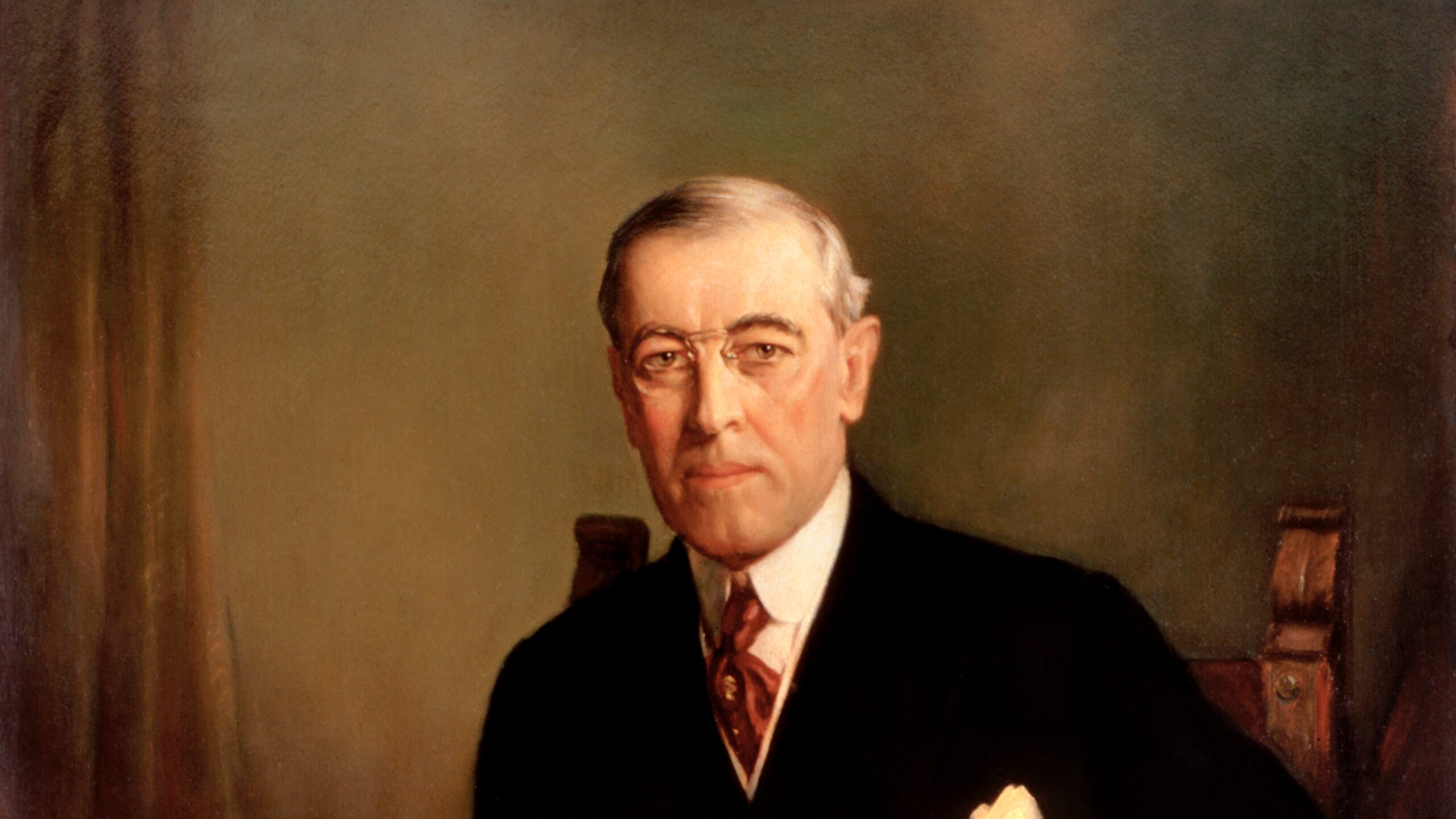
Recently, Justice Clarence Thomas used a speech at the University of Texas at Austin to remind Americans why Woodrow Wilson still matters in the fight for constitutional government. “Since Wilson’s presidency,” Thomas warned, “progressivism has made many inroads into our system of government and our way of life. It has coexisted uneasily with the principles of the Declaration. Because it is opposed to those principles, it is not possible for the two to coexist forever.” That is the right frame. Wilson did not merely fail the Constitution. He rejected its central premises—and helped build the machinery that continues to threaten the Founders’ vision of limited constitutional government.
Read more California’s Choice
When I survey the long parade of presidents who led this country, from giants like Washington and Lincoln to the mediocrities and failures, one man stands apart as uniquely destructive: Woodrow Wilson.
When he entered the White House in 1913, he brought unusual credentials: a doctorate from Johns Hopkins, a scholarly reputation, and experience leading Princeton University. Americans thought they were getting their first true scholar-president.
What they got instead was the worst president in American history, a man whose toxic blend of intellectual arrogance, racial prejudice, and authoritarian instincts inflicted wounds on this country that we are still trying to heal.
The Classroom Meets the Real World
Wilson’s academic background shaped everything in his presidency, sometimes for better, often for worse. He approached governing like a professor addressing a stubborn class, convinced that if he explained things clearly enough, everyone would eventually see the wisdom of his vision.
That worked in lecture halls. It failed spectacularly in the messy world of politics.
Wilson believed the Constitution’s system of checks and balances was holding America back. He saw it as machinery from a bygone era. “Newtonian,” he called it dismissively, when what the country needed, in his view, was something flexible and responsive, something organic rather than mechanical, something “enlightened men” could shape rather than something the people themselves could control. His aim was not to preserve the Constitution’s jealous division of power, but to make government more energetic, adaptive, and directed by capable hands. In practice that meant a stronger executive and a larger role for trained administrators who could act with less interference from the slow, messy give-and-take of democratic politics.
It is easy to see the appeal of that thinking, especially to someone who had spent his life surrounded by people who hung on his every word. But Wilson’s “living Constitution” approach opened doors that future presidents would walk through with less noble intentions.
The Birth of the Administrative State
Those ideas became the intellectual foundation for a dramatic transformation of American government.
Before entering politics, Wilson argued that the system designed by the Founders was outdated. In his 1887 essay “The Study of Administration,” he contended that modern government required something different from the limited structure the Founders had created. The separation of powers, he believed, was inefficient and belonged to an earlier age.
Wilson proposed a new model: government run by professional administrators and policy experts operating at a distance from politics. Elected officials would set broad goals, but the real work of governing would be carried out by trained specialists inside bureaucracies.
Wilson himself wrote that administration should be “removed from the hurry and strife of politics.” His arrogance and impatience left no room for what he would have regarded as the inefficiencies of a democratic republic. This reflected Wilson’s impatience with Congress and with any deliberative process that required compromise, a dirty word to him. It was a radical break from the Founders’ view that government existed primarily to protect individual rights and that power should always be divided and restrained. Wilson instead envisioned a government that would evolve and expand as society “progressed,” guided by experts rather than limited by constitutional barriers.
Much of what Americans now call the administrative state traces directly back to those ideas.
Wilson did not merely expand government during his presidency. He helped lay the intellectual groundwork for moving America away from a government of, by, and for the people and toward one increasingly run by a narrow class of unelected experts.
In theory, these administrators were supposed to serve the public good with greater skill and efficiency. In reality, human nature got in the way. The system helped create an expert class that, over time, became invested in protecting its own power, priorities, and permanence. That shift, from constitutional restraint and democratic accountability to bureaucratic rule by insulated elites, still shapes American government today.
The Tragedy of a Southern Gentleman
One of the most damaging aspects of Wilson’s presidency was how his Southern upbringing warped his views and policies on race. This was not just about prejudice, though Wilson certainly had plenty of that. It was about how those prejudices became federal policy.
But Wilson’s racism was not shaped only by the culture of the South. It was also reinforced by the intellectual world he inhabited as a scholar. Wilson was influenced by nineteenth-century German political philosophy, which treated the state as an organic force guiding society and often spoke in terms of historical “peoples” or races. In that climate, hierarchy was frequently treated as a natural feature of development. Wilson’s racism was not just inherited from the South. It was reinforced by the same worldview that placed enlightened rulers above older American ideas of equality and fixed human rights.
Wilson grew up in Virginia and Georgia during Reconstruction, in a world that told him the old South had been noble and wronged. When he became president, he brought those assumptions with him to Washington. The result was a federal government that actively rolled back civil rights progress.
Under Wilson, departments that had been integrated since the Civil War were segregated again. Black federal employees found themselves eating in separate cafeterias, using separate bathrooms, and facing barriers to promotion that had not existed for decades. When civil-rights leaders confronted him, Wilson defended segregation as being good for Black Americans, a position that now reads as breathtakingly condescending.
The personal became policy in other ways too. Wilson screened The Birth of a Nation at the White House, a film that portrayed the Ku Klux Klan as heroic. His academic writings also praised what he called “Aryan” civilization and reflected the eugenic thinking popular among many Progressives of his era.
When Crisis Reveals Character
World War I stripped away whatever restraints Wilson might have felt about expanding government power. Faced with an emergency, he created a propaganda machine and backed laws that made criticism of the war effort a federal crime.
Read more American ‘Ally’ Imposes Travel Ban on American Ambassador
The Espionage and Sedition Acts were not abstract policy. They put people in prison for expressing unpopular opinions. Socialist leader Eugene Debs was sentenced to 10 years for giving an antiwar speech. Suffragettes were jailed for protesting outside the White House. German Americans faced harassment and persecution sanctioned by federal policy.
Wilson’s administration temporarily nationalized the railroads, monitored mail, and used federal investigators and intelligence agencies to track opponents. These were not the actions of a man reluctantly assuming emergency powers. Wilson seemed to relish the chance to silence dissent and impose his will.
The Price of Good Intentions
Many of Wilson’s domestic policies were sold as reforms that would help Americans. The Federal Reserve was supposed to prevent financial panics. The income tax was meant to make the wealthy pay their fair share. The Federal Trade Commission would protect consumers from abusive business practices.
But each of these changes also gave the federal government new ways to reach into Americans’ daily lives. The income tax, which began as a modest levy on the wealthy, became the government’s primary funding mechanism and a continuing source of anxiety for working families. The Federal Reserve, designed to stabilize the economy, gave a small group of appointees enormous influence over everyone’s financial future.
Wilson’s supporters saw these as steps toward a more just society. His critics saw something more dangerous: the concentration of power in Washington in the hands of people who were certain they knew what was best for everyone else. The real danger lay not just in that certainty, but in how few checks remained if they got it wrong.
Wilson did not stop there. He appointed three justices to the Supreme Court, helping ensure that his vision would outlast his presidency. One of them, Louis Brandeis, championed federal regulatory power and helped advance the idea that the Constitution should evolve alongside progressive social policy. Wilson’s academic theories were making their way into constitutional law.
The World Stage Disaster
Wilson’s failures at home were matched by his failures on the world stage. His handling of the peace negotiations after World War I helped set the stage for an even more devastating war two decades later.
His Fourteen Points outlined a vision for international cooperation that might have helped prevent future conflicts. But his unwillingness to compromise, the same trait that had served him well as an academic, made him a poor negotiator when the stakes were highest.
When the Senate balked at his League of Nations proposal, Wilson could have worked with senators to find a version that might have passed. Instead, he took his case on a national speaking tour to go over their heads and appeal directly to the American people. The tour ended with Wilson suffering a stroke that left him partially incapacitated for the rest of his presidency, and the League died in the Senate.
What We Can Learn
Wilson’s presidency offers a lesson about the gap between good intentions and good governance. He was intelligent, committed to improving the country, and willing to take on powerful interests when he believed it necessary.
But intelligence without humility becomes dangerous when paired with presidential power, especially when Congress fails to check it. In that respect, Wilson’s presidency proved the Founders’ point: even gifted leaders must be drawn into conversation, disagreement, and compromise through a system of separated powers. Wilson’s certainty that he knew what was best for America, for black Americans, and for the world led him to make decisions that caused enormous harm.
His expansion of federal power might have been forgivable if it had been temporary, if emergency measures had receded once the crisis passed. Instead, Wilson’s precedents became permanent features of American government, creating institutions and expectations that future presidents would build upon.
His racial policies set back civil rights progress for decades. His wartime authoritarianism established precedents that would be invoked again in future crises. The bureaucracy he helped legitimize never returned to its pre-Wilson size or scope.
A Warning, Not Just History
Looking back at Wilson’s presidency, it is tempting to treat him as a relic of another era, a man whose prejudices and blind spots reflected the limitations of his time.
But Wilson’s real legacy is not found mainly in his specific policies, many of which have since been modified or abandoned. It lies in the model of presidential and administrative power he advanced, the belief that smart, well-intentioned people in Washington can and should reshape American society from the top down. In that sense, Wilson was not just a man of his time. He helped create the governing philosophy that still shapes modern progressivism: faith in experts, impatience with constitutional limits, and a tendency to treat executive action as a substitute for the hard work of persuasion and compromise.
Wilson did not merely fail within the American system. He helped teach generations of leaders how to govern against its premises.
His presidency reminds us that good intentions, impressive credentials, and intelligence are not enough to make someone a good president. Paired with arrogance and unchecked power, they can make one deeply dangerous.
That is why Woodrow Wilson stands, in my judgment, as the worst president in American history.
* * *
Jon Fleischman is a longtime California political strategist, analyst, and author. Jon writes at www.SoDoesItMatter.com.