








While Rome protects its neighborhoods, American leaders continue explaining away the people who terrorize them.
Read more Morning Greatness: Trump to Address White House Correspondents’ Dinner
As critical as I can be of Europe on matters like historical revisionism or hysterical views about air conditioning, they get an awful lot of things right as well. In my last work, “Manuel and Me,” I pointed out that Italy’s understanding of mystery, art, and the importance of preserving culture are things that America can and must learn from.
Another difference comes into sharp relief as I read the newspapers in Italy: Italian journalists still possess the ability to name problems and offer solutions. Many are trained economists or historians, rather than products of ultra-woke specialty schools that have inserted neo-Marxist ideology directly into their brains. Today, American journalists tend to be average writers, but they make up for it by knowing nothing. Even the most misguided Italian journalists, on the other hand, can be terrific writers with a good grasp of their arguments. I don’t agree with much of what I read, since they lean mostly left, but I find their work entertaining and usually come away having learned a fact or two.
The Italian left also retains some ability to name problems, whereas the American left increasingly refuses even to engage in naming them, let alone solving them. We can speculate about why that is another time. But Weimar-inspired German nonsense has invaded the American psyche to the point where we avoid solutions by renaming problems or refusing to acknowledge them. Anything and everything is permissible. It worked well for Germany. Why not here?
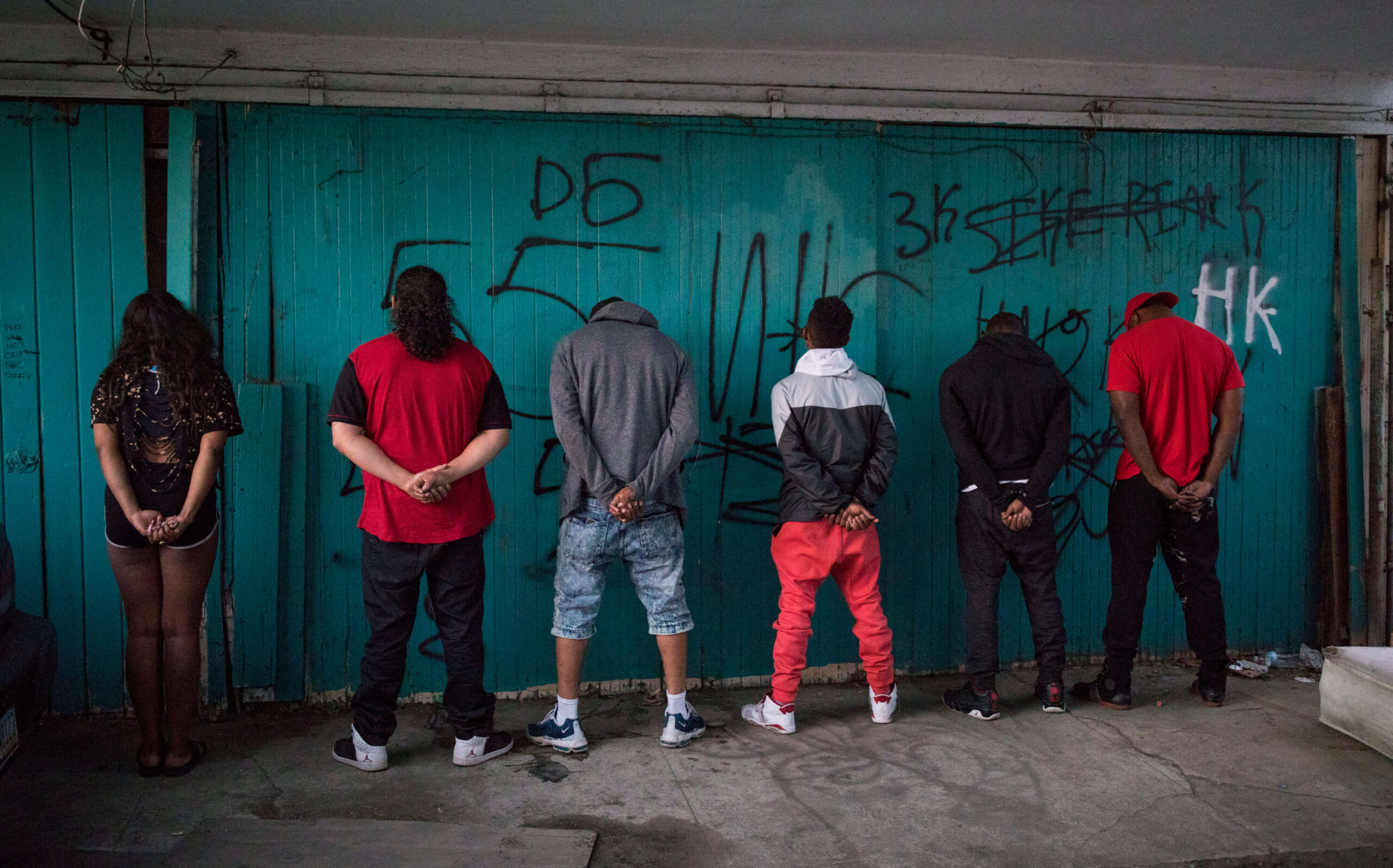
Today we are dealing with gang violence.
Gang violence has been with us almost since the birth of the country. First it was the Irish, then the Italians and others, and now black and Hispanic kids have been pulled into the grand old American tradition. This is how we have historically dealt with our troubled youth—not by providing decent schools, stable homes, or job training, but by renaming the problem, misidentifying it, or pretending it isn’t there. Or we pretend that, for one reason or another, a particular group is not worthy of serious attention until its neighborhoods are destroyed.
Rather than go over all our repeated failures, we should spend some time examining how Italy is dealing with its own youth-gang problem. Italy has adopted the straightforward approach of first identifying it as a problem. This alone may be over the heads of our social scientists and city mayors. Then the government does something else unheard of in America: it proposes laws designed to deal with it.
Most radically of all, the Italian government has embraced the crazy notion that citizens have a right to exist peacefully in their neighborhoods without being shot, intimidated, robbed, or vandalized. From there, it makes the wild leap that the safety and peaceful existence of citizens matter more than the inflated rights we have invented for criminals who commit violent acts.
Let’s unpack this a little more. Italy has decided that a gang does not become less dangerous merely because its members are young, its clothing is fashionable, its members listen to cool music, or its violence is committed by rappers. It does not even matter if one of them has a hit song.
Meloni’s government has now advanced a security package aimed in part at the groups popularly called maranza: clusters of adolescents and young men associated with robberies, assaults, vandalism, and intimidation in public spaces. Despite the messy Trump-Meloni split, she has not abandoned her core principles. Her proposal begins with the understanding that sociology cannot be allowed to erase individual responsibility.
For Meloni, the party is over. When teenagers surround a victim, damage a shop, attack a police officer, or arrive at a demonstration prepared for violence, her government proposes to treat that behavior as a public-order problem rather than an expression of righteous youthful alienation. Of course, there are leftists such as Elly Schlein—the Italian Lady Obama—who object to much of this. But Schlein often comes across as a nauseating combination of reconstituted Obama with a little Gloria Steinem thrown in. Hopefully, she stays in the shadows.
The concept behind the Italian approach is grounded in common sense. Reduce the standards of acceptable behavior, and the immediate result will be bad behavior. Take away police power to maintain the peace, and there will be disorder. It only takes someone with a Ph.D. to think otherwise.
In Italy, people are tired of it. The proposed measures are sweeping and concrete. They would permit preventive intervention in defined circumstances, extend certain powers to local police, strengthen exclusion orders for repeat troublemakers, provide for delayed arrest based on video evidence in certain cases, and increase penalties for group violence, property damage, and assaults on public officials.
Contrast this with the American approach. We are terrific at announcing commission studies and violence-interruption grants, renaming police units and debating the social origins of criminal behavior. We are too sophisticated to understand that people need to take responsibility, beginning with parents who do not discipline or control their children. If parents will not teach their kids how to behave, someone needs to.
Instead, in America we use poverty, family instability, school failure, addiction, or neighborhood collapse to justify antisocial and criminal behavior. Some, although not all, of these may be valid causes. But explanation has become exoneration, and prevention has been presented as an alternative to enforcement rather than its necessary companion.
Italy’s message is much simpler. A young person may deserve help before he commits a crime. If and when he does commit one, it is the public that deserves protection.
American social scientists sometimes appear to believe that we must eradicate poverty before we may punish crime. Since when? We have never eradicated poverty in the entire history of mankind. It will be a long wait. We cannot continue handing out get-out-of-jail-free cards to every kid who throws a rock through a window, steals a car, or kills or rapes someone until we complete the goal of eradicating global poverty and establishing the perfect utopia. It is not coming. It is never coming.
In the meantime, people need to live safely, go to work, walk through their neighborhoods, run businesses, and participate in recreation without fear of robbery, rape, or worse. One would think this is common sense, but that was before the disease that infected Weimar was transmitted to our university faculties, courts, and legislative chambers. They call it progress. A better description would be blatant stupidity.
Statistics claiming crime is down are not helpful. That’s because gang crime is concentrated. It can dominate particular neighborhoods even when a national or regional crime rate falls. So much for politicians boasting about declining crime as though an aggregate statistic matters to a woman who will no longer use the train or a shop owner being shot or replacing his window for the third time. Brandon Johnson in Chicago, Jacob Frey in Minneapolis, and their counterparts elsewhere have little to be proud of. Even where the numbers improve nationally, they can be largely irrelevant to the citizens trapped inside the places where gang violence is concentrated.
Older federal estimates described tens of thousands of active gangs and hundreds of thousands of gang members in the United States. The precise national count is difficult to establish, and the frequently quoted figures are dated, but there is no serious dispute about the existence of an entrenched system that moves drugs, firearms, and stolen property, controls territory, and recruits children into criminal identities.
Now combine this with the scale of firearms circulation. A January 2025 Justice Department summary of ATF research reported that, among more than 828,000 pistols recovered and traced between 2019 and 2023 for which ballistic evidence had been acquired, approximately 14 percent were involved in one or more shootings. Those firearms were associated with more than 191,000 shooting events. Beaming with pride yet?
Read more South Korea’s Crackdown on U.S. Companies Threatens South Koreans’ Access to Advanced Technology
Italy’s street gangs can terrorize passengers on buses and trains, merchants, and nightlife districts. But an Italian fistfight or knife fight is far less likely to become a sh-tshow involving illegal handguns repeatedly passed through a criminal network. Americans are not only facing gangs. They are facing gangs operating in an environment saturated with drugs, sex trafficking, kidnapping, and firearms.
The president’s initiative to go after criminal gang networks is not remotely the same thing as going after otherwise law-abiding immigrant families. Local authorities are absurd in making that claim and must be called out for it—by the voters. Mayors and governors should cooperate with federal law enforcement in taking back the streets. American policymakers must stop treating every objection from the activist left as a veto over public safety.
Milton Friedman pointed out decades ago that corrupt or self-interested politicians are not an excuse for abandoning reform. If we understand that a politician is a particular kind of insect, then we understand that we can alter its behavior. Make lunacy politically unfeasible, and politicians will change their behavior.
Bill Clinton is a case in point. Clinton called for tough border enforcement in the 1990s not because he believed deeply in it. The man does not appear to believe deeply in much of anything. He called for it only because the public believed in it. The public forced his hand. Similarly, some Democratic politicians must exist who understand intellectually that our current immigration and criminal justice policies are insane. But their core objective is to win the next election. It is up to voters to show them that tolerating gang violence, poor border control, and reduced consequences for violent offenders is political suicide.
Waiting for a moral politician to arrive and fix everything is absurd. Honest Abe shows up every few centuries. The system is far too compromised for one honest politician to alter reality without help from voters. And finding an honest person who wants to remain in politics indefinitely is about as frequent as the passing of Halley’s Comet. The voters who want to take their streets back have to start by taking back the voting booth.
Italy does have advantages in combating gang violence that we do not. Its government can establish a common public-order framework and assign powers to national and local police. America cannot get federal and local law-enforcement agencies to agree on much of anything. The ghost of Alexander Hamilton and his well-founded cynicism that anything other than a federalist system would work haunts us every day.
Our divided and splintered government is becoming an increasingly serious problem as the nation gets larger and more diverse. Our authority is divided among federal prosecutors, state legislators, governors, county district attorneys, mayors, police departments, school systems, and juvenile courts. Some cities pursue repeat offenders aggressively. Others adopt diversion programs, restrictive pursuit rules, and reduced juvenile detention, or treat group violence as a collection of isolated incidents. The result is not one American gang policy or one concerted effort. It is chaos embodied in hundreds of local experiments, often changing from election to election.
Another American weakness is the artificial separation of prevention from punishment. We understand that the most effective moment to stop gang membership is before the first gun, the first robbery, and the first loyalty test. Of course, we need schools that do not resemble prisons or babysitting services. Kids need stable families. Youth sports, employment opportunities, and credible mentors should not be reserved for affluent neighborhoods.
But here is the real issue: too much American policy rests on a false choice. Social policy cannot substitute for arrest once a gang member has chosen violence. Leftists act as though every violent offender is merely a child waiting for the correct social worker to come along. Not every kid pulled into a gang is a hardened predator without hope. But some are chronic offenders who develop a terrifying lack of morality at earlier and earlier ages.
A functioning system must distinguish between the hardened predator and the kid who can safely make an exit. Our lawyers, judges, and social workers need to be wise enough to know the difference. It is not the individuals in the gangs alone we should be worried about. It is everything and everyone they touch. And they leave a trail of destruction everywhere they go.
Italy’s proposal exposes another weakness in the American system: group crime is different from individual crime. Five thugs surrounding one person are not simply five misunderstood teenagers who happen to be making the same bad choice at the same time. The group psychology changes the nature of the encounter. It is Lord of the Flies writ large.
An individual’s recklessness and lack of judgment are amplified inside the group. The group diffuses individual responsibility, terrifies the victim, and then uses the victim’s fear to supercharge itself. Italy’s proposed law recognizes that organized intimidation, coordinated property destruction, and planned violence are aggravating features. It does not simply dissolve the event into a collection of minor individual charges.
Federal prosecutors are overworked, but they can also be lazy and lack creativity. They have enormously powerful tools at their disposal that remain underused. Federal racketeering, firearms, and narcotics laws are adequate to dismantle violent organizations. Federal prosecutors have used these laws to charge dozens of gang members at a time, including a 2025 prosecution of Trinitarios leaders tied to six murders and 11 attempted murders and a California operation charging 38 gang members and associates with drug and firearms offenses. We have the tools, but we do not apply them consistently.
Our mayors, governors, and congressional leaders also refuse to protect ordinary public space. Transit platforms, shopping streets, parks, school entrances, and theater districts belong to citizens, not gangs. Yet politicians, judges, and law enforcement regularly surrender the right of way, forcing ordinary people to avoid neighborhoods, remain indoors during certain hours, close businesses early, avoid public transportation, and absorb the continuing cost of criminal damage. This familiar failure is inexcusable.
Italy’s approach restores the forgotten citizen to the analysis. The teenager or woman afraid to take a train, the elderly merchant paying for repeated broken windows, and the immigrant family whose children are being recruited all possess rights.
Politicians are primarily concerned with themselves and will have to be forced by voters to take coordinated action. Voters need to wake up and understand that. But there is much we can borrow from Italy. Police should be not only authorized but expected to take swift action, followed by certain consequences. Deferred arrest based on video evidence could add another tool in appropriate cases. Courts must impose significant penalties on repeat offenders who terrorize trains, commercial districts, public parks, and other common spaces. Prosecutors should aggregate connected crimes to reveal the true gang structure rather than bargaining each incident into invisibility. As a former prosecutor, I can attest that they often exhibit an astounding lack of creativity.
This 200-year catastrophe—begun by Irish, Italian, and other immigrant gangs and now destroying black, Hispanic, and other inner-city neighborhoods—needs to come to a crashing end. The definition of insanity is doing the same thing repeatedly and expecting a different result.
Rome has grasped something that Washington and American cities have not: compassion for young people and intolerance of gang violence are not opposites. They are parts of the same moral position.
A decent society rises to rescue a child before he joins a gang. There is considerable work to be done on that front. But once the gang begins preying on others, that same society must rise to rescue the neighborhood.
Read more Illegal Immigrant Trucker Caught With $3 Million in Stolen Toxic Powder