







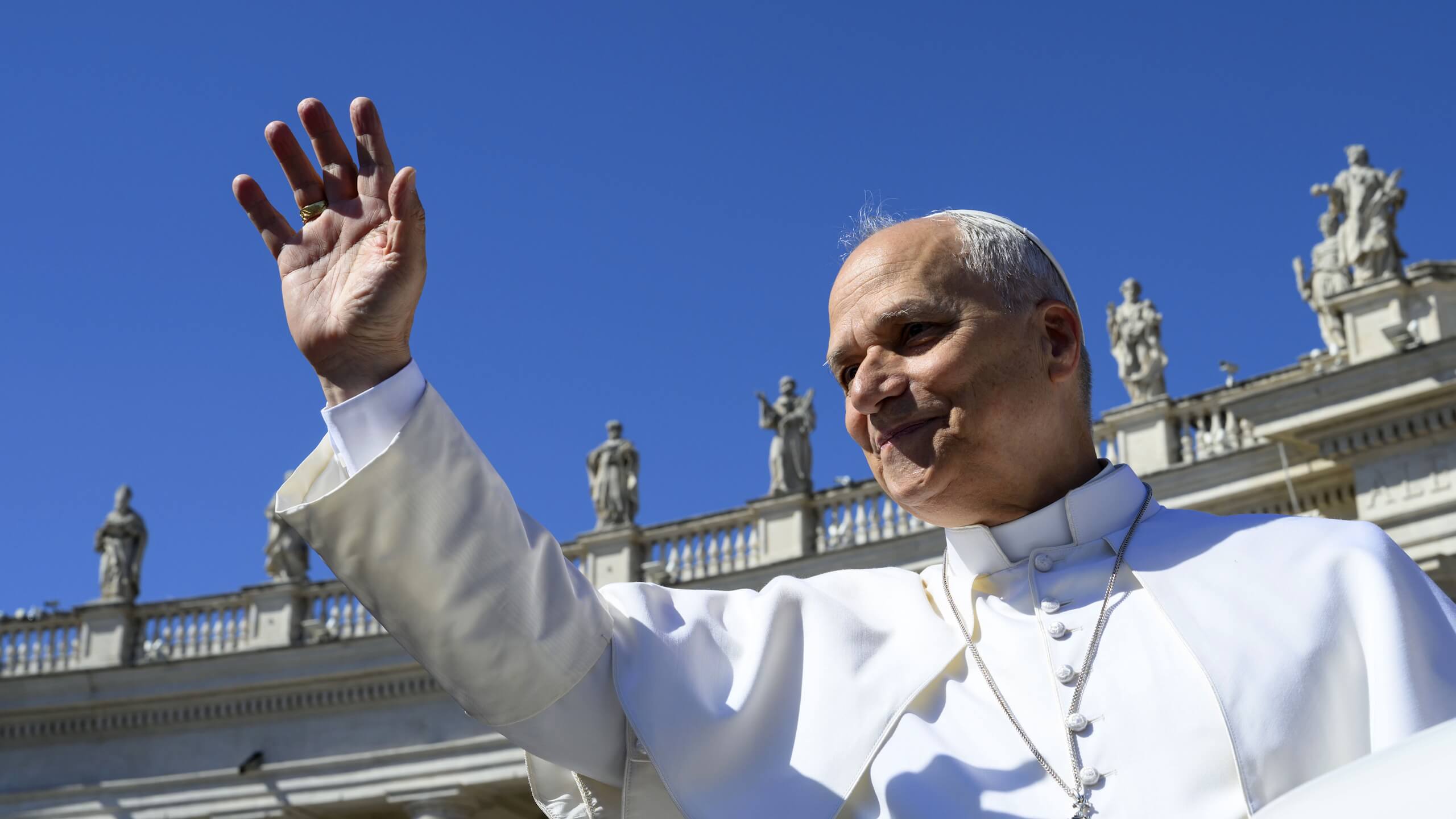
Reading around in Magnifica Humanitas, the Pope’s new encyclical on “Safeguarding the Human Person in the Time of Artificial Intelligence,” I couldn’t help but recall Dr. Johnson’s comment about Paradise Lost. He found a lot to admire in that sprawling opus. But Johnson also noted that “none ever wished it longer than it is.” Magnifica Humanitas weighs in at more than 40,000 words. It is inspired by, and in some respects modeled on, Rerum novarum, Leo XXIII’s 1891 encyclical on society’s duties to the poor. At some 14,000 words, that earlier “circular” seems almost sonnet-like by comparison.
Read more Justice Department Sues Four States for Denying Undercover License Plates for Federal Agents
Magnifica Humanitas is not only long. It is also prolix. Like the eponymous river in Turkey, it meanders. Its ostensible subject—the threat that artificial intelligence may pose to human flourishing—is counterpointed throughout by nuggets of politically correct sentiment. There is a lot about “economic injustices and the climate crisis” in this expostulation. Also migrants. He quotes with approval Pope Francis’s insistence that we view migrants “not simply as a problem to be managed but as a living image of the People of God on the move.” Leo is also against war, you will be relieved to hear, but he writes as if war were a modern invention. “Today,” he writes, “we are witnessing a real paradigm shift . . . with a troubling revival of war as an instrument of international politics, while the very ethical principles that had previously limited its use are being eroded.” No-one tell Alexander, Caesar, Genghis Khan, Sherman, Patton, or–well, open a history book. In brief, Magnifica Humanitas betrays a fair quota of naïveté. Mirabile dictu, one of the stars of the show is the United Nations, which Leo mentions several times, always with admiration.
I suspected at first that the encyclical was written by a committee. Its tone and rhetorical structure vary substantially from one section to the next. I wonder, though, whether there isn’t something to the naughty suggestion that this admonition about the dangers of AI wasn’t itself written with the help of AI.
I haven’t really digested this heaping portion of exhortation yet, so for now I will limit myself to two points. The first is a linguistic observation. Towards the beginning of the encyclical, Leo cites his predecessor’s encyclical Rerum novarum. This is in a section called “The res novae of our time.” Leo translates res novae as “new things.” But what the phrase really means is “social turbulence” or “revolution.” If we wish society to prosper, Cicero said, we must beware of “turbulent men eager for revolution” (turbulentis hominibus, atque novarum rerum cupidis). I mention this because although Magnifica Humanitas comes wrapped in the warm rhetoric of “promoting a dignified life for all,” “building a world in which everyone can flourish,” etc., its implicit message often veers towards something more radical. Leo is eager that we “establish adequate regulatory tools capable of upholding justice and curbing the distorting effects of technological power.” He is also worried about “who holds this power today and how they use it.” AI, he says, must be “disarmed.” Did someone mention the United Nations?
My second point concerns the substance of Leo’s analysis of the threat of artificial intelligence. “Today,” he writes, “we find ourselves facing a new situation. The power and prevalence of emerging technologies are interwoven into the fabric of daily life, shaping decision-making processes and deeply affecting the collective imagination.” Well, yes. But is that really a new situation?
In his book The Abolition of Man (1943), C. S. Lewis underscores the point that recent technological developments yield not only powerful new instruments of control but also a changed attitude towards humanity itself. Science is all about “conquering nature,” Lewis acknowledges. But every such victory increases the domain of that which we treat as “mere Nature,” i.e., something to be mastered. “It is in Man’s power,” Lewis writes, “to treat himself as a mere ‘natural object’ and his own judgments of value as raw material for scientific manipulation to alter at will.”
The frightening moral developments that C. S. Lewis, among many others, foresaw have borne poisonous fruit only with recent technical innovations. But the attitudes, the view of nature and humanity that are presupposed by such developments, have their roots in the intellectual revolutions of the sixteenth and seventeenth centuries, the revolutions of “the new science,” of Copernicus and Galileo, of Bacon, Newton, and Descartes. In seizing the freedom to determine itself, humanity at the same time began to assert its freedom to take charge of nature.
It would be difficult to overestimate the importance of this shift. Since the time of Aristotle, science had been essentially a contemplative matter; truth was conceived as a stable order that man strove to behold. But in the modern age, science became fundamentally aggressive, inseparable from the project of grasping and manipulating nature—including man’s nature—according to human designs. Instead of opening himself up to nature’s secrets, man now strove to reconstruct those secrets by active intervention. Francis Bacon’s celebrated declaration to the effect that “knowledge is power” typifies the new approach.
Nowhere was this new approach more dramatically crystallized—or more systematically worked out—than in the philosophy of René Descartes, who can with some justice be considered the architect of modern science. In a famous passage near the end of the Discourse on Method (1637), Descartes heralds a “practical philosophy” that, unlike the speculative philosophy of scholasticism,
would show us the energy and action of fire, air, and stars, the heavens, and all other bodies in our environment, as distinctly as we know the various crafts of our artisans, and could apply them in the same way to all appropriate uses and thus make ourselves the masters and owners of nature.
Read more We Are Only in Act III of the Iran War
To make ourselves the “masters and owners of nature”: that is the goal. The index of knowledge here is not accurate theory but power and control. Like the artisan, we really know something when we know how to make it. And among the benefits that Descartes envisioned from his new philosophy was a more efficacious medicine: by understanding the principles of nature, Descartes wrote, we might hope to control man’s physical nature, freeing him from “an infinitude of maladies both of body and mind, and even also possibly of the infirmities of age.”
The staggering success of modern science and technology—including modern medical technology—underscores the power and truth in some respects of Descartes’ vision. What we call the modern world is in a deep sense a Cartesian world, a world in which humanity has exploited the principles outlined by Descartes to remake reality in its own image.
But there is, as Leo points out, a dark side to this mastery. Increasingly, one confronts the fear that humanity, despite its technical prowess, may be enslaved by its dominion over nature. “If man chooses to treat himself as raw material,” Lewis writes, then “raw material he will be.” Nor is this fear confined to the effects of our science, to the lethal arsenal of weapons and pollutants that human ingenuity has scattered over the face of the earth. Equally (if more subtly) fearsome is the crisis in values that modern science has helped to precipitate. Committed to the ideal of objectivity, of treating everything as “raw material,” modern science requires that the world be silent about “values,” about meaning in any human sense, for it requires that everyday experience be reduced to the ghostly, “value-free” language of primary qualities and mathematical formulae. While this language has given man great power over the world, it cannot speak to him of his place in the world. Similarly, deployment of “large language models” by AI will put the world at our fingertips. It will tell us nothing about how we are to live in that world.
There are two dangers. One is the danger of technophobia: retreating from science and technology because of the moral enormities it makes possible. The other, perhaps more prevalent danger, is technophilia, best summed up in the belief that “if it can be done, it may be done.” There are many things that we can do that we ought not do. But whence does that “ought” acquire its traction and legitimacy? As science and technology develop, we find ourselves wielding ever greater power. The dark side of power is the temptation to forget its limitations. Lord Acton was right to warn that “power tends to corrupt, and absolute power corrupts absolutely.” That observation has relevance in the world of science and technology as well as politics. None of us, of course, really commands absolute power. Our mortality assures that for all of us—rich and poor, famous and obscure—life will end in the absolute weakness of death.
But the exercise of power can be like a drug, dulling us to the fact of our ultimate impotence. It is when we forget our impotence that we do the most damage with the power we wield. At the end of his book Main Currents of Marxism (1978), the Polish philosopher Leszek Kolakowski observed that “The self-deification of mankind, to which Marxism gave philosophical expression, has ended in the same way as all such attempts, whether individual or collective: it has revealed itself as the farcical aspect of human bondage.” It would be a mistake to think that Marxism has a monopoly on the project of self-deification. It is a temptation as old as mankind itself. The Greeks called it hubris. And the Book of Genesis warns us about such hubris with the story of the serpent’s promise to Eve: “Ye shall be as gods.”
If that seems hyperbolic, consider Yuval Noah Harari, the Davos-friendly, best-selling author of pop-philosophy books warning—or crowing (it’s not always easy to tell)—that human beings are just about to exceed their shelf life and need to be replaced by something better. “We are really acquiring divine powers of creation and destruction,” he said in a recent interview. “We are really upgrading humans into gods.” “Upgrading.”
Because humans are now “hackable animals,” Harari argues, they will soon grow out of their attachment to outmoded ideas such as the worth of the individual and free will. Such ideas were ok for people like Locke, Rousseau, and Thomas Jefferson, he admits, but thanks to technological advances we’ve gone beyond all that. “That’s over,” he says about the idea of free will.
It’s all quite breathtaking. “The most important question in 21st-century economics,” Harari writes in the best tech-mandarin style, “may well be what to do with all the superfluous people.” There will be so many “superfluous” people, you see, because only a small portion of humanity will be “upgraded” to be “superhumans” who will “enjoy unheard-of abilities and unprecedented creativity, which will allow them to go on making many of the most important decisions in the world.” People, it goes without saying, like Yuval Noah Harari.
All of which is to say that modern technology has upped the ante on hubris. Our amazing technological prowess seduces many people into thinking we are or, with just a bit more tinkering, might become “as gods.” The first step in that process is to believe that one is exempt from normal moral limits: that “if it can be done, it may be done”—i.e., the capacity to do something brings with it the moral sanction to do it. It is a foolish thought, a dangerous thought. But it is a thought with which we will all find ourselves having to contend as we continue to surprise ourselves with our strange cleverness. This is the spiritual neighborhood through which Leo wanders in Magnifica Humanitas. My cursory reading suggests that a priest friend was correct when he observed that “the majority of the encyclical is not about AI and instead is a mental meandering through the maze of gentle political correctness, haunted by the specter of melting ice cubes and heroic immigrants.” Bingo.
Read more F Around and Find Out: Hasan Piker Could Finally Be on His Way to Jail