






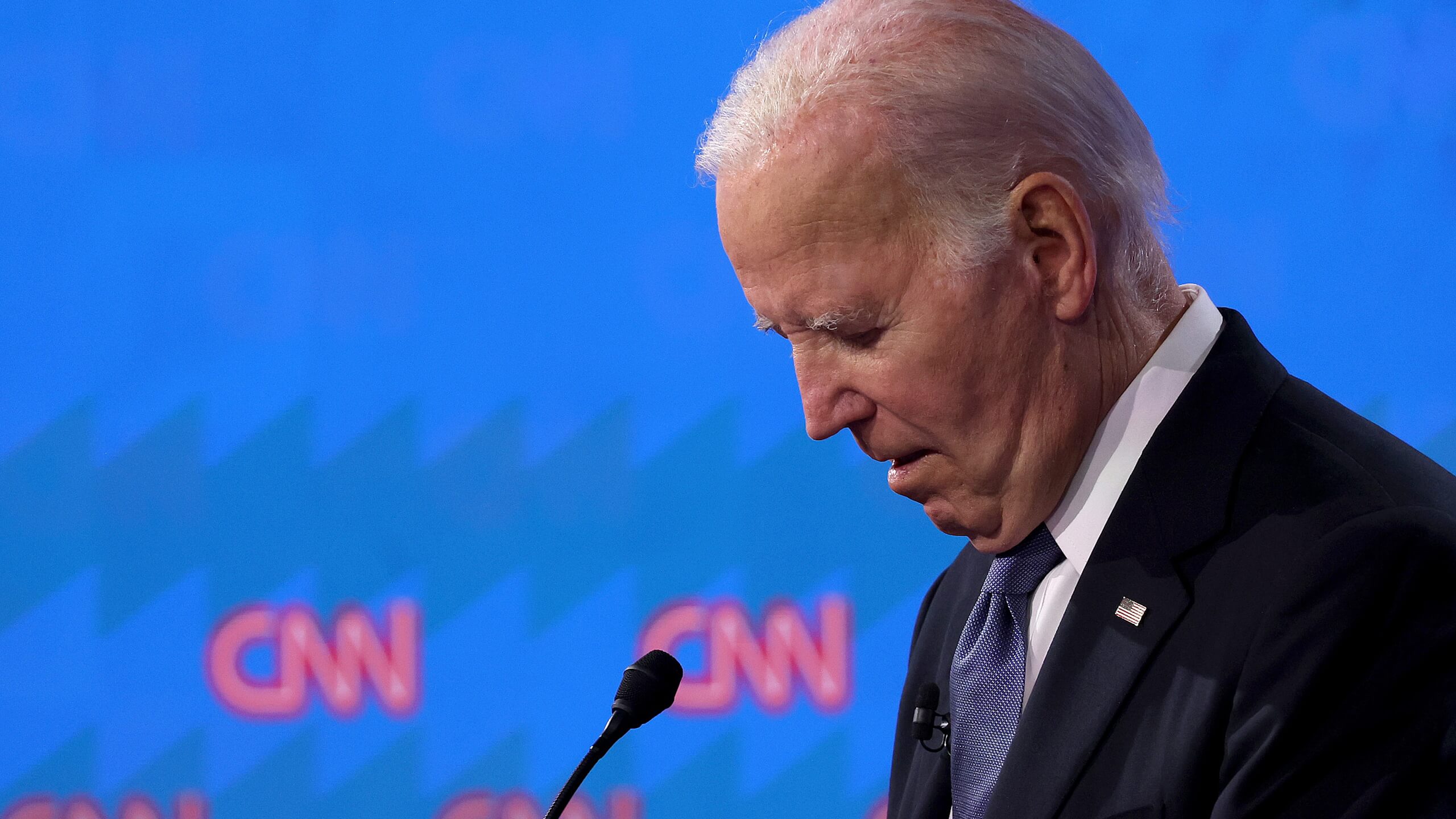
Joe Biden’s presidential reelection hopes went up in smoke after Americans watched his confused and incoherent performance during the first presidential debate on June 27, 2024. During the debate, Biden’s mental and physical decline could no longer be shielded from the American electorate by the Democrat-media complex. After the debate, Democrat protectors ramped up even more to defend Biden, but the shocking new poll numbers panicked Democrats into undemocratically swapping out Biden for Kamala Harris.
Read more Sophie Cunningham May Not Be Interested in Politics, But…
Republicans have a similar octogenarian decline problem that Republican leaders in the U.S. Senate are trying to manage or hide. Mitch McConnell’s increasing frailties have been exposed by his frequent freezing during press conferences, requiring assistance from aides or members of his security detail to walk into the Senate chamber, and now hospitalization on June 14 for an unspecified medical condition. Some have speculated that he suffered a cardiac arrest, as dispatch audio reported paramedics performing CPR on an unconscious individual at McConnell’s home. Who else could it have been?
In both cases, close aides circled the wagons to deflect physical and mental health questions and carry on as if everything were normal. This frequently happens to very powerful people upon whom a cottage industry of aides, advisers, staffers of all types, and many others depend. Efforts to shield these people from public scrutiny frequently result in questions of cover-ups, as well as a lack of public trust in institutions.
What follows is a comparative analysis of documented decline, staff influence, and unresolved questions as they relate to the sorry cases of Joe Biden and Mitch McConnell. The last chapters of their stories have yet to be written.
Joe Biden’s Record
Public decline signals. Biden’s February 2024 showed him struggling to recall key dates and details, reflected in long silences and prodding from aides in the released audio. His June 2024 debate performance triggered a bipartisan wave of concern that ultimately ended his reelection campaign.
A less-remembered but well-documented episode came a year earlier: at a September 2023 Hanoi press conference, Press Secretary Karine Jean-Pierre cut Biden off mid-sentence and abruptly ended the event as he was still answering a question about a conversation with China’s premier, and jazz music began playing over the loudspeakers while a visibly confused Biden continued talking, unaware his microphone had been cut, before being walked offstage. That single incident is a useful microcosm of the broader pattern: staff didn’t just manage the substance of his day; they managed the literal off-ramp when he could no longer manage himself in real time.
“The Politburo”—the staff-control record, beyond the autopen. The autopen dispute is the most legally consequential example, but it sits inside a much larger, now well-documented pattern of staff control that goes considerably beyond any single mechanism. The fullest account comes from CNN’s Jake Tapper and Axios’s Alex Thompson, whose book “Original Sin” was built on more than 200 interviews and corroborated much of what House Oversight later found in sworn testimony. Their reporting, and the committee record that followed it, describes several distinct layers of control:
Read more Movie Review: Christopher Nolan’s ‘The Odyssey’
- Access and scheduling. Insiders described a small group—Mike Donilon, Steve Ricchetti, Bruce Reed, and Ron Klain, later joined by family-aligned aides Anthony Bernal and Annie Tomasini—as the “Politburo,” a term administration insiders themselves used, reflecting the group’s control over what reached Biden and in what form. Cabinet members were kept further from Biden than even the press, and one Cabinet member told the authors that while Biden technically made final calls, the group’s framing of decisions meant “it wasn’t much of a decision.”
- Concealment from allies, not just the public. In his final two years, Biden reportedly had private moments where he could not recall the names of top aides, had an increasingly narrow schedule, and was prone to losing his train of thought—details that shocked Democrat lawmakers, Cabinet officials, and donors who largely chose not to speak out publicly. Multiple Cabinet members told the authors that, as of 2024, they lacked full confidence Biden could handle a genuine 2 a.m. crisis call.
- Deliberate loyalty over disclosure. As late as January 2025, one senior aide reportedly maintained that even if Biden mixed up names, his substantive judgment on major decisions like Middle East policy remained sound—a defense Tapper and Thompson describe as bordering on “zealotry” rather than clear-eyed assessment.
- Medical gatekeeping. indicated political advisers, including figures like Anita Dunn, resisted calls for cognitive testing to protect his reelection prospects, and that his personal physician, Dr. Kevin O’Connor, never conducted a formal cognitive assessment. Deputy Chief of Staff Bruce Reed, a core “Politburo” member, testified to the committee that Biden’s poor June 2024 debate performance was attributable to a stutter and that the decision to hold the debate earlier than usual was a deliberate strategic choice—an account of the aftermath, notably, still coming from inside the same group accused of managing the underlying problem.
- Fifth Amendment invocations. Three former aides—Dr. Kevin O’Connor, Annie Tomasini, and Anthony Bernal—declined to answer House Oversight’s questions under the Fifth Amendment, a documented fact regardless of what one concludes about underlying culpability.
The autopen specifically. Within that larger pattern, the House Oversight Committee’s October 2025 report—built on 14 depositions and transcribed interviews with former Biden aides—alleged that senior staff exercised presidential authority via autopen on executive actions and clemency decisions, including some involving Biden family members, without clear documentation of his personal sign-off.
On Biden’s denials. Biden has personally and publicly denied the underlying premise, telling reporters he made the decisions on pardons, executive orders, legislation, and proclamations himself and calling suggestions otherwise “ridiculous and false.” Those denials deserve to be weighed rather than simply credited: a president protecting his legacy has an obvious incentive to say exactly that regardless of what actually happened, and Biden’s denial is coming from inside the same information environment his own aides admit they curated. That’s a legitimate reason for skepticism. It isn’t, on its own, proof the denial is false—self-interested denials are sometimes still true—but given how many people inside his own camp (not just partisan critics) have since corroborated the broader concealment pattern, the denial carries less evidentiary weight than an unprompted, independently corroborated account would.
Bottom line on Biden: “The autopen” is really one data point inside a much wider, now well-corroborated pattern—schedule control, information gatekeeping, medical gatekeeping, scripted public appearances, and a named inner circle (“the Politburo,” a term staff used about themselves) that operated with enough independence that even sympathetic Cabinet officials described Biden’s decisions as pre-shaped before they reached him.
That’s the strongest evidentiary case of the two men in this comparison, even though the single narrowest legal question—whether any specific autopen-signed document lacked authorization—remains contested rather than conclusively proven.
The whole purpose of the cover-up of Biden’s decline was to preserve Democrat political power by creating the façade that “Biden was in control” when the opposite was obvious.
Concluding Thoughts
Part I of this two-part series ends here. Part II will examine Mitch McConnell’s situation and compare the decline of the two men in terms of similarities and differences.
Read more Movie Review: ‘Pressure’