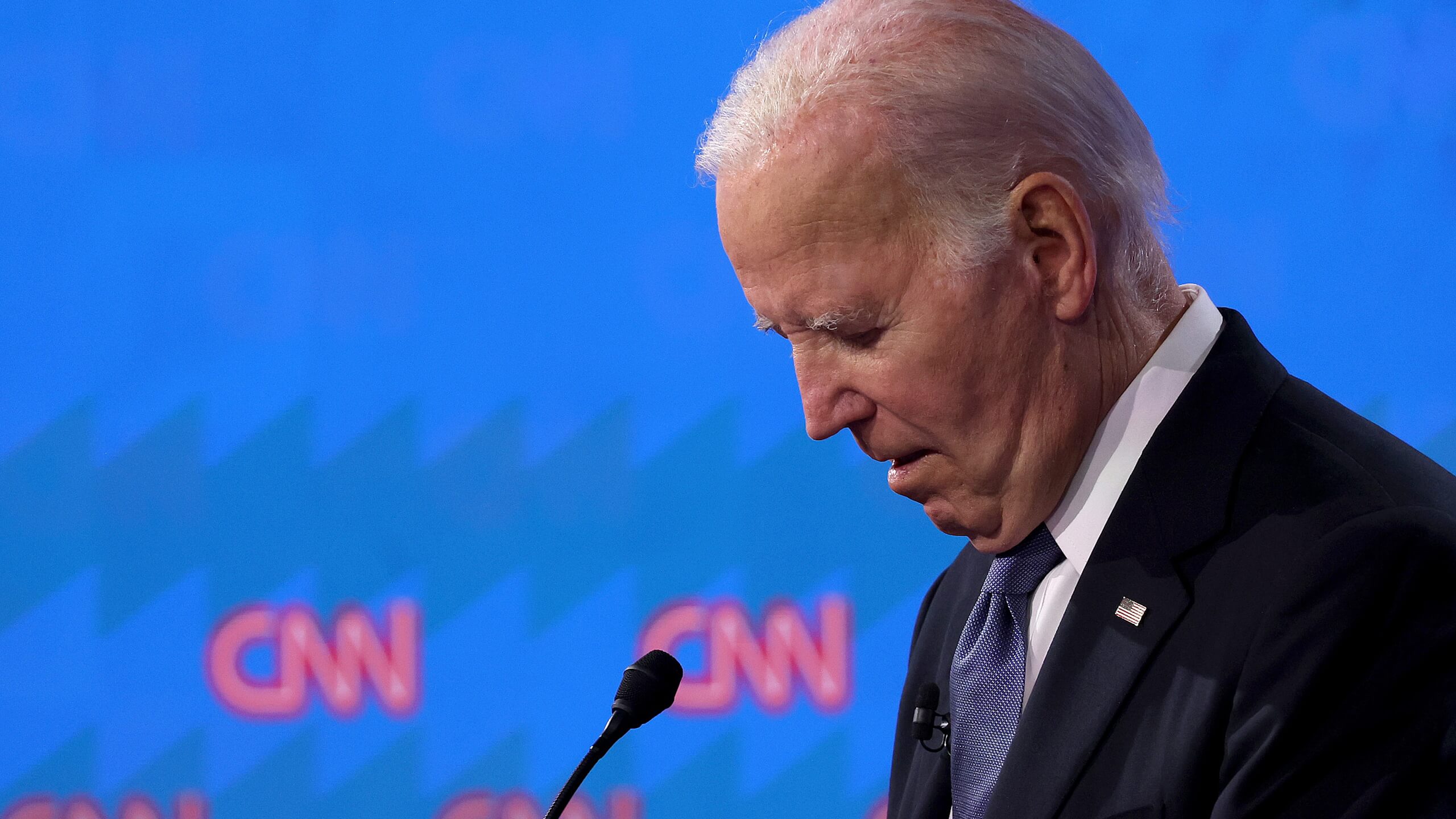








Two octogenarian politicians at the apex of their power and influence have been in obvious physical and mental decline for years. In both cases, close aides of Joe Biden and Mitch McConnell circled the wagons to deflect physical and mental health questions and carry on as if everything were normal. Efforts to shield these people from public scrutiny have resulted in questions of cover-ups, as well as increased public cynicism regarding politicians in general.
Read more The State of American Elections: For the Left, ‘The Worse, the Better’
This is Part II of a two-part series that is a comparative analysis of documented decline, staff influence, and unresolved questions as it relates to the sorry cases of Joe Biden and Mitch McConnell. Part I covered Joe Biden. This part examines Mitch McConnell’s decline.
Mitch McConnell’s Record
Public decline signals. McConnell’s two 2023 freezing episodes are the closest analogue to Biden’s debate moment: he suddenly stopped speaking mid-remarks at a July 2023 press conference, went silent for 19–21 seconds, and had to be walked away from cameras by Senate colleagues, then froze again for more than 30 seconds five weeks later at an event in Kentucky, requiring help from people around him. Both incidents followed a March 2023 fall: he tripped after a Senate Leadership Fund event, was hospitalized with a concussion and a rib fracture, and didn’t return to the Senate for roughly a month.
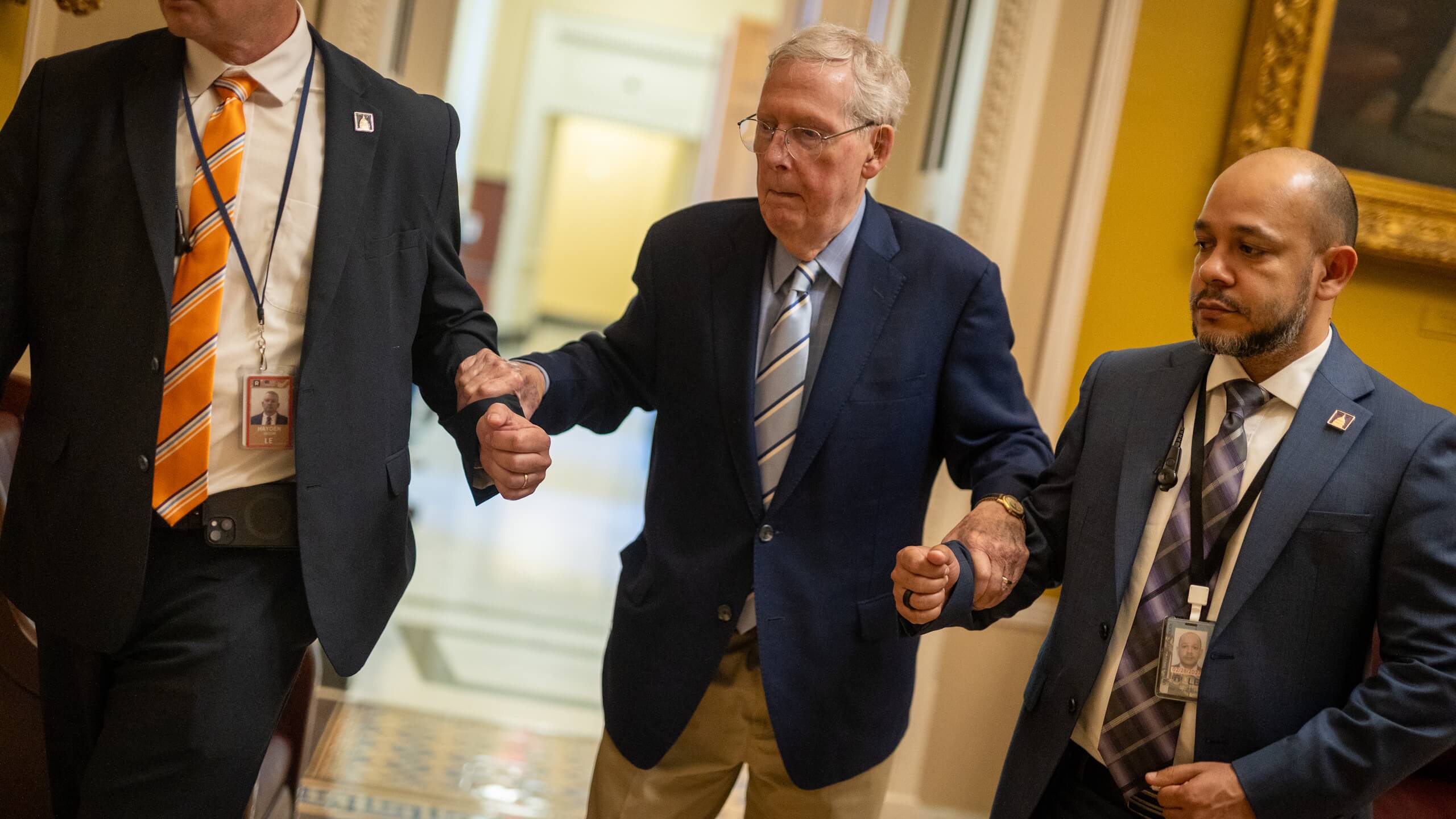
The pattern continued past 2023: he had additional falls in 2024 and 2025 that injured his wrist and face, was hospitalized in February 2026 for more than a week with “flu-like symptoms,” and by April 2026 was being navigated around the Capitol by aides in a wheelchair. His office has consistently attributed each episode to something situational and non-cognitive—the freezing spells to feeling “lightheaded,” the falls to lingering effects of childhood polio—an explanatory pattern that, taken individually, is plausible, but that collectively has drawn the same skepticism Biden’s “bad cold” and fatigue explanations did.
Staff visibly directing him in real time. The clearest documented instance of staff intervening in the moment, rather than managing the narrative afterward, came in May 2026: during a Senate Appropriations Committee hearing, McConnell attempted to wrap up the proceeding while several senators still had unasked questions, and an aide had to approach him and audibly instruct him, on a live microphone, that Senators Baldwin, Shaheen, and Kennedy still needed to speak. The moment was significant enough that President Trump publicly demanded that the aide be fired for making McConnell “look completely out of it”—a notable reaction, since it reflects a Republican president reading the incident exactly the way Democratic critics read Biden’s mic-cutoff moment: as staff visibly propping up a principal who could no longer run his own meeting.
Information control during the 2026 hospitalization. This is where McConnell’s operation most resembles the “Politburo” pattern on the Biden side, though the record here is thinner and the crisis is still unfolding. Since McConnell’s June 14, 2026 hospitalization:
- His office initially said only that he was “receiving excellent care,” and it took until June 22—more than a week later—for staff to disclose he would miss votes that week, with spokesperson Robert Steurer declining to say whether McConnell remained hospitalized, whether staff had even communicated with him since he was found unconscious, or what his diagnosis was.
- Public 911 dispatch audio later surfaced showing paramedics responding to an “unconscious” person in “cardiac arrest” at McConnell’s D.C. address the same morning he was hospitalized and administered CPR—a materially different account than his staff’s “receiving excellent care” framing, though McConnell was not named directly in the audio.
- Day-to-day operations are run by longtime aide Terry Carmack, described as “camera-shy” and drawing a salary above $226,000, who, along with the rest of McConnell’s office, has declined to answer specific questions about his condition.
- Even Senate leadership’s own account has shifted under scrutiny: Majority Leader John Thune said June 15 that McConnell “sounded good” on a call, but three weeks later Thune’s office appeared to know nothing further about his condition before pushing out a fresh statement describing a “lengthy and substantive” call that had reportedly just occurred—a pattern of intermittent, hard-to-verify reassurances that mirrors how Biden’s aides periodically vouched for his sharpness to a skeptical press corps.
The institutional and structural layer. Unlike the presidency, there is no congressional equivalent of the 25th Amendment providing a mechanism for addressing a senator’s incapacity—short of resignation, election loss, or death, McConnell and his staff retain full control over what information about his condition is shared or withheld. This is a structural fact that makes staff gatekeeping considerably more consequential in the Senate. Layered onto this is the durable financial/institutional machine built and controlled by McConnell over his 41 years in the U.S. Senate—the Senate Leadership Fund and One Nation—which continues to function as McConnell’s enforcement arm for GOP primaries and discipline largely independent of his day-to-day capacity.
Bottom line on McConnell: the picture is now considerably fuller than “two freeze-ups and a fall.” There’s a documented instance of an aide directing him mid-hearing in real time, a documented pattern of staff attributing each new physical episode to a non-cognitive cause, and—during the current hospitalization—a documented pattern of delayed, vague, and shifting disclosure from an office run day-to-day by a single long-tenured aide.
What’s still missing relative to the Biden side is the equivalent of sworn testimony or an insider book: everything above comes from press reporting, public records (911 audio), and on-camera moments, not from depositions or aides testifying under oath about what they concealed and why.
Part III: Side-By-Side Comparison
On public decline evidence, Biden’s case rests on the debate performance, the Hur interview audio, and years of accumulated gaffe compilations, while McConnell’s rests on two on-camera freeze-ups in 2023, the 2023 fall and concussion that preceded them, and the ongoing 2026 hospitalization.
On the official explanation offered, Biden’s camp pointed to a “bad cold” and general age-related fatigue alongside outright denials of decline, while McConnell’s office attributed the freezing episodes to dehydration and fatigue and later cited a “clean bill of health” after testing.
Read more The GOP Is Fighting to Hold the House. It Just Might Do It.
On the formal investigative record, the asymmetry is stark: Biden’s situation produced a genuine institutional record—House Oversight depositions, subpoenas, a staff report, and a DOJ pardon-attorney inquiry—while McConnell’s situation has no equivalent. No depositions or subpoenas have targeted his inner circle.
On the mechanism alleged for staff control, Biden’s case is actually the broader of the two once you look past the autopen headline: a named inner circle (“the Politburo”) controlling scheduling, information flow, medical gatekeeping, and public-facing damage control, with the autopen dispute as its single most legally consequential thread. McConnell’s is more institutional and diffuse in a different way—the Senate Leadership Fund and One Nation function as a disciplining apparatus, plus the general opacity around how Senate business is being managed by his staff during the 2026 hospitalization—but it lacks an equivalent named, corroborated inner circle with its own book-length insider account.
On aides asserting the Fifth Amendment, three former Biden aides did so; no equivalent has been reported on the McConnell side.
On the legal consequence if true, Biden’s scenario is contested territory—most legal scholars maintain that autopen use doesn’t void official acts regardless of the underlying capacity question. McConnell’s isn’t really analogous here, as Senate Leadership Fund spending is legal under current campaign finance law irrespective of his day-to-day capacity, so there’s no equivalent “invalidation” stakes.
On the subject’s own denial, Biden has been explicit and on the record, calling the staff-control suggestion “ridiculous and false.” McConnell hasn’t had occasion to issue a comparable denial, largely because no comparably specific allegation—i.e., that staff exercised his formal powers without authorization—has yet been leveled against him.
And on the party response, Biden’s team and DNC-aligned figures have mounted an institutional defense, while Senate GOP colleagues have generally minimized concerns about McConnell—captured well by Mitt Romney’s line that “we might lose 20 seconds a day from Mitch McConnell, but the other 86,380 seconds are just fine.”
What’s Genuinely Similar
The similarities between the two are summarized below.
- Age and incumbency as structural rot. Both men held their positions into their eighties, well past the point where their own caucuses were privately discussing succession—Biden inside the White House, McConnell inside Senate leadership circles going back to at least 2023.
- Loyalist gatekeeping. In both cases, a small, long-tenured inner circle controlled access, information flow, and the public narrative about capacity. Biden’s version is the more fully documented of the two—a named group (“the Politburo”: Donilon, Ricchetti, Reed, Klain, plus family-aligned aides Bernal and Tomasini) whose existence and function are corroborated by both journalists and sworn testimony. McConnell’s equivalent circle is real but far less publicly mapped—there’s no comparable insider account naming names and describing a systematic information-control operation.
- Institutional self-protection over disclosure. Both parties’ establishments prioritized continuity of power and messaging discipline over transparent public accounting of their leader’s condition—this is the closest thing to a genuine “Uniparty” behavioral parallel: not collusion between the two camps, but a shared institutional reflex to protect incumbency at the expense of candor.
- Outside money as an independent power center. Biden’s decision-making apparatus and McConnell’s Senate Leadership Fund both illustrate how modern leadership offices function less as a single human’s judgment and more as a networked operation that can run largely independent of the nominal principal’s day-to-day condition—a feature of the modern presidency and Senate leadership generally, not unique to either man.
What’s Genuinely Different
Here is a summary of the differences between the two:
- Evidentiary maturity. The Biden case has moved from speculation to a formal, if contested, congressional investigatory record—sworn depositions, subpoenas, and an insider book built on more than 200 interviews. The McConnell case has real documented instances of staff intervention (the May 2026 hearing incident, the pattern of shifting explanations for each health episode, the delayed and vague disclosure during the current hospitalization) but nothing at the level of sworn testimony describing what staff concealed and why. The gap between the two cases is narrower than it first appears, but it’s still a gap, as McConnell’s record is built from press reporting and public records while Biden’s is from that plus an investigatory paper trail.
- Nature of the alleged mechanism. Biden’s is a discrete, falsifiable claim (did staff use a physical or digital signature device on specific documents without sign-off?). McConnell’s is a diffuse claim about institutional power (does a leader’s PAC network functionally run policy outcomes regardless of his day-to-day capacity?)—a much harder claim to prove or disprove because outside-group influence is legal, normal, and largely undisputed as a feature of Senate leadership generally.
- Legal stakes. Biden’s alleged scenario touches presidential authority over pardons and executive orders—among the highest-stakes unilateral powers in the constitutional system. McConnell’s touches on campaign finance and legislative whipping—significant, but constitutionally lower stakes and not currently the subject of a DOJ referral.
- Current status. Biden’s story is retrospective (his term has ended, and the investigation concerns a completed presidency). McConnell’s is live and unresolved—he remains hospitalized as of this writing, which means firm conclusions about “who is calling the shots” are premature in a way they no longer are for Biden.
Closing Thoughts
The Biden and McConnell decline stories are genuinely parallel at the level of symptoms (public incapacity, institutional concealment reflexes, aging leadership past the point of full capacity) and the level of staff conduct. Both have documented instances of aides directly managing their principal in real time (the Vietnam mic cut and Politburo scheduling on one side, the May 2026 hearing intervention and wheelchair navigation on the other), and both have documented patterns of situational, non-cognitive explanations offered for each new episode of visible decline.
Where they diverge sharply is at the level of proof: Biden’s case has an actual paper trail—depositions, subpoenas, Fifth Amendment invocations, a book built on more than 200 interviews—that gives the “who was really in charge” question real institutional weight, even though its ultimate legal conclusions remain contested.
McConnell’s case rests on strong circumstantial reporting (the May hearing incident, the delayed hospitalization disclosures, the 911 audio); it’s a genuinely stronger case than “just inference” at this point, but it still hasn’t been tested under oath the way Biden’s has.
The last chapters of their stories have yet to be written. Preserving the illusion of competence, control, and legacies apparently trumps transparency and the public’s right to know the truth for these two figures atop the American political system.
Read more Morning Greatness: Trump to Meet With Ukraine’s Zelensky
It is long past time for age limits on elected officials.