








Anyone who knows anything about college sports rivalries—or better yet, about pre-Civil War American history—will know how hard what I’m about to do and write is for me. I, a proud Kansas Jayhawk and University of Kansas alumnus, would like to give Sophie Cunningham, a proud Missouri Tiger and lifetime resident of Columbia, Missouri, some heartfelt advice. Why, you ask, would I want to do this? Well—and this is the hard part for a Jayhawk—because I think Sophie is fantastic. She’s smart, she’s charismatic, she defends her teammates (one, in particular) against unfair play from other teams, and most important of all, she’s fun. Sophie doesn’t take herself too seriously. She knows she’s playing a game for a living, something girls just a generation before hers could barely dream of doing. She knows, or at least appears to know, that athletic success and fame are fleeting and that she should, therefore, take advantage of her good fortune and make the most of it while she can. Occasional overly skimpy outfits notwithstanding, Sophie Cunningham is someone whom young girls can and should see as a role model. She’s worked very hard to get where she is, and now she’s maturely, but not too maturely, enjoying the fruits of that labor.
Read more Movie Review: Christopher Nolan’s ‘The Odyssey’
So, what’s my advice for the young WNBA superstar? DUCK!
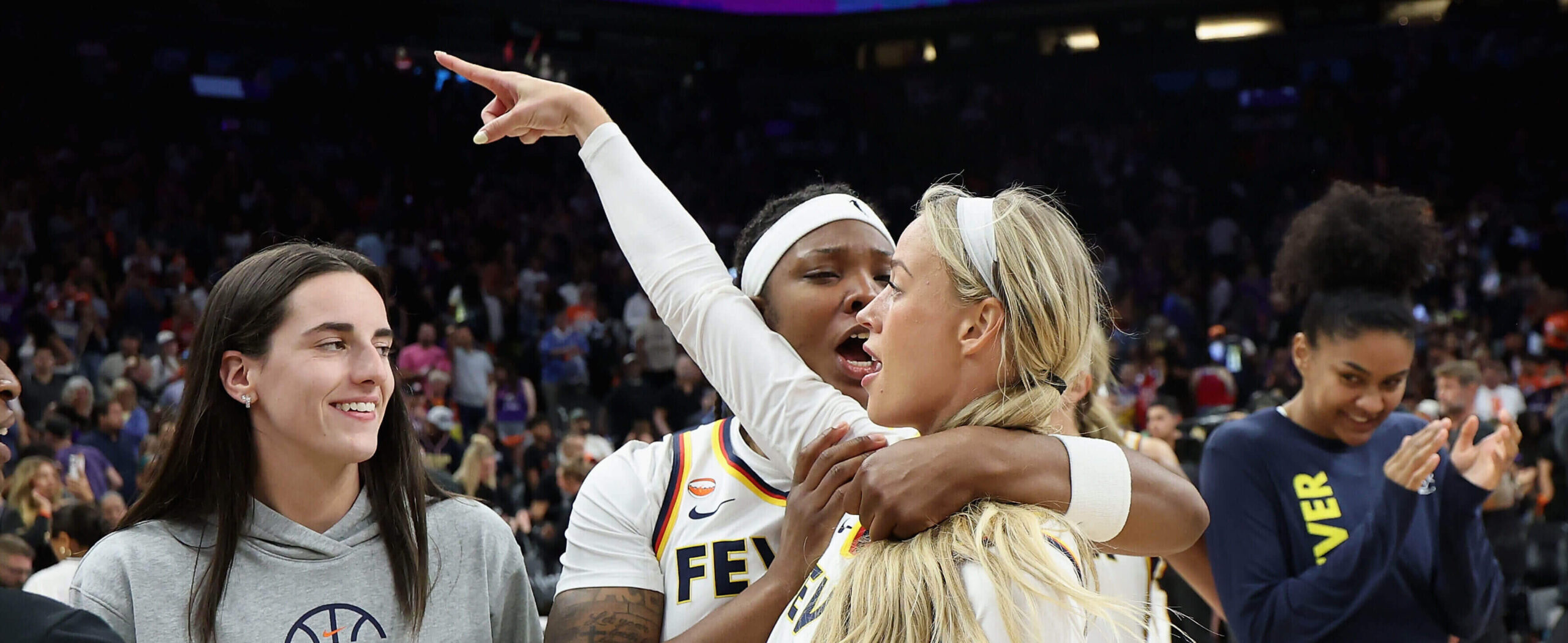
Now, to be honest, that’s not the first thought that popped into my head this past week, when I saw that Ms. Cunningham had “gone viral” for making a comment, reported by ESPN, about men and boys playing women’s and girls’ sports. “I . . . think,” Cunningham said, “that love is truth, being honest. And I want to protect young girls in a locker room or young girls in sport who shouldn’t have to go against biological men.” This wasn’t the first time Cunningham had said something in defense of girls’ sports, but it was the first time she’d done so since she became one of the all-time greatest memes (currently rivaled only by Secretary of State Marco Rubio) and super-famous because she (half-seriously, half-hilariously) stared down and pointed at an opposing player, DeWanna Bonner, for more than 20 seconds.
Immediately after Sophie’s comments appeared, the usual suspects lined up on their usual social media positions and fought it out over whether that (extremely mild) statement made Sophie an angel or a devil. Because of course they did. Sophie, for her part, responded calmly, stating, “I said what I said” and “it’s important to protect children.” Again, these comments are extremely mild, but no one cared. The knives came out, as did the White Knights. Because of course they did.
Meanwhile, Christina Pushaw, the former press secretary for Florida Governor Ron DeSantis, urged Cunningham to stay out of politics: “This might be an unpopular opinion, but I hope Sophie Cunningham stays far away from the Con [Conservative] Inc/media/influencer ecosystem. She could make a much bigger cultural impact by staying right where she is, doing what she loves. . . .” I agree wholeheartedly, and so the first bit of advice I thought to give Sophie was, “RUN!” “Get as far away from politics as you can, as fast as you can,” I thought, “and never look back. Politics is stupid and ugly and destructive, and you play basketball. You don’t need to be the Bruce Springsteen or Anne Hathaway of the Right—a jabbering idiot, prattling on stupidly about things you don’t understand, taking advantage of your fans and their naïve trust in you. RUN! RUN! RUN!”
That was my first thought. My second thought was, “Never mind. It doesn’t matter.” No matter what Sophie Cunningham does or doesn’t do, believes or doesn’t believe, says or doesn’t say, she’s going to be hated by at least half of those who are obsessed with politics. It doesn’t matter if she stays far, far away from “Con. Inc.” It doesn’t matter if she says, as she did in the ESPN article mentioned above, that “I’m very much in the middle. I agree with things on both sides and disagree with things on both sides.” It doesn’t matter if she just wants to play basketball, make funny TikTok videos, and talk about Missouri sports. It doesn’t matter if she doesn’t care about politics. It—whatever—doesn’t matter. Politics cares about her. Because of course it does.
Many political observers—myself included, as recently as two weeks ago—have noted the politicization of everything in the country. There is nothing, it seems, that isn’t fodder for the partisan hate mill. Everything is political, and politics is everything. Many of those same observers—again, myself included—have also noted that this is almost inarguably the manifestation of what the Weimar-turned-Nazi jurist Carl Schmitt called the “total state,” which he defined as a society that “no longer knows anything absolutely nonpolitical.” The political realm becomes a battlefield on which various ideas and beliefs compete for supremacy and on which people and groups come to see others exclusively as “friends” or “enemies.”
What many people forget, however, is that Schmitt defined the categorization of friends and enemies in a very specific way—which defines the total state. Obviously, man has always had friends and enemies. That’s the nature of the beast. Some people are close and likeable and help us, while others are distant, outsiders whose goals and ambitions conflict with our own. That’s just the way things are. For Schmitt, the Total State was different, in large part because the politicization of everything made goals and ambitions largely inconsequential and placed higher importance on “values.” The “political enemy,” he wrote, “need not be morally evil or aesthetically ugly; he need not appear as an economic competitor, and it may even be advantageous to engage with him in business transactions. But he is nevertheless the other, the stranger . . . each participant is in a position to judge whether the adversary intends to negate his opponent’s way of life and therefore must be repulsed or fought in order to preserve one’s own form of existence.” Self-defined values are all that matter and all that delineate friends and enemies.
The politicization of women’s basketball is about as clear an example of what Schmitt meant by this as exists in the real world.
Read more Movie Review: ‘Pressure’
Up until a couple of years ago, the overwhelming majority of Americans couldn’t have named a single player in the WNBA if they were put in front of a firing squad and ordered to. Today, I’d guess that a majority of Americans—or at least a significantly higher percentage than before—could name a player. And for most of them, it’d be the same player, Caitlin Clark. Because of this single player’s impact on the game, the league has thousands, if not millions, of new fans. Teams now fly charter rather than commercial. They stay in nice hotels, not Holiday Inns. The players generally make more money, and they have greater access to endorsement deals, shoe contracts, and all the rest of the comforts that the male counterparts have long enjoyed.
And how have the players, the game officials, the league officials, the coaches, and the localized WNBA community reacted to this newfound bounty? Some have reacted well and gratefully. The majority, however, have reacted with anger, frustration, and bitterness. They spurn Clark whenever possible. They criticize her relentlessly. They leave her off the league’s 30th anniversary commemorative poster. They beat the tar out of her in games. Sometimes, they even accuse her of the most heinous things imaginable, as USA Today columnist Nancy Armour did last week, when she compared Clark to the men who murdered Emmett Till and implied that some of Clark’s fans are white nationalists. Armour was forced to apologize, of course, and her column has been “updated” to remove the offensive claims, but before it was, it read like a note smuggled out of an insane asylum:
It shouldn’t need reminding that this country has an awful history of Black people being harmed, even killed, in the name of “defending” white women. The irony of the WNBA’s All-Star Game is that it’s happening this weekend in Chicago, the hometown of Emmett Till, who became an icon of the civil rights movement after his tragic murder. The local art gallery is currently hosting an exhibit imagining his life if he hadn’t been lynched. While it’s incumbent on the WNBA to do more to protect its players, there also should be an expectation on Clark to recognize the broader implications of her actions being weaponized.
Wait. What?
Why does Armour hate Clark? Why does anyone hate her? They won’t say, obviously, because they can’t, but it’s mostly because Clark is an attractive, heterosexual, white woman from a square state in the middle of the country, and she’s taking all the attention from other women, who have been playing in the league longer with far less recognition and are predominantly not white and are frequently not heterosexual. That’s it. Clark hasn’t done or said anything to make people think she dislikes her black or lesbian teammates. Indeed, by all accounts, she’s a great teammate. Likewise, she hasn’t said or done anything political, hasn’t endorsed President Trump or spoken out about the threat she sees from illegal immigration (or anything else for that matter). She seemed almost as starstruck last week, chatting with former President Barack Obama at an All-Star game event, as he did. She is decidedly apolitical.
And they despise her for it.
Again, the hatred isn’t about goals or traditional advantages. If it were, they’d all love Caitlin, and they’d all be grateful for the attention—and revenue—she’s brought to the league. It’s about values, or in this case, perceived values. She may not share our values, and certainly, she doesn’t openly embrace them. Therefore, she’s an enemy.
All of the same, of course, is said about Sophie Cunningham—also attractive, white, heterosexual, and from a square flyover state. This weekend, some folks on social media celebrated because Sophie’s new shoe from Adidas sold out almost instantly online. Aha, they said, the haters can’t keep her down; they can’t deter her fans! She’s as great for the league and for women’s basketball as Caitlin is! What these enthusiasts don’t understand is that it doesn’t matter. Caitlin Clark merchandise sells out everywhere and immediately as well. And the haters still hate her. And they’re still going to hate Sophie as well. Because of course they are.
I would love to be able to tell Sophie Cunningham to enjoy her moment in the sun, to enjoy being young and successful, and to run as fast as she can from anything at all to do with politics. Sadly, though, that wouldn’t be enough. To paraphrase Trotsky, Sophie may not be interested in politics, but politics is interested in her.
Read more Odysseus Visits the Smithsonian
Oh, and Rock Chalk Jayhawk!