







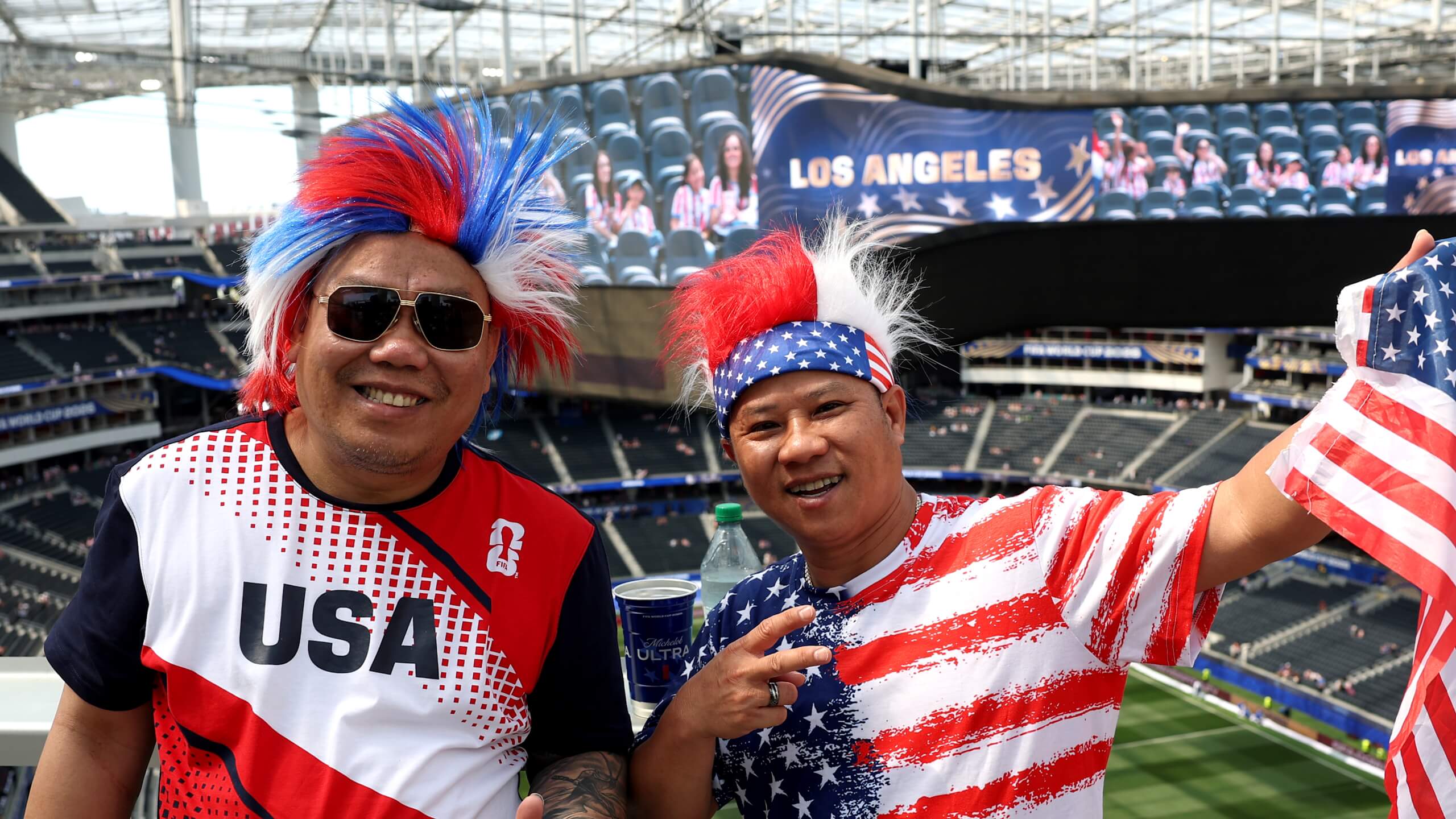
I don’t watch soccer, and I can show you why baseball and football are the quintessentially American games, but it’s been a delight to read about the fun that people from around the world are having as they visit the United States for the first time to attend the World Cup matches. They are discovering that ordinary Americans are a cheerful and friendly lot, nothing like how the mass media in this nation and all throughout the world have portrayed them to be. They gasp in wonder at the grocery stores, the gas stations where you can get a meal, the diners with endless choices for full meals or breakfast all day or 10 kinds of pie or 20 kinds of sandwiches, the oddball attractions, and Americans eager to say, “Oh, you have to go see this,” and ready to give them directions too.
Read more Are iPhones Dialing Up the Birth Dearth?
I know my countrymen. I like them. We have our problems, certainly, but they are not the problems that those who despise their fellow Americans suppose. Fatherlessness—a huge problem; the childlessness that goes along with it; the social dysfunctions that result. But we are no readier to go all “fascist,” whatever that is supposed to mean, since evidently the people who make the accusation do not have in mind the statism that they themselves share with the likes of Mussolini, than a Salvation Army band would be to play for a striptease. I mention the Salvation Army advisedly, because it, too, is American to the core, and its stores are centers of real social assistance, without the interference of government directors skimming their substantial take.
But the fun—it has not yet disappeared! And I ask myself where I would have taken a good crew of Scotsmen if they showed up in my hometown years ago, and I wanted them to see Americans in their natural state. My answer? A bowling alley.
When I was a boy, just nine or ten years old, I’d go on a Saturday night to the nearby Valley Lanes with my cousins Bob and Frank, who were a couple of years older. One of our parents would drive us there, because the alley was five miles away, and drop us off, expecting us to give them a call when we were ready to go home. We would bowl three games each, get something to eat, and play the pinball machines for a while, the whole of the outing taking about two hours. And it suddenly occurs to me that you need quite a lot of things in place in order to have a bowling alley and to trust that three boys would do all right there without any surveillance.
Think of it. Frank had his own bowling ball, but Bob and I had to pick ours out from the racks, where you’d choose from about 200 possibilities, according to the fit of the finger-holes and the weight you liked best. We kept our own score. The proprietors of Valley Lanes had to trust us not to throw the ball when the rack was down or to do other things that might hurt the lane or disrupt other bowlers. Sometimes a ball would get stuck in the ball-return, and then we’d have to tell them about it, and one of the workers would walk down the alley, not on the boards but in the gutters, to get the ball free. They also had a “red pin special” on that night, meaning that one pin in the ten would be solid red, and if that pin showed up as the head pin and you got a strike, they would give you a ticket for a free game the next time you came to play. Obviously, they had to trust us not to lie about it, and of course we only claimed the free game when we did what the rule said.
Valley Lanes was owned and operated by an Italian family, and it’s still in lively operation, and the same family is still in charge. America—a place where immigrant Italians end up building and running a 24-lane bowling alley for bowling leagues, parties, a high school boy taking his girlfriend on a date, or just kids having fun. Why don’t they have things like that—I don’t mean bowling alleys particularly—in Germany or England or Italy?
Why not? In some areas, it has to do with a lack of trust, and that’s true of America also. If I were going to build a bowling alley now, I’d never put it in downtown Portland, Minneapolis, Seattle, or anywhere else exposed to the passions and the destructiveness of a sudden mob. But supposing the trust is there, what made places like Valley Lanes possible? Three things, as I see them, though all three are under duress.
Read more Tulsi Gabbard Releases Bombshell Files Alleging Fauci Helped Spark COVID Pandemic
The first is that families were both strong and were felt to be allied with all other American families. The tribalism that stifled the southern Italians described by Edward Banfield in The Moral Basis of a Backward Society does not exist in the United States. So you could have mom-and-pop enterprises without earning the enmity of all the moms and pops around you. Quite the contrary. In my hometown, Irish people shopped at the Italian grocery, and Italian people shopped at the Irish grocery, and everyone took it as a fact of life. We could use more of such places, but then you need strong two-parent families rich with children. That is the subject of another article.
The second is that when Valley Lanes was built, government at the municipal, county, state, and national level did not put so many obstructions in the way. Licensing and other forms of regulation will always favor big businesses and franchises at the expense of family businesses, because, as my father showed me when I was a boy, the bigger you are, the more you have to gain from regulating your smaller competitors out of the way. Sixty years ago, when Valley Lanes was built, the family did not have to move heaven and earth for permission to do it. They did not have to take a chance of ruin just to cover the legal expenses.
The third was a function of the second, springing from it and corroborating it in turn. I can only compare it to the great open spaces of the prairies. Americans tend to have big imaginations. There is land to build on. No one will tell you, here, “That cannot be done.” This was especially the case before zoning laws, so often counterproductive in their effects, blocked small family businesses that could be run out of the home, so that even in my economically depressed small town, four small groceries were within a five-minute walk of our house, along with a tailor, barber, beautician, restaurant, pharmacy, hardware store, and two taverns. A family owned and ran the best amusement park in our part of the state. A family had lakeside property a couple of miles from us, running a concession stand and an arcade there, while roping off an area for people to swim in—a place friendly to parents with small children. My parents first met there, and so if it hadn’t existed, I wouldn’t, either.
But to return to the bowling alley! When I was 11 years old, a new priest at our parish, Father McDowell, decided that what our Catholic school needed was a bowling league for both boys and girls, which he organized by himself. It met every Saturday morning, for 12 weeks in the fall and 12 in the spring. I think we had at least 16 teams, with five kids on a team. Father kept the stats for averages and for determining handicaps to make sure the games were competitive. Every week, the boy and the girl with the highest total score for the three games would receive a Bowler of the Week trophy, though once you had won, you were not eligible to win another for the rest of the year—and that spread the wealth around. The alley was and is called Idle Hour Lanes, after the tale of Rip Van Winkle, told by America’s first great writer of fiction, Washington Irving, and the interior walls were painted with pleasant cartoons of those dwarfs in those cliffs above the Hudson River with their jugs of hooch and their bowling balls and pins. And of course, the kids had to behave themselves, and we did, and we weren’t quiet about it, either. And of course you could grab your lunch there and play the pinball machines too, and the proprietors again had to trust us that we wouldn’t walk off with our bowling shoes or a bowling ball, that we wouldn’t eat and drink on the lanes themselves, that we wouldn’t get into fights, and so on.
Imagine Europeans showing up at a place like that. That’s the America I love. That’s my home, and I’m proud of it.
Read more Obama Center Opening Ceremony Land Acknowledgement Draws Ridicule, Mockery