



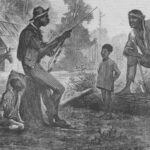



Few historians are willing to sit with a subject as unsettling as the eating of slaves and outsiders, and fewer still manage to do so without either sensationalizing the material or explaining it away. Christian Siefkes’ Edible People: The Historical Consumption of Slaves and Foreigners and the Cannibalistic Trade in Human Flesh (Berghahn Books, 2022) belongs to the rarer second category. Drawing on missionary letters, colonial officers’ diaries, ethnographic reports, and the dynastic histories of imperial China, Siefkes assembles a patient, cross-regional argument that the ritualized or commercial consumption of enslaved and captured people was neither a myth invented by colonizers nor a timeless African or Pacific pathology, but a set of practices shaped by concrete economic and social conditions, conditions that could sustain the practice, intensify it, or eventually extinguish it altogether.
Read more Morning Greatness: Trump Announces Historic Enrollment of 70 Million Children Into Trump Accounts
New Zealand supplies the book’s opening case study, and it is instructive precisely because slavery there was not organized around plantations or markets in the Atlantic sense but around war. Māori captives who were not killed outright became slaves, and their masters retained, as more than one 19th-century observer confirmed, full power over their servants’ lives. Siefkes lets the primary witnesses carry much of the narrative weight. The British artist Augustus Earle recorded watching a returning war party bring back “human heads, human flesh, and many prisoners”; the prisoners’ fate settled the moment they were captured. The trader Joel Samuel Polack, who lived in the north of the island for two decades, described how a slave woman was killed with a blow from a tomahawk merely for eating her master’s cold meal, her body afterward “dressed, cooked, and on their arrival eaten” by the assembled guests.
An even more harrowing episode involves a European trader named Anscow, who watched helplessly as a 15-year-old slave girl was executed for a minor infraction and butchered before him, unable even to complete the purchase that might have saved her life. Earle’s own attempt to disrupt a similar killing, staged by a chief named Atoi, ended in a kind of grim comedy: he and several companions dug up the buried remains of the victim in protest, only to be told the next day that the villagers had simply exhumed the body afterward and finished the meal. These are not incidental anecdotes. Siefkes uses them to establish that Māori slaves occupied a genuinely precarious category, valuable enough to keep alive for labor, yet always liable, as Te Rangi Hiroa put it, to be “drawn upon to supplement the food supply.”
The book’s center of gravity, however, lies in the Congo basin, where the evidence is richer and the economic logic more explicit. Along the Ubangi, Ruki, and Lulonga rivers, European traders seeking ivory or provisions frequently discovered that local sellers had no interest in cloth or trinkets. Steamer captains trying to buy goats found themselves being offered ivory in exchange for people instead, since meat, as the villagers explained, had grown scarce. The journalist Edward Glave was propositioned in similar terms along the same river, told plainly that the trade he was being offered was “meat for meat.” A Dutch trader sent upriver to purchase tusks reported that the locals wanted not goods but children between four and 16 years old, whom they intended to eat. What emerges from these accounts is a startlingly literal market, in which slaves destined for the cooking pot were exchanged for ivory at rates that could be quoted almost like a tariff: a small tusk for one captive, a larger one for two or more. Missionaries such as John Weeks and William Bentley described the same commerce with evident revulsion. The latter noted that captives bought for consumption were sometimes deliberately fattened on bananas and fish before being killed, a practice confirmed independently by the German officer Curt von François, who once tried and failed to purchase a man he found already being prepared in this way.
It would be a mistake to read this trade as something colonialism introduced. Siefkes is careful to trace its roots into the precolonial period, showing that raiding for consumption long predated the European scramble for Africa. Among the Mandja people, for instance, children captured in raids had in earlier, precolonial times typically been sold onward to Swahilo-Arab slavers rather than kept locally, a pattern that only shifted once colonial administration disrupted the older trading networks. Elsewhere in the northeastern Congo basin, a young chief spoke to a missionary with open nostalgia about the days, only recently passed, when captives could still be fattened at leisure before being eaten, a custom whose origins clearly reached back well before any colonial official had set foot in the region. The picture that emerges is one of an indigenous institution with its own logic and its own history, which colonial contact would eventually reshape but did not invent.
Where Europeans on the whole preferred to keep their hands clean, purchasing slaves and ivory through local intermediaries rather than joining raids themselves, the Swahilo-Arab merchants operating out of Zanzibar and the East African coast behaved rather differently. Siefkes devotes a full chapter to this contrast, and it is one of the book’s sharpest arguments. Sir Samuel Baker’s informants described how Swahilo-Arab traders traveling with a group known to them as the Makkarika allowed their allies to join every raid and to eat the bodies of those killed on the spot, even quarreling with them when the allies insisted on killing children the traders had hoped to sell. The German explorer Georg Schweinfurth witnessed something similar while traveling with a trader he considered a friend, a man named Mohammed, who deliberately incited one Zande group to raid another.
When Schweinfurth pressed his companions about their complicity, he was told that the raiders were merely Muslims fulfilling God’s will among unbelievers and that it was not their place to act as lawgivers to people they considered heathens. Tippu Tip, the most formidable of these merchants and for a time even governor of the Congo Free State, ran an operation whose subordinates were instructed simply to gather as many slaves and tusks as they could, with little apparent concern for what became of those the local allies chose to keep for themselves. Siefkes’s point is not that Europeans were innocent bystanders, since they profited from the same trade, but that the Swahilo-Arab merchants were far more willing to march alongside their local partners into the raids themselves, treating the resulting human traffic as an unavoidable cost of doing business.
Read more Republicans Are Fighting Again. Let’s Enjoy the Show.
The long arc of the book’s Congo chapters bends, eventually, toward disappearance, and here the role of colonial administration becomes genuinely double-edged. Missionaries such as Weeks attributed the change to decades of religious instruction, noting that by the early twentieth century men who had once eaten human flesh openly had grown ashamed even to admit it. The diplomat Roger Casement credited the deterrent effect of colonial law, observing in 1904 that the open sale of human flesh he had once witnessed had become impossible, at least in the areas under close administration. Siefkes is at his most persuasive, though, when he isolates the underlying mechanism: cannibalism required raids and warfare to supply victims, and wherever a colonial power actually suppressed raiding, the supply of victims dried up along with it.
France offers the clearest illustration. Visiting the French Congo in the early 1900s, the botanist Auguste Chevalier found the Bondjo peoples still passionately attached to eating human flesh in principle, yet reported that such meals had become far rarer than before, thanks to what he called the surveillance of the French administration, which had largely brought raiding on neighboring villages to a halt. On the Belgian side of the same river, by contrast, state control remained patchier for far longer. A British traveler who visited the Belgian Congo around 1920 found cannibalism still widespread along the Kasai and Sankuru rivers, with the colonial state, in his words, largely leaving the matter alone. The comparison is quietly devastating: it was not colonialism as such that ended the practice, but the specific, uneven willingness of particular administrations to police the violence that fed it.
China occupies a different register entirely, and Siefkes uses it to widen the book’s scope beyond stateless or decentralized societies into one of history’s oldest continuous bureaucracies. Drawing on the sinologist Bengt Pettersson’s survey of the dynastic histories, he shows that Chinese court chroniclers recorded well over three hundred episodes of cannibalism stretching from around 140 BCE into the early twentieth century, most of them tied to famine or warfare rather than to any settled culinary custom. What distinguishes several of these episodes from simple desperation is their thoroughly commercial character. During a sixth-century famine, one chronicle records that human flesh was sold openly alongside beef and horse meat even before other sources had run out entirely, and during a later famine, a pound of human flesh reportedly cost five times less than what dog meat commanded, meaning the poor, rather than the destitute, were its typical consumers.
Equally striking is the ancient custom, first recorded during a siege in 593 BCE and still remembered by survivors of Mao’s Great Leap Forward famine some 25 centuries later, in which starving families exchanged children with their neighbors so that no parent would be forced to eat their own child directly. The persistence of this single practice across so vast a stretch of Chinese history gives the book one of its most chilling throughlines, and it is a testament to Siefkes’s method that he lets the parallel with the Congo and the Pacific speak for itself rather than forcing the comparison.
If the book has a limitation, it is not that it accepts colonial accounts too readily, but that readers may too quickly dismiss those accounts as products of European fantasy or sensationalism. Siefkes demonstrates that reports of the consumption of enslaved people were often corroborated across independent observers, including missionaries, traders, and administrators. Rather than treating cannibalism as an imperial myth invented to justify conquest, he shows that in many regions it was a documented social practice tied to warfare, slavery, and ritual. Equally important, he traces how these practices frequently declined under colonial rule through legal prohibitions and sustained missionary efforts.
The result is not an apology for empire, but a historically grounded reminder that colonial intervention, whatever its many failings, often played a decisive role in ending the killing and consumption of enslaved captives. By following the evidence across New Zealand, the Congo Basin, imperial China, and elsewhere, Siefkes shows that the eating of enslaved and captured people was neither a European invention nor an inexplicable aberration, but an institution with identifiable social and economic logic that ultimately disappeared in many places under the combined pressure of colonial governments and Christian missions.
Read more Morning Greatness: Trump-Deranged Jack Smith Spied on Suzie Wiles, Trump Attorneys, Associates