





The following is an excerpt from Rod D. Martin’s new book Trump’s New World Re-Order, to be released on October 20.
Read more Elon Musk Takes Flight While the Left Takes Offense
Daddy’s Home: Trump’s “Transactional” Foreign Policy Is Anything But Retreat
When NATO Secretary General Mark Rutte joked at the 2025 summit that “Daddy” Trump sometimes had to use strong language to stop the children fighting, he was referring to Israel and Iran. But the setting made the larger point unavoidable: Europe knew exactly who had forced it to grow up.
What it wasn’t was the unending “America is withdrawing from the world” refrain of our neoconservative friends.
Rutte, a Dutch globalist to his bones, knew exactly who had dragged NATO out of decades of complacency, who had forced Europe to stop coasting on American protection and start taking its own defense seriously. He was acknowledging, in public, that the man so often accused of undermining NATO had in fact saved it from irrelevance.
In Riyadh, Trump cast his foreign policy as “Commerce Not Chaos,” and that’s certainly the positive side of it. But the negative, necessary side could be better summed up as “Partners, Not Dependents.”
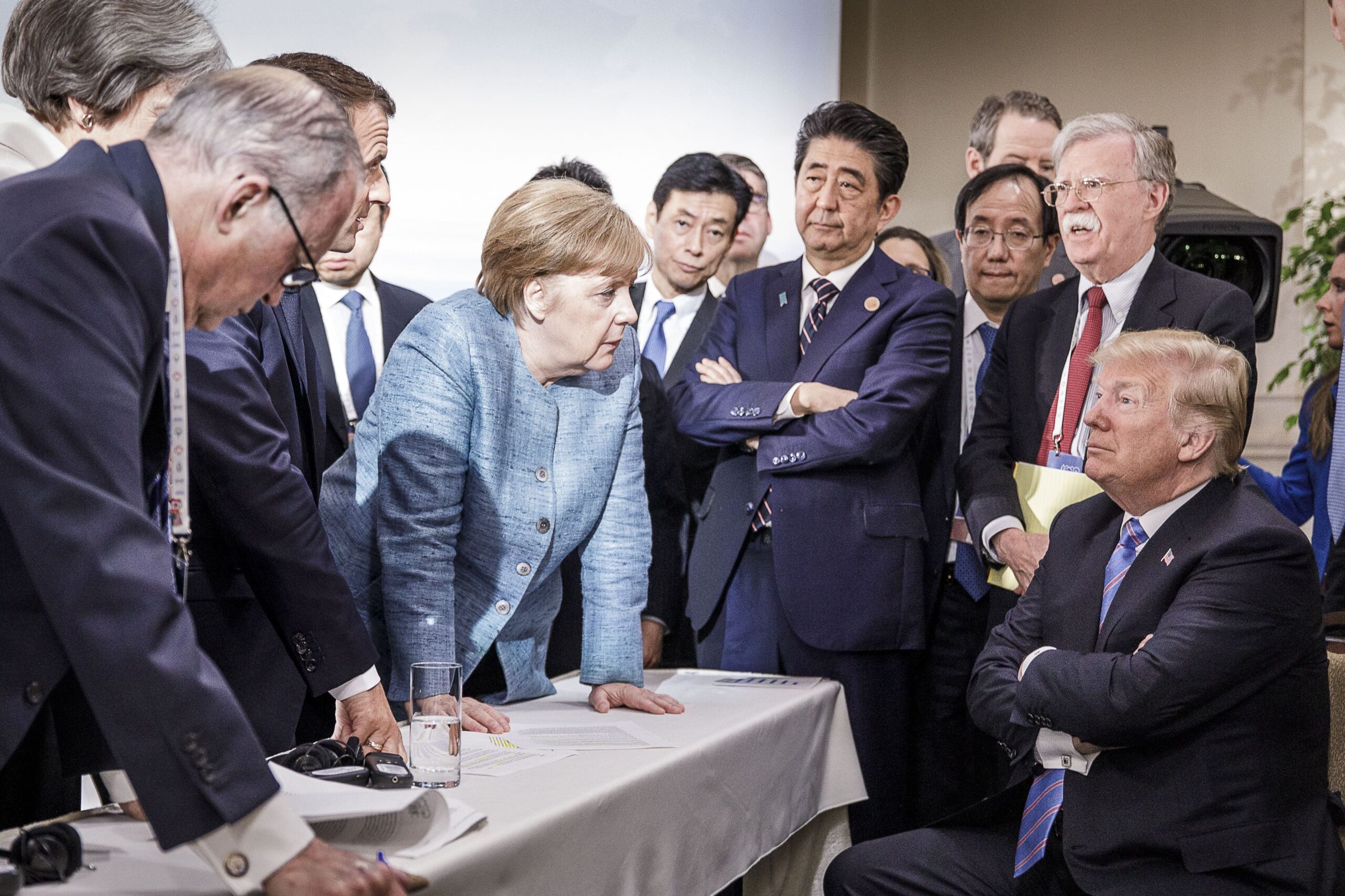
For decades following the Cold War, America’s relationship with much of the developed world has resembled a dysfunctional household. We were the responsible but indulgent parent, working two jobs, paying all the bills, and fighting off the burglars, while our grown children—perfectly capable, wealthy in their own right—offered sanctimonious lectures from our basement, spent lavishly on domestic luxuries, and quietly undercut us in trade and diplomacy.
This was called “alliance.” In reality, it was dependency. Europe was content, giddy, really, to sneer at American boorishness while outsourcing its defense to us, effectively a subsidy of the German welfare state, while, for lack of rifles, Germany trained its soldiers with broomsticks and bought its energy from its supposed geopolitical nemesis.
Washington’s foreign policy establishment was fine with that. Occasionally they scolded a bit or sent a “strongly worded letter.” But they were terrified of “what might happen” if they expected more from the grown children in the basement. They convinced themselves that this lopsided arrangement was “leadership,” that anything else would mean “abandonment” or “retreat.” And they took overweening pride in being “essential.”
It would be easy at this point to say something like “everyone but the American people benefited.” But even that’s not true. How does weakness serve Europe’s interests? And how does it serve America’s? Has dependence on Moscow for energy made Europe more able to carry out its economic sanctions against its frenemy? Has dependence on Washington made it better able to arm its ostensible Ukrainian ally?
If Europe feels threatened by Russia, or anyone, isn’t that because Europe couldn’t fight off a gang of armed teenagers (literally, as it turns out)? And exactly whose fault is that?
Donald Trump never bought into that fiction. Unlike the childless European elite, Trump has raised five impressive offspring, each capable and accomplished in their own right. He knows what that cost. He also knows what we can all plainly see: that his family is stronger as a result, that the whole is greater than the sum of the parts. He could have let his kids play video games while the butler brought them beer and brie. Instead, he made them learn every part of the business they now masterfully run.
He also knows those principles apply to more than just family.
This is the political meaning of ordo amoris, Augustine’s proper ordering of loves. We owe real duties to all men, but greater duties to those God has placed nearer: family before strangers, countrymen before foreigners. Your wife and children depend on you to a degree that someone else’s wife and children do not. America First does not deny love of neighbor. It insists that the American government’s first duty is to the American people.
That does not mean America has no duties abroad. It means those duties must be ordered—and that our allies must become partners capable of carrying their share, in service of the people who’ve trusted them with leadership. Good fathers raise adults, not dependents.
The keepers of the Uniparty foreign policy consensus recoiled in horror at this new approach, seemingly incapable of understanding it. It is as though the entire modern “international order” is an inversion of ordo amoris, a demand that you care more for those far away than for those at home. In fact, it shares that inversion with socialism.
But the results speak for themselves. Despite the hysterical screeching to the contrary (and from people who ought to know better), Trump’s foreign policy is not a retreat from the world. In fact, it’s the exact opposite: a commitment to more than double allied defense expenditures, creating vastly more forces with which to confront all threats, combined with a leveling of the playing field in trade and investment that interconnects nations more than ever before: “Commerce Not Chaos.”
That’s not “withdrawing.” It’s leadership of the sort we haven’t seen since Reagan, of a growing community aligned not by moralizing but by interest. Far from “withdrawing from the world,” Trump is asserting American hegemony.
Hegemony is an interesting word, frequently confused with empire. “Empire” means rule over unrepresented people by a foreign elite in some distant capital. Hegemony is none of that. Hegemony is an alliance in which one of the allies is significantly stronger than the rest.
That distinction matters because Trump’s project is explicitly nationalist. It starts with “America First,” but it doesn’t stop there. And that’s what truly horrifies many of Trump’s critics. His vision of strong partner states reduces the very dependency that made them all subjects of the preferred globalist, elitist order.
Ironically, in so doing, Trump has enhanced and extended America’s global hegemony more than any president since Reagan. “First among equals” means more when the others are strong enough to have some measure of true equality.
America isn’t retreating. America is deputizing its allies to take more responsibility in their own regions, allowing America to bring overwhelming force to bear anywhere at any time, without danger of Bush-Obama era overstretch.
This may be “transactional” and “bilateral,” but it isn’t isolationism. It’s just not neoconservatism. It’s the restoration of a model that worked under Reagan—a model of moral realism and hegemony, not imperial arrogance and overreach.
By respecting, affirming, and strengthening sovereignty, demanding responsibility, and recognizing the limits of American power long ignored by the Uniparty establishment, Trump has ensured those limits will not be reached. Indeed, by empowering partners, he has expanded those limits. In doing so, he has extended America’s influence and spread its ideals farther than his recent predecessors ever could.
The people who cry “retreat” understand this on some level. They just don’t like it. The Beltway class thrives on dependency. NGOs, defense contractors, and diplomatic bureaucracies all profit from client states who can’t—or won’t—stand on their own. Moreover, as DOGE discovered at USAID, the entire system has become a corrupt giant leftist slush fund for unaccountable off-books projects, both foreign and domestic.
Trump threatens that business model. By ending the subsidies and demanding performance, he strips the establishment he inherited of its influence and relevance. So, they call it “isolationism.” People who, for the most part, don’t believe in capitalism denigrate it as “transactional.” People who, for the most part, are ashamed of American sovereignty deplore it as “bilateral.” But their real fear isn’t that America will disengage—it’s that it will engage in ways they can’t control or monetize. And even worse still: it’s that increasingly potent partnerships of strong, assertive nation-states will prove fatal to the globalist project.
Read more Delayed Accountability in the American Political Class, Part Two
The Virtue of Transactionalism
On Trump’s first major foreign-policy trip of his second term, the royal families of Riyadh, Doha, and Abu Dhabi rolled out the lavender carpet, escorting Air Force One over the Arabian dunes with sleek American-made fighter jets and hosting him—along with his entourage of American titans of industry—in their ornate, marbled palaces.
They were well rewarded for their efforts. At the Saudi-U.S. Investment Forum in Riyadh, Trump outlined a new, practical, workable vision for peace:
“Before our eyes a new generation of leaders is transcending the ancient conflicts of tired divisions of the past and forging a future where the Middle East is defined by commerce, not chaos; where it exports technology, not terrorism; and where people of different nations, religions and creeds are building cities together, not bombing each other out of existence.”
No apologies. No sanctimony. No utopian blather. Just a clear, forceful statement of shared interest and an opening to make real lives better.
This was not a one-off. It was the clearest articulation yet of the emerging Trump Doctrine: bind nations through trade, not treaties; through leverage, not lectures. And above all, replace the failed imperial fantasies of the globalist elite with hard, transactional realism. Trump is building a new architecture of peace—not through war, but through deals. Not by dominating, but by disincentivizing disorder.
In this, Trump takes a page out of Immanuel Kant. In Perpetual Peace, Kant wrote:
The spirit of trade cannot coexist with war, and sooner or later this spirit dominates every people. For among all those powers (or means) that belong to a nation, financial power may be the most reliable in forcing nations to pursue the noble cause of peace (though not from moral motives); and wherever in the world war threatens to break out, they will try to head it off through mediation, just as if they were permanently leagued for this purpose.
Kant’s thought clearly did not eliminate conflict, as evidenced by two catastrophic World Wars. On the other hand, it has worked pretty well since then (especially when coupled with nuclear deterrence), perhaps most notably in the otherwise dysfunctional European Union. The more interconnected the economies, the more difficult war becomes, even with foes as catastrophically opposed as Germany and France have been. Skin in the game, it turns out, matters.
Can it matter even in the Middle East? Perhaps—especially if the Gulf’s newly diversified economies can be integrated with Israel’s, a newly minted engine not only of technology but also of smart venture capital (which is as much about strategic guidance as cash). Add to that the implicit military and intelligence-sharing alliance between Israel and the Gulf States against their common enemy Iran (and common rival Turkey), and the integration could become significant.
Trump certainly believes so. Across the world, but nowhere more so than in the Middle East, the president proposes a (dare we say it?) new world re-order quite different than the old NWO, one based not on sanctimony, hectoring, and the occasional twenty-year military occupation, but on economic and defense integration, not just of America and its other partners but even of Arabs and Israelis.
These disparate nations may not share a moral, theological, or ideological framework. But all of them like money. The Gulf States in particular, led by a new generation of leaders intent on diversifying their economies away from just oil and their transport networks away from the Strait of Hormuz, are seeking to include their people in a new prosperous order that disincentivizes Islamist revolution. And in the Gulf states, as in Jerusalem, all of them fear Iran, and would prefer to deal with Washington than with Beijing.
The Hamas war made peace harder, delayed but no less likely. But the Iran war advanced peace and regional integration mightily. The Gulf States need Israel’s technology and military support; the Israelis need peace and would benefit from investment in both directions.
But it’s not just Israel and the GCC. Syria needs more than one backer if it is to escape becoming a Turkish colony; it also needs a complete and total reconstruction it can’t possibly pay for. That last bit is true of Ukraine and Russia to a lesser degree.
And so it goes around the world: a prosperous Pakistan has greater immunity against its increasingly powerful Taliban; a prosperous India has greater security against China; and a militarily contained China that can no longer game the global trade system is ultimately less dangerous, more prosperous, and potentially even free.
But back in the Middle East, the region assumed to be the most intractable, the price of entry to this new order is very clear: stability, predictability, and in due course, peace and partnership. The reward: access to American markets, arms, capital, and protection. A de facto alliance of most of the Middle
East is more than Iran can handle, more than Turkey can conquer, and more than enough to allay Arab fears of “Greater Israel.” It’s also a region with half a billion prospective consumers for whoever will best serve them, if they have enough prosperity to afford consumption.
The penalty for noncompliance? Ask Iran. And MbS understands another thing the Ayatollah does not: Prosperous people don’t often overthrow their governments. They also frown on the people who want to upset their lives and incomes.
If the president is right, if this works, it will work because it’s honest. There are no illusions in the Trump Doctrine. There is only alignment: economic, strategic, and where possible moral—but above all, practical. Meeting real people’s needs with real solutions they want—the essence of capitalism—is morality. All the platitudes of the last several decades got us very little. What matters is outcomes. What matters is peace.
And in Trump’s world, commerce is the mechanism by which chaos is not merely avoided—but made unprofitable.
Trump’s Riyadh speech was not rhetoric—it was rollout. The president laid the foundation for an order in which disputes are overshadowed by commonalities, from Qatar to Kiev, from Mumbai to Moscow.
Can it work? Perhaps the better question is how could it not work better than the neocon adventurism of the last twenty-five years?
An America-Centric Global Order
Trump’s foreign policy is not “withdrawal from the world” or “isolationism,” no matter how many learned hands tell us otherwise. The father who makes his sons work, train, contribute, and become prosperous on their own doesn’t abandon them—he prepares them for a better future and to stand with him in a fight. That’s what Trump has done for his own family, and it’s what he’s doing for America’s allies. In the process, he has only increased American power, and yes, hegemony.
The freeloading is over. The New World Order is over. Trump is reorienting American governance and American foreign policy to serve American voters. He is reordering not just America but the world.
Daddy’s home.