


Failing to prosecute politically connected wrongdoers promptly and with the same severity applied to ordinary citizens emboldens further and more brazen misconduct by the individuals who escape consequence. Furthermore, non-enforcement itself functions as an incentive structure to others contemplating corrupt actions. And a justice system that appears, case after case, to apply one set of rules to the politically connected and another to everyone else breeds cynicism and corrodes public trust in the institutions responsible for enforcing the law.
The purpose of this article is to test that well-established pattern against four decades-long case studies plus three additional cases that have matured substantially in the years since the political events that first drew scrutiny. Part I covered Edward Kennedy and the Clintons; this part examines John Kerry, John Brennan, James Comey, Hunter Biden, and the Uranium One case.
METHOD
Material presented in the various case studies is classified into three evidentiary tiers:
[Documented] denotes material resting on court records, sworn testimony, official government reports, or comparable contemporaneous documentary evidence.
[Credible, Unconfirmed] denotes material reported by credible outlets or officials but not judicially established or admitted.
[Speculative] denotes material resting on single-source, anonymous, or otherwise weak corroboration. Weakly sourced material is flagged rather than omitted, on the view that a fair accounting of what has been alleged against a public figure is more useful than a silently curated one, provided the evidentiary weight of each claim is stated plainly rather than implied.
Case examinations continue below.
JOHN KERRY
[Credible, Unconfirmed]: Kerry’s four-month Vietnam combat tour, the circumstances of his Purple Heart awards, and his subsequent request for reassignment under a Navy instruction permitting transfer after three Purple Hearts became a major public controversy in 2004 when the group Swift Boat Veterans for Truth disputed his account and the official citations. The Navy’s own records supported the citations Kerry received, while Swift Boat Veterans and sympathetic historians such as John B. Dwyer argued that the awards and Kerry’s own retelling did not match the underlying events.
[Documented]: In 1970, while still a Naval Reserve officer, Kerry traveled to Paris and met separately with delegations from North Vietnam and the Viet Cong’s Provisional Revolutionary Government during the Paris peace talks. He described the meeting himself in 1971 testimony to the Senate Foreign Relations Committee.
[Documented; Speculative]: Kerry’s decades-long policy record supplies the broader case against Kerry’s judgment, distinct from any prosecutable conduct. This includes opposition to President Reagan’s defense buildup, missile defense program, and intervention in Grenada to thwart a communist takeover; advocacy for a unilateral nuclear freeze; a 1985 trip to Nicaragua in which Kerry went south to broker terms with Sandinista leader Daniel Ortega; support for normalizing relations with Cuba, culminating in his 2015 visit to reopen the U.S. embassy in Havana; his own 2004 acknowledgement, during the presidential campaign, of shifting Iraq War votes; and a 2015 meeting as Secretary of State with Rodrigo “Timochencko” Londono, then the top commander of the FARC (a U.S.-designated international terrorist organization). Each of these events is documented. Characterizing them collectively as disqualifying misjudgment rather than defensible diplomacy is an interpretive claim, not a legal finding, but it fits a pattern.
[Documented]: As Secretary of State, Kerry’s department was also a conduit in the Steele dossier’s circulation. Former Deputy Assistant Secretary Johnathan Winer acknowledged in a 2018 op-ed that he received dossier-related material from Christopher Steele and Clinton confidant Sidney Blumenthal and passed some of it “up the chain” at State. Separately, Judicial Watch sued the State Department in 2019 to obtain then-Assistant Secretary Victoria Nuland’s communications with Fusion GPS (hired by the law firm Perkins Coie, representing the Hillary Clinton campaign and the Democratic National Committee, to compile the Steele dossier).
[Documented]: Kerry was a central figure in negotiating the 2015 Iran nuclear deal, under which the U.S. transferred $1.7 billion to Iran, timed to the release of American detainees. Related, but [Credible, Unconfirmed]: A 2018 Washington Times column, citing anonymous sources, reported that some of those funds were later traced to Hezbollah and Houthi-linked activity. The State Dept disputed direct traceability at the time (unsurprising), and the claim rests on unnamed sourcing rather than a public audit trail to this very day.
[Documented]: After leaving office, Kerry met repeatedly with Iranian officials, including Foreign Minister Zarif, and also met with German President Frank-Walter Steinmeier and French President Emmanuel Macron and spoke with EU official Federica Mogherini in what was contemporaneously described as an effort to encourage European counterparts and Iran to preserve the nuclear deal against the first Trump administration’s stated intent to exit it. Kerry did not dispute that the meetings occurred. Multiple members of Congress, including Rep. Michael Waltz (R-FL), formally sought a Logan Act referral over the conduct, and President Trump publicly criticized Kerry’s “freelance” diplomacy.
[Credible, Unconfirmed]: As with the 1970 episode, whether this later conduct with Iranians and Europeans met the elements of the Logan Act is genuinely disputed; the DOJ never opened a prosecution, and no charge has been filed to date.
In summary, Kerry’s case, spanning more than five decades from Paris to Tehran, demonstrates that the accountability gap examined in this article extends to a Cabinet-level diplomat operating outside declared U.S. policy on at least two separate occasions a generation apart, with no legal consequence either time. The pattern is clear.
JOHN BRENNAN
[Documented]: Brennan voted for Communist Party USA candidate Gus Hall in 1976 before joining the CIA in 1980. He publicly claimed in a 2011 speech that no noncombatants had been killed in drone strikes, a claim later contradicted by internal reporting. He denied in 2014 that the CIA had accessed Senate Intelligence Committee computers, a denial the CIA’s own inspector general later found to be false, prompting a rare Brennan apology to the Senate. He testified in 2017 that he did not know who commissioned the Steele dossier.
[Documented]: The Senate Judiciary Committee’s “Arctic Frost” oversight effort produced records that the committee describes as evidence of a broad FBI effort targeting Trump-aligned individuals during the Biden administration, with Brennan named as a subject of scrutiny. In October 2025, the House Judiciary Committee formally referred Brennan to the DOJ for criminal prosecution, alleging perjury tied to Brennan’s Steele dossier testimony.
Read more Opera Must Be Restored–But How?
No indictment has been returned to date, and the referral remains pending—meaning that Brennan’s case, more than a decade after the underlying conduct, is still an open question rather than a closed one.
CONFIRMATORY CASES
Three further matters, each maturing after the original scrutiny of the figures examined so far, offer a direct test of one of this article’s premises: does accountability, once it finally arrives, still function as intended? Or has the intervening delay already done its damage?
JAMES COMEY
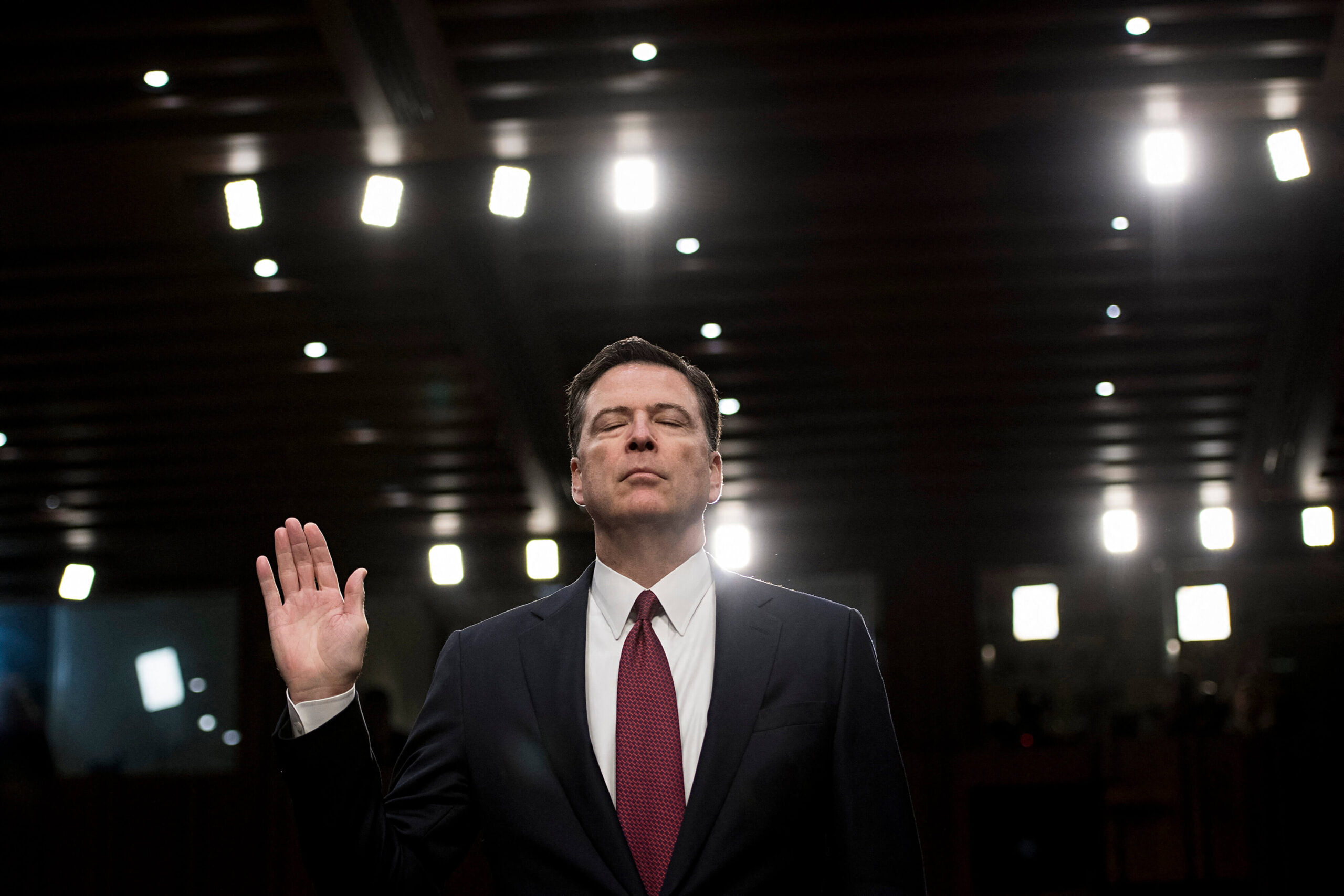
[Documented]: In September 2025, more than eight years after the underlying conduct, a federal grand jury indicted former FBI Director James Comey on charges including making false statements to Congress and obstruction of a congressional proceeding. In November 2025, a federal judge dismissed the indictment on the ground that interim U.S. Attorney Lindsey Halligan had been unlawfully appointed. This was a procedural ruling, not a finding on the underlying merits, and DOJ has signaled it may attempt to re-indict through a properly appointed prosecutor.
This sequence is this article’s thesis in miniature: an eight-year delay, followed by an attempt at accountability that was itself undone by a process failure, illustrates how difficult it becomes to prosecute cleanly once a case has gone cold for the better part of a decade. It also shows how an accountability effort that finally arrives can end up looking rushed and procedurally vulnerable rather than vindicated.
HUNTER BIDEN
[Documented]: Hunter Biden joined the board of Ukrainian energy company Burisma Holdings in April 2014, within weeks of Russia’s annexation of Crimea and while his father, as vice president, held lead responsibility for U.S.–Ukraine policy. His board compensation, addressed in his own later testimony to the House Oversight Committee, has been documented at roughly $50,000 a month.
[Documented]: Devon Archer, Hunter Biden’s former business partner, testified to the House Oversight Committee in July 2023 that Hunter Biden placed his father on speakerphone with foreign business associates on approximately twenty occasions—testimony cited as evidence Hunter was selling access, real or perceived, to his father’s office.
[Documented]: IRS whistleblowers Gary Shapley and Joseph Ziegler testified before Congress in 2023 that DOJ leadership slow-walked and constrained the Hunter Biden tax investigation. ultimately obtained a 2024 federal conviction on gun purchase charges and a related tax resolution. In December 2024, President Biden issued his son a sweeping, preemptive pardon covering roughly a decade of potential conduct, closing the matter before sentencing and foreclosing further inquiry. Vice President Biden separately pressed the Ukrainian government to remove Prosecutor General Viktor Shokin, telling a 2018 Council on Foreign Relations audience, on the record, that he had threatened to withhold a $1 billion U.S. loan guarantee unless Shokin was fired within six hours—a threat he said succeeded.
Note: the pardon is the starkest available illustration of one of this article’s premises—that where prosecution finally threatens to arrive, the political class retains a final mechanism, the pardon power itself, to convert delayed accountability into no accountability at all.
URANIUM ONE, AGAIN
[Documented]: The underlying transaction unfolded in stages between 2009 and 2013, as Rosatom, Russia’s state nuclear agency, acquired first a minority stake and eventually full ownership of Uranium One, a Canadian-listed company with U.S. mining operations. This was a deal that required the unanimous consent of the nine-agency CFIUS. During the same timeframe, the FBI was separately investigating a Russian nuclear industry bribery, kickback, and extortion racket run by Vadim Mikerin, a Rosatom subsidiary executive who pleaded guilty in 2015 to a money-laundering conspiracy. Court records and subsequently unsealed filings established that federal investigators had evidence of the scheme years before the Uranium One transaction received its final approvals, without that evidence becoming public or apparently reaching the CFIUS review itself.
[Documented]: Mining financier Frank Giustra, whose company was a predecessor to Uranium One and who was a longtime Clinton Foundation donor, contributed millions of dollars to the Foundation. Some of those contributions were not disclosed as the Foundation’s ethics agreement with the Obama administration required. Bill Clinton separately received a $500,000 speaking fee from Renaissance Capital, a Kremlin-linked Russian investment bank, within the same period Rosatom’s acquisition was under review.
To summarize: this matter involved a documented bribery scheme running concurrently with a multi-agency approval process, a Justice Department review under U.S. Attorney John Huber that was opened in 2017 and closed in 2020 without a final report, and a further DOJ look in 2025 that was itself reported stalled. Each of those junctures offered an opportunity to resolve the matter on the merits, and none did. The delay mechanism this article describes does not require the underlying allegation to be true; it only requires that the question keeps being reopened and never answered, which is precisely what has happened here across four administrations and sixteen years.
POLICY IMPLICATIONS
If delay is the mechanism that defeats deterrence, the corrective indicated by the same theory is not leniency but restored celerity, i.e., proportionate charges pursued as soon as evidence supports them, applied without regard to the target’s rank or party, and insulated as much as institutionally possible from the appearance of after-the-fact political score-settling that undermined the Comey prosecution.
The strongest version of an accountability argument is not a call for anything outside the legal system, but a demand that the law’s own existing penalties actually be used, promptly and evenly, rather than quietly waived for the well-connected. Advocacy for that standard—full, swift application of existing law—is what serious accountability should mean in practice.
CONCLUDING THOUGHTS
A central conclusion is that delay itself remains a central mechanism by which political accountability is defeated in the U.S. and that prosecutions now underway constitute a live, ongoing test of whether that pattern can still be broken once a case is old enough to have gone cold.
This matters because, whatever one concludes about any single case examined here, the cumulative effect of a public record this long and this unresolved is measurable in the distrust of the criminal justice system by a majority of Americans who also believe the law applies differently to the politically connected. Those perceptions will not be repaired by any single prosecution, however swift or severe. The real downstream cost is a public that no longer expects the system to answer the question of guilt or innocence at all, and that adjusts its own conduct and its own faith in institutions accordingly.
Read more The Left’s Rank Hypocrisy on ‘Socialist Influencers’