




The outlook for the Ukraine War looks grim as winter approaches. Russian missile and drone strikes are battering Ukraine’s energy infrastructure, with Black Sea ports disrupted, steel production halted, and rail systems strained. Kyiv is enduring almost round-the-clock drone and missile attacks. Ukrainian officials have urged some residents to leave their homes because heat and power may be in short supply. Ukrainian President Volodymyr Zelensky criticized a recent U.S. purchase of Russian diesel as a concession that undercuts Ukrainian leverage and said Russia kept striking Ukrainian energy facilities even after the energy ceasefire President Trump announced on October 12. Trump has said Ukraine needs new leadership. These tensions, set against an energy crisis and mounting civilian hardship, make a negotiated solution look remote.
Read more Book Excerpt: Trump’s New World Re-Order by Rod D. Martin
Nevertheless, President Trump’s Ukraine envoys, Steve Witkoff and Jared Kushner, are doggedly pushing ahead to test whether the war’s attrition and emerging stalemate might create an opening for a ceasefire.
Ukrainian General Oleksandr Syrskyi recently told the BBC that Ukrainian forces have largely stabilized the front and degraded Russia’s ability to advance. Russian territorial gains in the first half of 2026 were minimal. More striking is the shift in Russian casualties: according to the British Ministry of Defense, total losses have surpassed 1.5 million killed and wounded, with monthly figures around 40,000. Ukrainian commanders report that as many as 70 percent of Russian battlefield casualties are now deaths rather than wounds, driven by the density and precision of Ukrainian FPV drones. British intelligence estimates put Russian dead at roughly half a million. These enormous losses, combined with limited territorial progress, impose mounting pressure even as Russia prepares further mobilization.
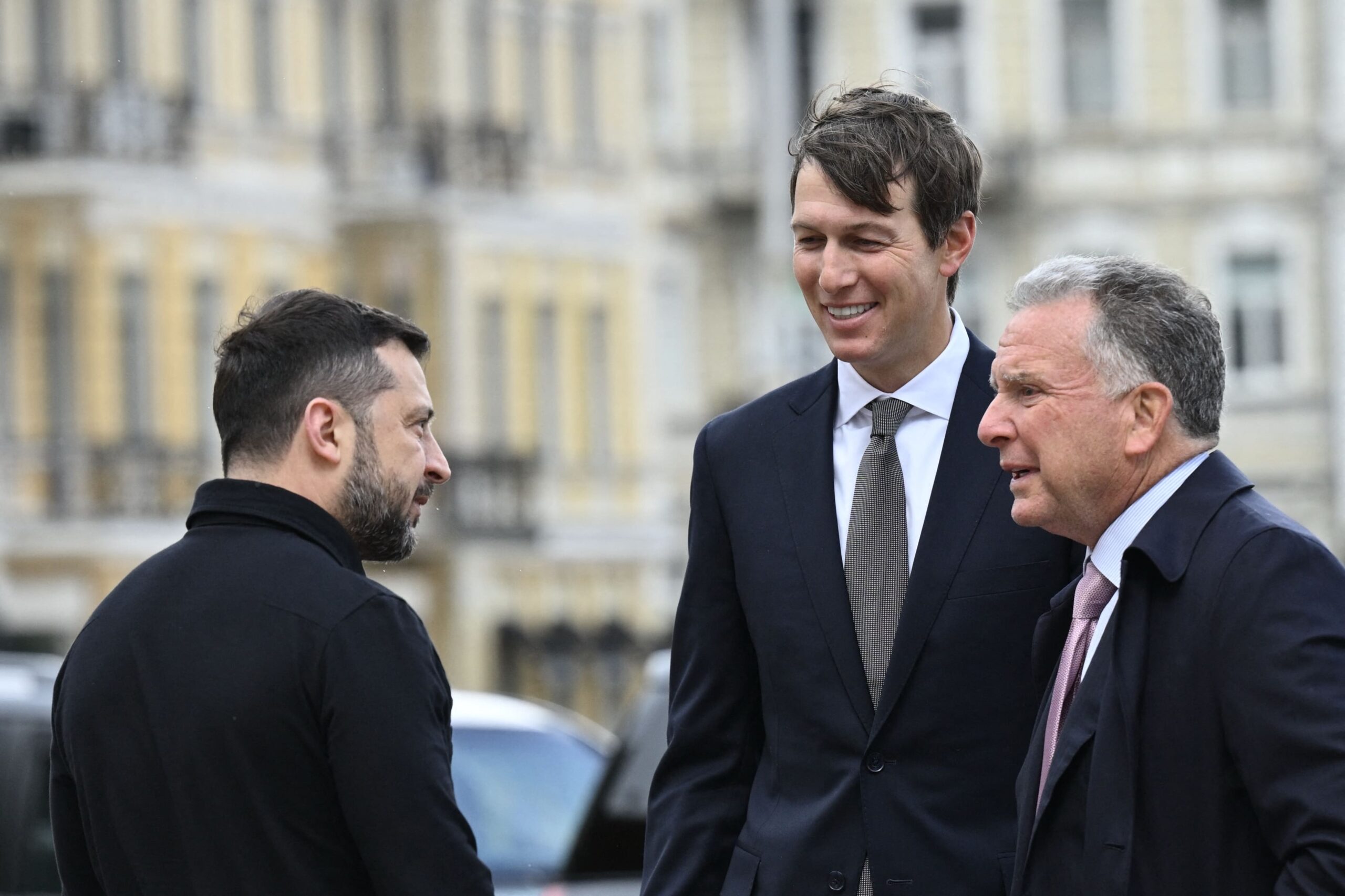
Witkoff and Kushner sought to explore that pressure during a meeting last week at Witkoff’s Shell Bay Golf Club in Florida with Ukrainian officials and representatives from the U.K., France, Germany, the European Union, and NATO. According to Washington Post foreign affairs columnist David Ignatius, the U.S. envoys outlined a broader package intended to “make the problem and the solution bigger”—moving beyond the immediate line of control to discuss postwar arrangements that could leave both sides better off than continued fighting. The talks, scheduled for two days, ended after one without a formal agreement.
The package has four main elements.
First, a reconstruction framework for Ukraine involving the World Bank and private capital to rebuild infrastructure, support veterans’ families, and restart the economy. This would require Kyiv to provide credible cost estimates and safeguards against corruption.
Second, security guarantees from the United States and European states that would function in practice like NATO’s Article 5 commitment, without admitting Ukraine to NATO—likely barring its membership for a decade or more.
Third, economic measures that would benefit both Ukraine and Russia, potentially including pipeline arrangements to restore Russian access to European energy markets, oil-revenue sharing with Ukraine, and sequenced sanctions relief.
Fourth—and most difficult—a ceasefire along the existing line of control, leaving Russia in possession of the territory it currently holds, including parts of the Donbas, while Ukraine retains the portions Russia has been unable to seize.
Both sides will find these elements hard to accept. Ukraine would need to accept, at least de facto, the loss of territory seized by force and a long delay in any path to NATO membership. Russia would abandon its maximalist aims, including its demand for all of the Donbas, and tolerate Western security guarantees for Kyiv.
Read more Elon Musk Takes Flight While the Left Takes Offense
The alternative, however, is a winter of intensified economic damage for Ukraine and continued high-casualty assaults for Russia. Syrskyi’s assessment of a more static front, reinforced by the rising lethality of Ukrainian drones, reduces the prospect of significant breakthroughs or total victory. The reconstruction and economic elements of the package could convince both sides to settle by giving each something positive to show its public beyond merely stopping the bleeding.
The hurdles to this plan are very high. The line of control continues to shift in small increments. Russia has repeatedly shown more interest in delay than in settlement. A source close to the Kremlin told Reuters that Putin will return to talks only after he controls the rest of the Donbas. Ukraine’s domestic politics, already strained by the military command shake-up and nationalist pressure, will resist a deal that formalizes any loss of territory. Zelensky faces huge opposition to any deal that cedes territory or looks like a win for Russia.
Ultimately, I believe the tipping point for a peace deal will come when Putin finally accepts that the war is unwinnable and his only chance for an honorable exit is through a deal with Trump. This should be the central theme of any Witkoff-Kushner negotiations with Putin.
A question I have raised with national security experts in the U.S. and the U.K. is how the United States and its European partners would protect a fragile ceasefire if one could ever be reached. I believe the West must be ready to act promptly to engage Russia to compel it to honor any agreement and to arm Ukraine heavily enough to deter Putin from restarting the war. I hope this is part of Witkoff and Kushner’s calculations.
I believe the current chances of a peace deal are low. But the combination of a battlefield stalemate, extraordinarily high and increasingly fatal Russian casualties, a severe energy crisis in Ukraine as winter approaches, and a diplomatic package built on mutual compromises could represent a small step forward. The main challenge will be convincing both sides that the proposed postwar architecture is worth painful territorial trade-offs.
Witkoff and Kushner’s chances of making progress will improve if all parties lower the temperature and allow negotiations to proceed quietly, without public statements, recriminations, or threats from leaders on either side or in Washington. The U.S. envoys have put a planned trip to Moscow on hold until Kyiv and the Europeans agree on a common proposal, and Ukraine has invited them to a new round of talks in Brussels this week. The odds may be long, but the mounting costs of continued war give both sides reason to look hard at a settlement.
* * *
Fred Fleitz is vice chair of the America First Policy Institute Center for American Security. He previously served as chief of staff of the Trump National Security Council.
Read more Delayed Accountability in the American Political Class, Part Two