






Managing the Muslim Brotherhood Rather Than Destroying It—And the Battle for Texas
Read more ‘Regime Change’ Requires Eradicating an Ideology
One of my mentors, whose name I will not use, was pulled into the American intelligence world in 1951 as a very young man, barely 20 years old. He came out of Army-based training and was taken into a life that placed him inside some of the darkest machinery of the Cold War. Korea, covert action, high-value targets, foreign networks, proxy wars—these were not abstractions to him. They were lived experiences.
Decades later, he is now in his 90s. Over one of our many coffee meetings, I asked him a question I thought was simple: “How do you destroy the Muslim Brotherhood?” He laughed and said, “What do you mean, destroy it? We created it.”
At first, I objected. The Brotherhood was founded in Egypt in 1928 by Hassan al-Banna. He waved that away. “Sure, but we amplified it tremendously.”
His point was not that the United States invented the Brotherhood at its origin. His point was that during the Cold War, Washington and its regional partners learned to treat political Islam as a usable force. Nasserism, Ba‘athism, Arab socialism, and secular military nationalism were often aligned with, or open to, the Soviet orbit. The Brotherhood and related Islamist networks were viewed through the old logic: the enemy of my enemy can be useful.
During the Cold War, Washington increasingly viewed political Islam through an anti-Soviet lens: not as a unified ideological threat, but as a usable force against Soviet influence and Soviet-aligned regimes.[1] That logic still serves Washington in many parts of the world. It still serves geopolitical balancing, intelligence relationships, regional leverage, energy security, and the management of unstable states. But what serves Washington abroad does not necessarily serve the backyard of Texas.
That is the distinction Americans now need to understand.
The Shell Game
The West never dismantled political Islam as a system. It learned to manage it.
Over time, that management strategy created confusion by design. The Muslim Brotherhood appears fragmented because fragmentation is the tactic. Western governments look for formal hierarchy, command structures, organizational charts, signed orders, and direct operational chains. But the Brotherhood does not operate like a Western corporation or military bureaucracy.
It operates like a distributed ideological system.
Political Party here. Charity there. Student organization here. Media arm there. Militant wing somewhere else. Every piece denies responsibility for the others. Every piece claims independence. Every piece says: that is not us.
The point is not simply to hide. The point is to make the West believe there is nothing unified to see.
That deception becomes especially dangerous when Western governments begin treating one part of the system—the so-called peaceful elements of the Muslim Brotherhood—as the cure for another: the violent kinetic elements, not understanding that they are one and the same.
One Operating Field
This is why major events cannot be viewed as isolated eruptions.
The 1993 World Trade Center bombing. September 11. The USS Cole. Hamas and Gaza. Islamist attacks across Europe. The Bondi massacre in Australia. The antisemitic atmosphere visible at Columbia University and other elite institutions. Even local controversies, such as allegations of antisemitism surrounding the Dallas school environment.
These events emerge from the same operating field: political Islam adapting itself to different environments, institutions, and jurisdictions while maintaining the same long-term civilizational direction.
The Center Is Doctrinal
The Brotherhood appears amorphous because its center is not corporate. It is doctrinal.
The system does not require a headquarters, yet it has several around the world, including in the United States, because its organizing logic comes from political Islamist readings of the Quran, Hadith, and Sirah, expressed through concepts such as civilizational jihad, , offensive jihad—tactical warfare adapted to the context of each battle arena. The tactics change by place and circumstance, but the strategic direction remains the same: the expansion of political Islam as a governing order, ultimately organized around the idea of a caliph and a caliphate.
Founded by Hassan al-Banna in 1928 after the Ottoman collapse, the Muslim Brotherhood was not merely a religious movement. It was a strategic answer to defeat: a disciplined effort to restore Islamic political power through a global caliphate. From long-bearded militants with AK-47s in the mountains to the new generation of jihadis in suits, the branches differ, but the root is the same. One mission. One tree. One civilizational project.
This transcends how Western institutions are trained to think about organizational structure.
The Western mind looks for hierarchy, paperwork, institutional liability, and direct chains of command. But this system operates through shared doctrine, shared interpretation, and shared end-state.
That is why it is so difficult for Western governments to classify correctly.
The Outer Shield of the War Machine
Most Muslims are not extremists. Most are ordinary people trying to live moral and religious lives according to the religious understanding they receive through family, mosque leadership, scholars, and community institutions. But that reality also creates structural protection for the larger machine.
Because the Quran, Hadith, and Islamic jurisprudence require deep study, most believers rely on religious authority structures for interpretation. From their perspective, these authorities are legitimate custodians of faith and moral order. That creates a hierarchy through which narrative, grievance, and political framing can flow from the top down.
Political Islamist movements can exploit this structure. Criticism of Islamist networks can then be reframed as criticism of Muslims themselves. Accusations of “Islamophobia” become both a shield and a deterrent, creating paralysis across politics, media, academia, and law enforcement.
Weak politicians often understand this privately but refuse to confront it publicly for fear of social backlash, reputational destruction, or losing votes. The result is a system in which difficult questions are avoided long after the underlying problem becomes visible.
The peaceful outer community therefore becomes the public face—and the protective barrier—of the inner political machine, even when many ordinary Muslims are themselves trapped inside it.
The first victims of political Islam are frequently Muslims themselves. Opposing entrenched Islamist power structures can mean ostracism, intimidation, exile, imprisonment, or death. Many are not participants in the machine; they are living under its pressure.
At the geopolitical level, Western strategists have long believed these tensions could be managed, redirected, or contained as part of broader regional balancing. But the divide is not accidental. Political Islam depends on it. It cultivates grievance, polarization, and asymmetric pressure because division itself becomes a strategic asset.
The issue, therefore, is not Muslims as a people. Most Muslims are not hardened Islamists; in fact, most are bad at being hardened Islamists precisely because they are not living according to the totalizing political-war doctrine embedded within Islamist interpretations of Islam. They are trying to live ordinary religious lives.
But from the point of view of the war machine, that distinction is strategically irrelevant. Peaceful Muslims may see themselves as separate from political Islam, and morally they are. But political Islam can still use them as cover, leverage, mass, legitimacy, and deterrence. That is what makes the Islamic war machine one: not because every Muslim consciously serves it, but because the machine can absorb the peaceful majority into its shield whether they consent to that role or not. The danger lies in ideological movements that understand how to fuse belief, politics, institutional cowardice, narrative control, and long-term strategy into a durable war machine.
Qatar and Texas
Qatar is the principal nation-state platform for the Muslim Brotherhood.
The Brotherhood supplies the ideological architecture and the global network. Qatar supplies the state platform: money, media, diplomacy, education, energy leverage, legal cover, elite access, and institutional protection.
Texas now sits inside that network.
Qatar’s penetration of Texas is not theoretical. Texas A&M at Qatar gave Qatar Foundation broad ownership rights over intellectual property developed through the Doha campus, while the campus also partnered with Qatar’s Ministry of Defense-linked Reconnaissance and Surveillance Center on drone, surveillance, software, control-systems, and UAV-related research and training.
Add to that Qatari funding of Arabic and cultural programs in Texas schools, QatarEnergy’s 70 percent stake in Golden Pass LNG in Sabine Pass, and Qatari-linked investments in Texas-connected energy infrastructure, and the pattern becomes clear: Qatar is not outside Texas. Qatar is inside the Texas institutional landscape.
More broadly, Qatar has poured billions into the United States to shape the minds of a generation through universities, businesses, cultural programs, policy institutions, media influence, and elite access.
Unfortunately, the situation is made even more complicated by the geopolitical reality that Europe became increasingly dependent on Qatari natural gas after Russian energy flows were disrupted during the Russia–Ukraine war. That dependency has deepened Western reliance on Qatar at the exact moment when serious questions about Qatar’s long-term role in supporting and enabling Islamist movements should have been receiving greater scrutiny.
But what may serve broader geopolitical balancing does not necessarily serve Texas. Those are not always the same interests.
The issue is cumulative penetration: education, research, energy, technology, diplomacy, business, and political access.
Texas is not dealing with a foreign-policy abstraction. It is dealing with a local operating environment.
Texas Is the Front Line
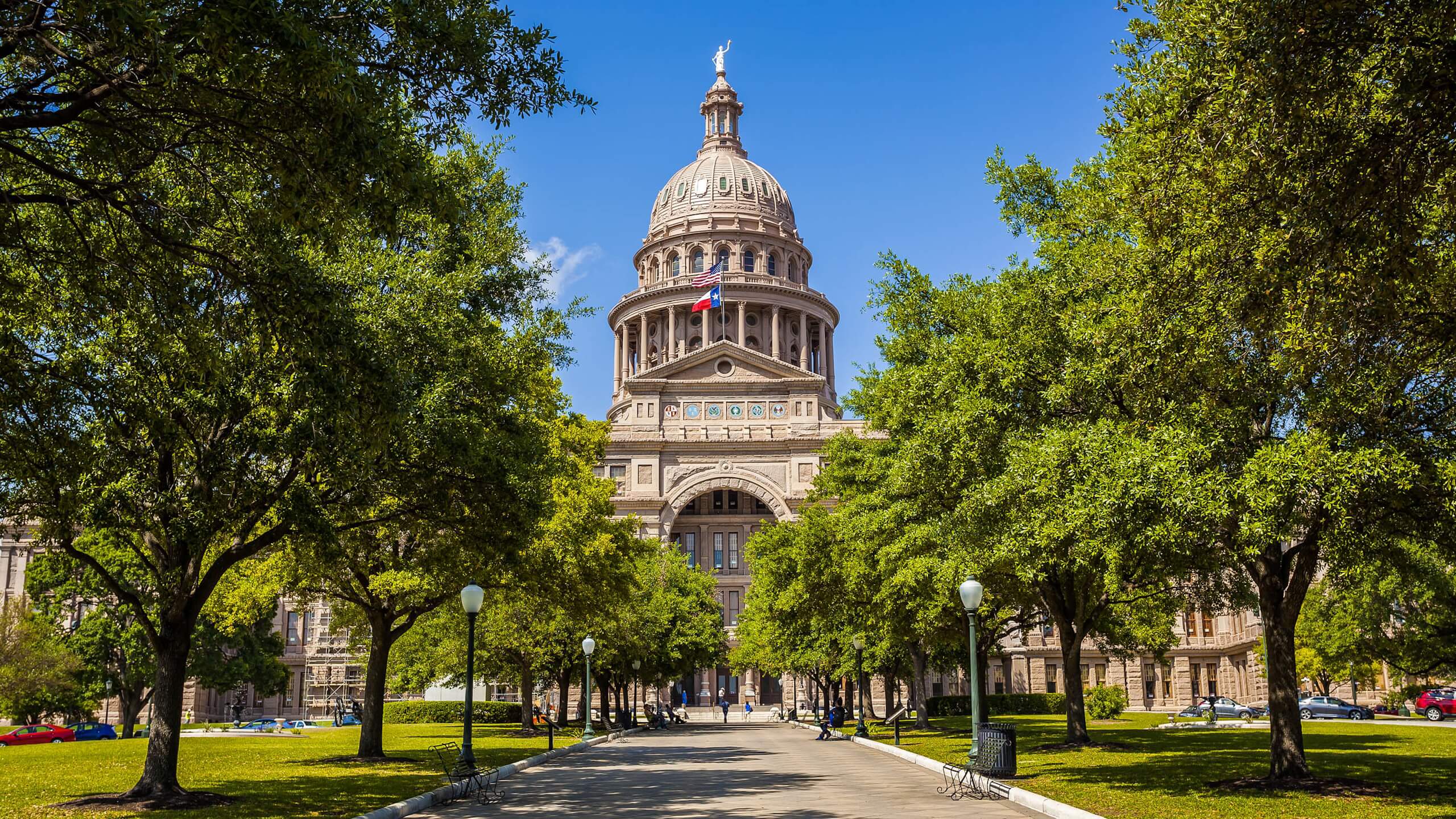
This is why the fight unfolding in Texas matters.
Texas, not Iran, is the frontline in the struggle over political Islam inside the United States.
The objective is not simply influence abroad. It is long-term institutional influence inside America itself. Any serious attempt at that begins with Texas.
Governor Greg Abbott and Attorney General Ken Paxton designated the Muslim Brotherhood as a terrorist organization at the state level. But the Trump White House designated only specific branches: Egypt, Jordan, and Lebanon.
Now think that through for a second.
Once multiple definitions are introduced—violent branches here, peaceful branches there—the shell game becomes institutionalized. Groups operating inside the United States can then argue that the “real extremists” exist only somewhere overseas and have nothing to do with domestic networks.
Russia, whatever one thinks of Moscow, did not make that distinction after years of Islamist terrorism on its own soil. Following atrocities such as the 2002 Moscow theater hostage crisis, its Supreme Court listed Bratʹya-musulʹmane» / «al-Ikhwān al-Muslimūn (Muslim Brothers” / “Al-Ikhwan al-Muslimun) as a terrorist organization in 2003.
CAIR, identified in Holy Land Foundation documents as part of the Brotherhood’s broader legal and advocacy ecosystem, is now suing Texas. The central issue becomes definition itself.
If Texas cannot define what the Muslim Brotherhood actually is, then every domestic branch can claim to be the peaceful branch.
And if Texas loses this fight, the consequences will not remain in Texas. A precedent will be established that allows Brotherhood-linked organizations to continue expanding state by state while always claiming that the extremists exist somewhere else.
The shell game continues.
I know what many Americans are thinking at this point. We are not Russia. And that instinct is a good one. We are Americans. But the lesson many people draw from that distinction is the wrong one.
The point is not that the United States must become authoritarian to defend itself. The point is that America already possesses the legal architecture, investigative capability, and constitutional authority necessary to confront organized political warfare if it chooses to define clearly where religion ends and a coordinated ideological machine begins. America is not powerless. Texas is not powerless.
The deeper problem is that for decades the signal has been buried beneath institutional fog by people whose incentives are tied not to resolution, but to management and, of course, the advancement of their own personal careers. The system folds back upon itself like a serpent feeding on its own tail, consuming truth carefully enough that the machinery surrounding the problem may continue to live from it.
And so the public is taught to stare at fragments instead of systems, incidents instead of doctrine, symptoms instead of architecture. The result is paralysis disguised as sophistication.
The Intelligence Problem
What makes this problem even more dangerous is that the intelligence layer underneath it is not irrational.
From the standpoint of statecraft and counterterrorism, the logic appears internally coherent. Intelligence agencies must simultaneously manage geopolitical relationships, maintain regional stability, and prevent another kinetic terrorist attack inside the United States.
That pressure creates incentives to work with the so-called “peaceful” elements of the Brotherhood in order to understand and contain the violent ones.
But intelligence agencies do not operate alone. Surrounding them is an entire think tank, policy, academic, consulting, media, and lobbying industrial complex that functions as the outer shell of the American intelligence architecture.
That industrial complex shapes the assumptions, frameworks, and “acceptable” interpretations that eventually become government policy.
The result is that political Islam continues to be analyzed as fragmented actors rather than as a unified adaptive system—a framework that may serve the needs of Washington and clearly serves the Muslim Brotherhood but does not currently serve the needs of Texas.
This does not require conspiracy. Institutions protect their own frameworks naturally.
The problem is the Washington system itself: intelligence officials, think tanks, contractors, consultants, lobbyists, media networks, and government officials all reinforcing the same assumptions until those assumptions harden into doctrine—and, of course, the politicians compromised through Muslim Brotherhood-funded super PACs, or those who choose to look the other way for fear of accusations of “Islamophobia.”
Those assumptions become white papers, briefings, expert testimony, media narratives, and eventually policy.
When that industrial complex decides the Muslim Brotherhood should be managed rather than dismantled, that logic eventually reaches the White House.
This is not a malfunction of the system. It is the system.
Their job is to stop the next attack. So they turn to the so-called “peaceful” elements of the Brotherhood to help them understand the violent ones.
There is a logic to that. But when has the United States ever won that exchange?
Osama bin Laden, who lived and died as a Muslim Brother, is simply the clearest example of what happens when Washington convinces itself it can manage one part of the system against another.
Washington grabs the gi and believes it has control. The Brotherhood grabs back, changes the angle, and leaves America in a worse position every time.
Many think tanks also have a vested interest in perpetuating the problem. If the problem were truly solved, entire institutional ecosystems would lose relevance, funding, influence, and purpose.
Our Green Berets understand a different motto: work yourself out of a job. They are not trying to perpetuate a problem. They are trying to solve it.
That is precisely the spirit Texas needs now.
The point is not to manage this problem forever. The point is to lower the noise, find the signal, and solve it.
But complexity gets added where clarity is needed.
Complexity becomes obfuscation.
Cutting Through the Noise
Let me leave you with two things so you can cut through the noise and get to the signal.
First: anyone telling you the Muslim Brotherhood is meaningfully cut into separate, unrelated segments is preserving the shell game and should be viewed with deep suspicion.
One example is Lorenzo Vidino, one of the most widely cited Western scholars on the Muslim Brotherhood. Vidino repeatedly distinguishes between violent and nonviolent branches, political and militant wings, lawful and unlawful actors, particularly inside the West.
In his 2011 paper, “,” Vidino warned against viewing the arrival of Brotherhood figures in Europe and North America as “a concerted and arcane plot” or as the result of a centralized plan. In his Lawfare essay, “Should the Muslim Brotherhood be Designated a Terrorist Organization?”, he argued that any designation should be confined to a specific Brotherhood chapter engaged in violence, not extended to Brotherhood entities elsewhere that “might have nothing to do with terrorism.” And in “The Muslim Brotherhood’s Pan-European Structure,” the framework shifts again into the language of “Muslim Brotherhood-influenced networks,” a phrase that softens the question of unified ideological command into a more ambiguous landscape of influence, affiliation, and proximity.
Years later, reporting on the Abu Dhabi Secrets and Alp Services controversy placed Vidino inside a broader UAE-linked research and influence ecosystem aimed at both Qatar and the Muslim Brotherhood. That does not answer the question by itself. It sharpens it. Did Vidino’s position genuinely evolve over time, or did it evolve according to the interests of those commissioning the research? If his earlier framework minimized the Brotherhood as a unified system, and later work became more useful to an anti-Brotherhood patronage network, then Americans are entitled to ask a simple question: which master is being served currently?
That distinction is the entire battlefield.
Eric Trager of the Washington Institute for Near East Policy has taken a similar approach for years. In multiple writings, Trager acknowledges the Brotherhood’s violent ideology, its historical “Secret Apparatus,” and even its encouragement of jihadist activity, while simultaneously arguing against broad terrorist designation and framing key Brotherhood-linked operations such as the Salsabeel case as regime persecution rather than evidence of an active covert infrastructure. The pattern remains the same: acknowledge enough of the violence to maintain credibility while stopping short of identifying the Brotherhood itself as the incubator.
Second: anyone telling you Qatar is not central is moving you away from the center of gravity should be viewed with equal suspicion.
Qatar is not peripheral; Qatar is the principal nation-state platform for the Brotherhood.
Michael Doran of the Hudson Institute is a very knowledgeable and educated man. He often provides useful analyses regarding Iran, Hamas, and failures of American foreign policy.
Yet when it comes to Qatar itself, Doran becomes remarkably restrained and tepid.
That restraint is visible in the way Qatar is handled in his own Qatar-related commentary. In “Israel Update: The Qatar-Gate Hoax,” the emphasis is not Qatar as a central operating platform for Hamas, the Brotherhood, and regional Islamist networks, but the alleged political misuse of the Qatar issue inside Israel. In “Why Trump Let Netanyahu Strike Hamas in Doha,” Qatar appears largely as the diplomatic stage on which Washington, Netanyahu, Hamas, and regional actors maneuver, rather than as the central strategic problem itself. In “After Gaza,” Doran rightly identifies Iranian support for Hamas, but the framing again pushes the center of gravity toward Iran’s Axis of Resistance while leaving Qatar’s role comparatively underdeveloped.
But Qatar is both the arsonist and the firefighter.
The deeper issue is not merely that Qatar acts as a mediator for the West. Qatar has positioned itself as the nation-state platform through which the various limbs of political Islam can be hosted, financed, legitimized, and negotiated for simultaneously. A state possessing effectively limitless natural-gas wealth, diplomatic immunity through strategic Western partnerships, elite institutional access, and one of the most influential Arabic-language media platforms on earth is not functioning merely as a mediator.
In strategic terms, it becomes a weapon of mass destruction.
- Qatar has hosted Hamas’s political office in Doha since 2012, while simultaneously presenting itself as an indispensable Western mediator.
- Qatar has been one of Hamas’s primary financial and political backers, providing support under the cover of the Palestinian cause.
- Qatar hosted the Taliban political office in Doha, which became central to U.S.-Taliban negotiations and diplomacy.
- Qatar has maintained relationships and channels with Hamas, Iran, and Brotherhood-linked movements, while broader regional reporting has treated those connections as part of a wider political-Islamist operating field.
- Qatar has poured enormous sums into American universities, cultural institutions, lobbying operations, media influence, and elite-access networks throughout the United States.
- Qatar’s state-aligned media ecosystem, especially Al Jazeera, has provided ideological amplification and narrative protection for Islamist movements throughout the Middle East and the West.
Whatever accurate observations Doran makes about Islamist influence networks become strategically incomplete if the primary state platform enabling many of those networks is treated with caution or diplomatic delicacy.
One cannot seriously analyze the architecture of modern political Islam while refusing sustained scrutiny of the state that has simultaneously financed, hosted, mediated, legitimized, amplified, and internationalized many of its most consequential actors.
And if one cares about the United States—and specifically Texas—one must ask: what is motivating Michael Doran?
Could it be selective amnesia on his part?
Perhaps.
Framing matters more than isolated facts. Analysts can provide accurate information while still steering attention away from the operational center of gravity.
The most dangerous analyst is not always the one who lies. Sometimes it is the one who gives you true data points while steering you away from the conclusion that Qatar itself is essential. In that case, the analyst has not clarified the problem. He has narrowed the battlefield and created more confusion for Americans.
Separating Iran, Hamas, Qatar, and the Brotherhood into entirely distinct problems plays directly into the strategy itself. Even the Sunni-Shia split is not properly understood in the West: after 1979, Brotherhood figures (Sunni in origin) openly supported Iran’s revolution (Shia) and later scholarship has traced the influence of Sayyid Qutb on Khomeini and Khamenei, including Arabic analyses of Quṭb wa-al-Fikr al-Īrānī al-Muʿāṣir (Qutb and Contemporary Iranian Thought) and the al-Ikhwān wa-al-Thawrah al-Khumaynīyah (The Muslim Brotherhood and the Khomeinist Revolution) The system survives by forcing the West to divide what should be analyzed together.
Texans should insist on clarification from all the mentioned gentlemen above—and there are many others like them—because we are not at a Georgetown cocktail party, drowning in the echoes of “on the one hand . . . but then on the other,” where consequences are cheap. This is war. And standing in the grey too long becomes an unforgiving place, where one’s true nature is stripped bare and revealed by those who may have stood outside that ecosystem all along—or inside it, long enough to become finished with the charade—and who now understand, with total clarity, which side they are on.
The Brotherhood is one system. It is not cut into separate pieces. It is one ideological project operating through different tactics in different environments.
Its goal is not simply influence. Its end-state is civilizational: the expansion of political Islam as a governing framework.
The branches are not separate destinations; they are different roads to the same destination.
A Lesson from America’s Past for a Sharia-Free Texas Future
America has dealt with this before.
Stephen Decatur became the American symbol of refusing tribute to Islamic pirate powers.
The Barbary Muslim corsair states enslaved captives, raided European coasts, preyed on Christian and American shipping, and demanded tribute as the price of peace.
America tried treaties first. It did not work.
In 1804, after Tripoli captured the USS Philadelphia, Decatur led a nighttime raid into Tripoli harbor, burned the captured ship, and escaped.
In 1815, he returned with an American squadron, captured Algerian vessels, forced the Dey of Algiers into a treaty, secured the release of American captives, and ended American tribute.
The lesson was simple: America would not pay Islamic pirate states to stop enslaving its sailors and extorting its commerce.
Decatur brought guns, ships, and consequences.
Texas should remember that lesson. The answer is not endless management, endless white papers, and endless Washington complexity. The answer is clarity, courage, and the removal of compromised elements from Texas institutions.
We have faced this kind of tribute system before.
We stopped paying.
The only difference is that Decatur was not dealing with a think tank industrial complex tied to the deep state inside America’s intelligence agencies—a complex that obfuscates the truth, adds unnecessary layers of difficulty, and makes the problem appear impossible to solve when, in fact, it is not.
Texas, no one is coming to save you from Washington, D.C.—not the think tanks, nor their deep-state counterparts in the intelligence agencies.
Apply the litmus test I have empowered you with. That is how you will differentiate between a true friend of Texas and one that is using you while serving another master.
Your attorney general, your governor, and your local politicians need to be correctly educated by a group of experts serving Texas and defending Western civilization—and no one else—whose only priority is to eradicate this problem from Texas and the rest of the United States, not perpetuate it.
You must pressure them to take care of this problem from the ground up and serve as an example to the rest of the United States in what I consider to be the most important war of the 21st century.
Texas has enough laws on the books and can create others through the legislative process to get this job done.
But Texas must win the court case.
If Texas falls, the Barbary pirates Stephen Decatur once confronted will not remain a memory from America’s past.
They—and the political Islamic ideology that guides their being—will grow exponentially in the heartland of the United States.
The General Who Transcended Death
Who today still fights for Napoleon? Who still fights for Alexander the Great? Who still fights for Genghis Khan or Caesar as living commanders of history? No one.
But nearly 1,400 years after the death of the Prophet Muhammad, men still fight in his name, organize around his example, and claim political authority through the civilization he founded. Muhammad was not merely a religious figure. He was one of the most consequential military and political commanders in world history. Unlike the conquerors whose empires died with their bodies, his model of rule, war, law, and civilization survived death and continues to animate movements that seek political power across the world.
That is what Texas must understand.
Lone Star State
The Muslim Brotherhood came to Texas not because Texans are weak, but because Texans are good. Texans mind their own business. Texans live and let live. Texans believe that faith, family, enterprise, and local community can coexist without domination from above.
That goodness is strength. But goodness without clarity becomes vulnerability.
For Texas to win this war, the good people of Texas do not need to become authoritarian. They do not need to abandon their Constitution. They need to become properly equipped with understanding: Who the enemies are, how political Islam operates, and, most importantly, the enemy within our gates who preserve confusion for their own advantage and have kept the state and the country from seeing the battlefield clearly.
Selected Sources & References
- CIA: The Muslim Brotherhood and Arab Politics
- CIA: Islam and Politics – A Compendium
- CIA: Comments on the Islamic Colloquium, Princeton, 1953
- Mohamed Akram – An Explanatory Memorandum on the General Strategic Goal for the Group in North America
- Sénat français – Radicalisation islamiste: faire face et lutter ensemble
- Texas Designation Announcement
- State Department Designations
- ФСБ: Единый федеральный список террористических организаций
- The 2002 Dubrovka and 2004 Beslan Hostage Crises
- Texas A&M Qatar Intellectual Property Reporting
- Golden Pass LNG / QatarEnergy
- Sky News Arabia – Hamas Leaders in Doha
- Al Ain – Qatar Funding and Brotherhood-linked Networks
- The National – Taliban Doha Office
- Al Ain – Qatar and the Muslim Brotherhood
- Al Ain – Qatar and Brotherhood-linked Activity in Europe
- Al Ain – Al Jazeera, Qatar, and Islamist Narrative Framing
- Lorenzo Vidino – Should the Muslim Brotherhood be Designated a Terrorist Organization?
- Lorenzo Vidino and Sergio Altuna – The Muslim Brotherhood’s Pan-European Structure
- The New Yorker – How a Private Swiss Bank and a Ragtag Band of Spies Helped the UAE Spy on Its Enemies
- Michael Doran – Israel Update: The Qatar-Gate Hoax
- Michael Doran – Why Trump Let Netanyahu Strike Hamas in Doha
- Michael Doran – After Gaza
- Eric Trager – Overplaying Its Hand
- Eric Trager – From Opposition to Power
- Eric Trager – Who’s Who in Egypt’s Muslim Brotherhood
- Eric Trager – Egypt’s Muslim Brotherhood Gets a Facelift
- ثروت الخرباوى: مسلسل الاختيار شتت الإخوان
- خفايا التعاون مع المخابرات المركزية
- Why Sayed Qutb inspired Iran’s Khomeini and Khamenei
- أثر سيد قطب في الفكر الإسلامي الإيراني المعاصر
- علاقة الإخوان بالثورة الخمينية في إيران
[1] See CIA: The Muslim Brotherhood and Arab Politics; CIA: Islam and Politics—A Compendium; CIA: Comments on the Islamic Colloquium, Princeton, 1953; Khafāyā al-Taʿāwun maʿa al-Mukhābarāt al-Markazīyah (The Secrets of Cooperation with the Central Intelligence Agency).
Read more Pentagon Cuts Recognized Religious Codes From More Than 200 to 31
* * *
“Elias Cohen” is an alias.