







Justice Ketanji Brown Jackson’s concurrence in the Supreme Court’s birthright citizenship decision, Trump v. Barbara, contains one of the most revealing passages ever written about the Declaration of Independence. Invoking its famous proclamation that “all men are created equal,” she suggests that America’s founding commitment to human equality points inexorably toward universal citizenship.
Read more Los Angeles Dodgers Donate $1.1 Million to Pro-Immigration Groups After ICE Raids
The sentiment may be admirable, but the logic is profoundly mistaken.
Justice Brown’s concurrence rests on an assumption the Founders themselves never accepted: that the principle of universal human equality is incompatible with the sovereign authority of a people to define the boundaries of their own political community.
The American Founding rested comfortably on both propositions.
The first is that every human being possesses equal natural rights because every person is created by God with equal moral worth.
The second is that every sovereign nation possesses the authority to determine who belongs to its political community.
The Founders embraced both ideas simultaneously. Justice Brown’s concurrence treats them as mutually exclusive.
That is not what the Declaration says. It is not what the Founders believed. And it is not what the Fourteenth Amendment accomplished.
The Declaration Presupposes Distinct Political Communities
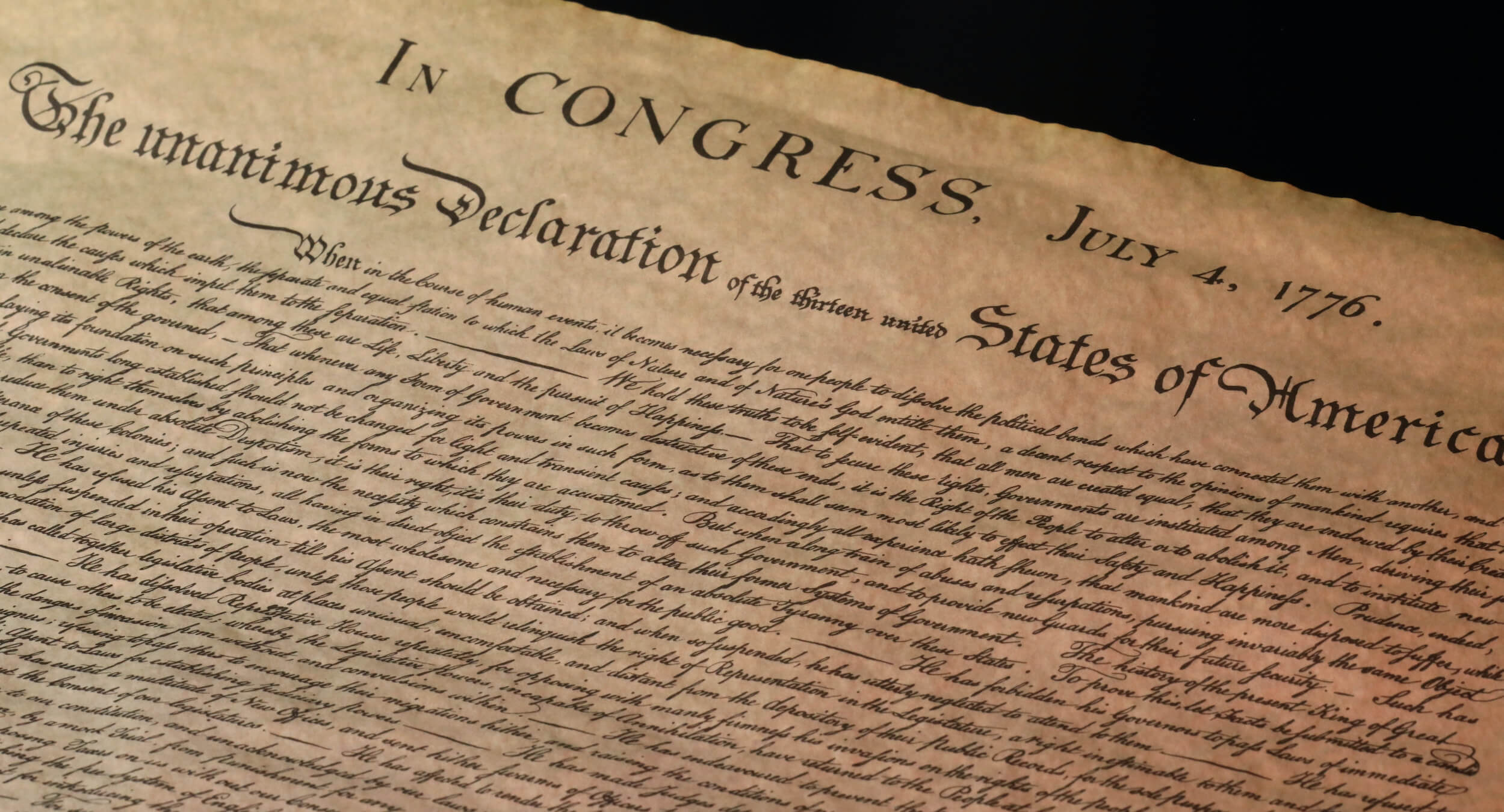
Justice Brown quotes the Declaration’s second paragraph. But its opening paragraph establishes the premise that makes the rest of the document intelligible.
The Declaration begins:
“When in the Course of human events, it becomes necessary for one People to dissolve the Political Bands which have connected them with another…”
Before Jefferson ever proclaimed that all men are created equal, he recognized the existence of distinct political communities—”one People” separating themselves from “another.”
That distinction is not incidental. It is the entire purpose of the Declaration.
The document repeatedly refers to “these Colonies,” “Free and Independent States,” and “the good People of these Colonies.” It concludes by declaring that those states possess “full Power to levy War, conclude Peace, contract Alliances, establish Commerce, and to do all other Acts and Things which Independent States may of right do.”
Those are the defining powers of sovereignty.
Among them is the authority to determine who belongs to the political community exercising those powers.
Nothing in the Declaration suggests that recognizing the equal natural rights of all mankind abolishes that authority. Quite the opposite. The Declaration assumes throughout that separate peoples may govern themselves while acknowledging the equal humanity of all.
The Declaration answers one question: What makes government legitimate?
It does not answer another: Who constitutes the people that establish it?
Justice Brown’s concurrence conflates the two.
Locke, Vattel, and the Founders Drew the Same Distinction
The distinction between natural equality and political membership was not unique to Jefferson.
It was a commonplace of eighteenth-century political thought.
John Locke began with mankind in a state of nature, where all persons are naturally “equal and independent.” But political society arises only when individuals consent to unite into a commonwealth. Natural rights belong to every human being. Citizenship belongs only to those who become members of a particular political society.
Emer de Vattel’s “Law of Nations“—perhaps the single most influential work on international law in the founding era—made precisely the same distinction. Every nation owed duties of justice to foreigners because all human beings possess natural rights. Yet every nation also retained the sovereign authority to determine who were its citizens, who might enter its territory, and under what conditions foreigners might become members of the political community.
The Founders knew these works well. John Locke’s “Second Treatise” and Emer de Vattel’s “Law of Nations” were among the most influential works of political theory and international law available to the Founding generation. Benjamin Franklin thanked Charles Dumas for sending copies of Vattel in 1775, observing that “the circumstances of a rising State make it necessary frequently to consult the law of nations” and noting that the volume “has been continually in the hands of the members of our Congress.” George Washington himself borrowed Vattel’s “Law of Nations” from the New York Society Library shortly after becoming President (and reportedly never returned it!). The Founders were therefore thoroughly familiar with a body of political thought that reconciled universal natural rights with the sovereign authority of nations to determine their own political membership.
Justice Brown’s concurrence effectively treats those principles as irreconcilable.
The Founders never did.
The Founders Practiced What They Preached
History provides even stronger evidence.
The very generation that proclaimed all men are created equal immediately enacted laws distinguishing citizens from aliens.
Read more DOJ Sues Virginia Over Assault Weapons Ban
The First Congress adopted the Naturalization Act of 1790 establishing the requirements by which foreigners could become American citizens. Congress revised those requirements in 1795 and again in 1798.
The federal government issued passports only to American citizens.
It negotiated treaties recognizing distinctions between citizens and foreign nationals.
It required oaths of allegiance before immigrants became members of the American political community.
No one suggested these laws contradicted the Declaration of Independence.
No one argued that limiting citizenship denied the equality of mankind.
No Founder claimed that proclaiming universal natural rights deprived the American people of authority to define their own political community.
To the contrary, they regarded those propositions as perfectly compatible.
Equality explained why governments derive “their just powers from the consent of the governed.”
Citizenship answered a different question: Who are “the governed”?
The Fourteenth Amendment Changed Many Things—But Not This One
The Fourteenth Amendment fundamentally transformed American constitutional law.
It repudiated the Dred Scott decision by guaranteeing citizenship to formerly enslaved persons born within the United States and subject to its jurisdiction.
It established a national baseline for citizenship that states could no longer deny.
But nothing in the debates surrounding the Amendment suggests that its framers believed they were abolishing the distinction between universal human equality and membership in the American political community.
Indeed, the Citizenship Clause itself reflects the opposite understanding.
It does not say that every human being possesses an inherent right to American citizenship.
It identifies the conditions under which citizenship attaches to those born in the United States—conditions that include being “subject to the jurisdiction thereof,” language that itself presupposes a distinction between those fully within the American political community and those who are not.
The framers of the Fourteenth Amendment were expanding citizenship within the American polity.
They were not abolishing the concept of an American polity.
A Logical Error With Significant Consequences
Justice Brown’s reasoning ultimately proves too much.
If equal human dignity itself determines citizenship, why should birthplace matter?
A child born in Paris possesses precisely the same human dignity as a child born in Pittsburgh.
If equality alone answers the citizenship question, then Congress would seemingly lack authority to distinguish between them.
Yet no one—including Justice Brown—believes that.
The reason is simple.
Equality answers one question.
Citizenship answers another.
The Declaration teaches that every human being possesses equal natural rights.
The Constitution establishes the institutions through which one particular people govern themselves.
The Founders never believed those principles were in conflict.
Indeed, Jefferson answered the question in the very first sentence of the Declaration. Before proclaiming the equality of all mankind, he explained that “one People” may dissolve the political bands connecting them with another. The Declaration thus begins not with universal citizenship, but with the existence of distinct political communities exercising the right of self-government.
Read more California Democrats Block Bill Barring Registered Sex Offenders From Public Office
Justice Brown quotes the Declaration’s second paragraph.
The rebuttal to her argument appears in its first.