









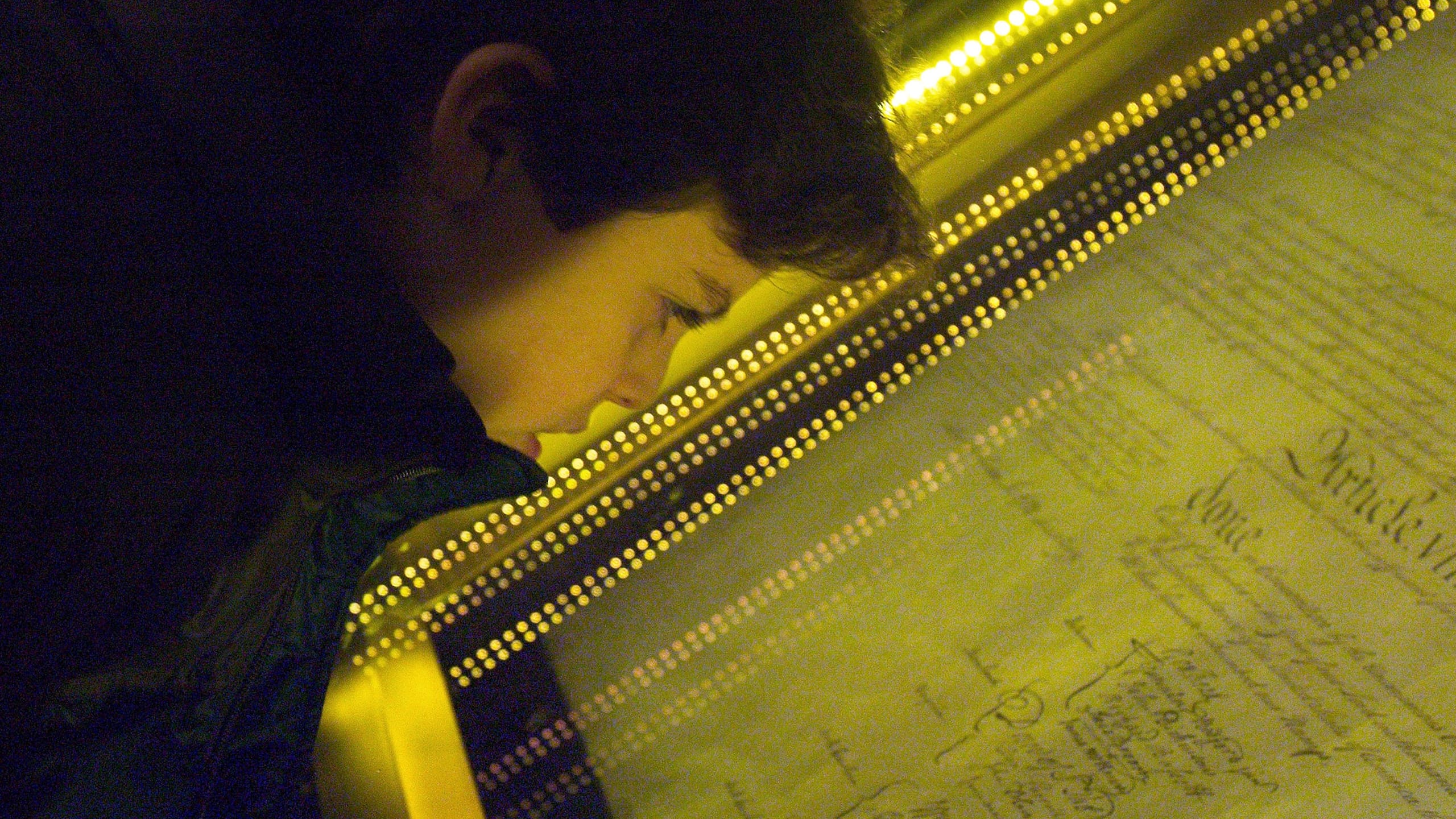
I no longer have the souvenir shop faux-aged, browning copy of the Declaration of Independence or the postcard of President Lincoln, both of which my parents purchased for me on our lone family trip to Washington, D.C. I bought the copy of the Declaration because it looked cool and I liked to read, and the postcard because, at the time, I attended Lincoln Elementary. (I believe my brother bought a copy of the Constitution and a miniature 18th-century artillery piece, which, in hindsight, perhaps, portended his later choice to become a bass player.)
Read more Clancy Holdout Juror Issues Statement: ‘I Didn’t Have Any Doubts’
I recall my parents happily purchasing these items for me, especially the faux Declaration of Independence. Though I was in elementary school, I was already showing the distinct signs of becoming an avid reader. This pleased my parents, who were both teachers. Indeed, they—as well as my aunt and grandparents—had a standing policy that they would always purchase any book my brother and I sought to read. All they asked in return was that we read them.
Back in the late 1960s and early 1970s, the concern my parents and their peers had was that children would become intellectual casualties of the “boob tube.” Unlike reading, an active interaction with a text, television was a passive interaction with that medium and its message. Consequently, the couch potatoes who spent the bulk of their time transfixed by the TV were thought to lose both their intellectual curiosity and ability to actively learn over a lifetime.
While the “idiot box” may not have created a zombie army of millions whose only exercise was getting up and changing the channel (a burdensome exertion “alleviated” by the advent of the remote control), it played a major role in the erosion of civic literacy.
In fairness, there were other factors contributing to this erosion. During that time, the culture careened toward anarchy and indulgence masked as a secularized “spiritual” self-actualization during the Baby Boomers’ willfully ignored “Me Decade” (“peace and love” morphed into “profit and coke”). Concurrently, in academia there was a curtailing of teaching civics (and economics, too) and an accompanying rise in left-wing ideological politicization of education that continues to this day.
Still, it was widely understood that our free Republic’s foundations were textual—printed documents that required active interaction to be accessible and understood. (Obviously, the blind and vision-impaired must have recourse to Braille and other aids to access these foundational documents. Thus, when I say “reading,” I am referring to the active interaction with these foundational documents, not the manner in which the individual interactively accesses them.)
The Declaration of Independence, the Constitution, the Federalist Papers—all formed the delicate basis of America’s revolutionary experiment in self-government, specifically an active, involved, and versed-in-civics sovereign citizenry. If nothing else, understanding how and why our governmental system of God-given rights, democratic elections, and intricate checks and balances works empowers citizens to navigate it, whether to improve their pursuit of happiness and/or seek a more perfect union or simply protect themselves from an unchecked government.
This is precisely why the Left is averse to civic education. It seeks to destroy the checks and balances on governmental power in the name of the “people.” The biggest obstacle to this aim is a public versed in its rights and how they can be protected from the Left’s desired “tyranny of the majority.”
Read more Hollywood Titan Paramount Threatens to Pull Out of California, Move to Nashville
Yet, as the Italian proverb states, “what the eye does not see, the heart can not grieve.” If citizens are ignorant of their rights and how to protect themselves, it is far easier to succumb to the Left’s siren song of instant gratification of material wants by trading away their liberty, prosperity, and property.
A half-century or so ago, there remained enough allegiance across the political spectrum to the foundational documents and civic education that an effort was made to increase young people’s interaction with civics (along with other educational areas). Schoolhouse Rock! is the prime example of attempting to boost civic literacy (in fact, all literacy as well as math) among America’s youth. In fairness, this approach was not a case of “if you can’t teach them, entertain them.” But despite this attempt to co-opt TV for educational purposes, the erosion of civic literacy continued, if not quite unabated.
And this was all prior to the advent of social media.
Let us not belabor the point, and stipulate that today’s youth—and, really, most adults—now prefer to receive their information via video—not text. Thus, for our nation that is carefully founded upon Judeo-Christian, philosophical, and political principles and self-evident truths expressed in our free republic’s seminal documents and, ergo, requires civic literacy, the question becomes: How do we encourage the active interaction with our foundational texts among a citizenry that prefers the passive interaction of video—one they can and do incessantly access?
I am leery that a handful of YouTube Shorts and TikTok videos algorithmically targeted at kids will suffice. At the risk of sounding like my parents, the danger looms that our free republic may devolve into a collective of vidiots.
Ultimately, on my part, I not only watched Schoolhouse Rock, but I also held up my end of the bargain by reading the souvenir shop Declaration of Independence (even though, technically, it wasn’t a book). Soon after, I read the Gettysburg Address, and the rest was history—and civics—literally.
Granted, for my parents, our family trip to Washington, D.C., was the calm before the storm, as my attraction to rock and roll and the guitar intensified. Nonetheless, not even my love of music eclipsed my love of reading. So, too, in many ways, while my love of country was not born on that trip, it was certainly nurtured by my visit to our nation’s capital and the souvenirs I brought home.
It remains unabated to this day. As does my gratitude for my parents’ prescient indulgences and my present concern for those parents trying to figure out a way to nurture their children’s active interaction with our nation’s foundational documents.
Read more 22 States Sue Trump Administration to Block Immigration Rule