


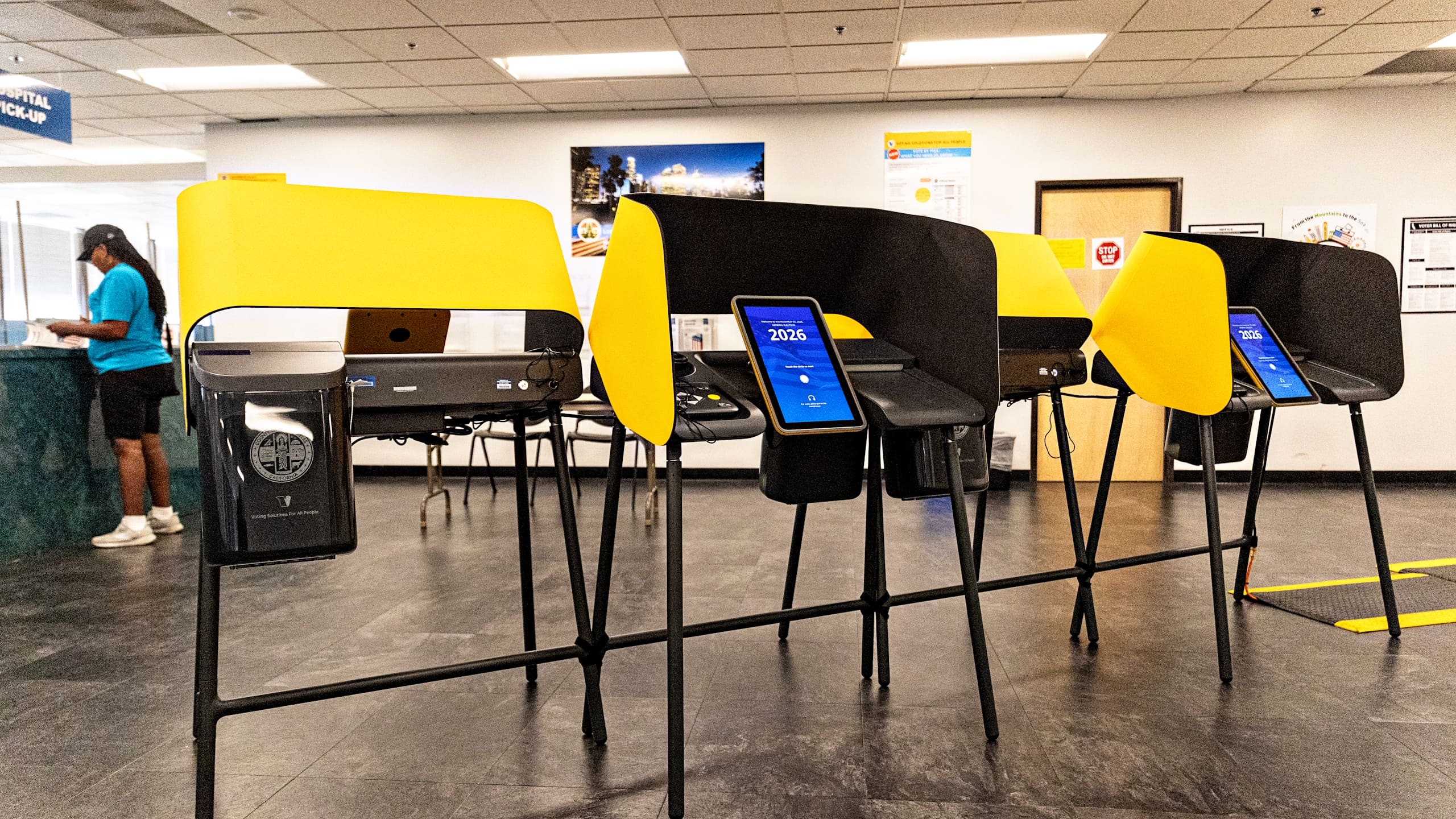
By the time this is published, we will be within two weeks of Election Day. To be more descriptive, in California we might say that on November 3 we will reach the end of the first half. During election season’s second half, also lasting 30 days, trained professionals will busily count ballots, cure ballots, and process ballots postmarked before but received after the end of the first half.
Read more Paradise From the Wall Socket: Why the Left Is Winning the Young, From Berlin to New York
There are good reasons to suppose the results aren’t going to be desirable for any Californian who wants lower taxes and more efficient government spending.
The nightmare scenario is that those voters most likely to reject more state and local ballot initiatives that will enact higher taxes and more wasteful spending will be less likely to vote. In California, where registered Democrats wield a over registered Republicans, any hope of stopping new taxes depends on a disproportionate Republican turnout. But as noted in a video posted on October 13, Republican member of the state assembly and longtime anti-tax crusader Carl DeMaio claimed that of California’s 5.7 million registered Republicans, 2 million are low-propensity voters who only show up for presidential elections.
These advantages favoring candidates and causes that will deliver higher taxes are compounded by recent events that further discourage Republican turnout.
To begin with, a massively disproportionate percentage of California’s Republican voters believe the system is rigged. A recent poll found that 90 percent of California’s registered Democrats have confidence in California’s elections, whereas only 20 percent of California’s registered Republicans shared that confidence. It is reasonable to assume that a higher percentage of Republicans will therefore not bother to vote, since so many more of them distrust the system.
The Los Angeles Mayoral primary did nothing to restore confidence in voting integrity. With three main candidates in the race, the two progressive, tax-and-spend contenders were going to split the vote. That should have allowed the insurgent candidate, Spencer Pratt, to stand a chance. It didn’t matter. Spencer Pratt came in third, and the way it happened was ugly. A day after the polls closed, Pratt had an eight-point lead over the third-place candidate, Democratic Socialist Nithya Raman. But every day his lead dwindled, and within a week after Election Day, Raman overtook Pratt to claim a spot on the November ballot.
To a Republican voter who already has diminished confidence in the process, what happened to Pratt in Los Angeles stinks. The possibility of actual fraud is almost irrelevant. Raman won because an army of fanatical democratic socialists, well funded and well organized, canvassed every “unhoused” individual within the Los Angeles city limits. They performed same-day voter registration and harvested a completed ballot in single face-to-face interactions. By the thousands, those ballots made it into a queue that, as counting progressed, pushed Raman’s number higher each day.
The legality of this obscures a moral imperative. Perhaps voting should require a modicum of actual effort on the part of any voter. Go get registered. Study the ballot. Report to a polling station. Making this suggestion isn’t advocating “voter suppression.” It reflects a simple truth: Democracy dies when a critical mass of swing votes are harvested from drug addicts and psychotics, living on the streets because that’s where there’s free food and free crack pipes, all courtesy of your local government-funded NGO. Want more? Vote for Raman.
This is disgusting, and when voters are disgusted with the process and disgusted with their options, they stay home. There are a million GOP-registered voters in Los Angeles County. They just watched a candidate for mayor in their biggest city, someone who gave them hope, get smashed by a political machine that’s stuck two avowed socialists on the November ballot. Incumbent Bass, the light socialist, and challenger Raman, the hardcore socialist. They have no option.
Read more Bank on It: Elissa Slotkin Was Speaking for the Entire Democrat Party
What happened in Los Angeles wouldn’t have been possible before 2010, the year California’s voters were conned into accepting the so-called “jungle primary.” Now that the top two primary finishers in California’s elections advance to the general election regardless of party affiliation, Republicans are frequently frozen out of even being on the ballot. In the state assembly races this November, nine out of the 80 seats up for grabs have two Democrats on the ballot. There is no Republican option. Republicans in these districts have less incentive to vote.
And then there was the bruising primary battle between gubernatorial candidates Steve Hilton and Chad Bianco, both Republicans. For a while, the contenders were tied in the polls, and while Hilton ended up beating Bianco and becoming a top-two finisher in the crowded primary, Bianco’s supporters, who delivered to him 10.2 percent of all primary votes, are bitter. This too is a reason many GOP voters may stay home this November.
Finally, the Republican brand in California has become, if not toxic, then simply not terribly respected, even to Republicans themselves. They have no power in the state legislature. They hold no statewide offices and haven’t for nearly 20 years. Now holding only one-fourth of the seats in the state senate and the state assembly, Republicans haven’t been able to prevent a two-thirds Democrat supermajority since 2017. Without at least one-third of the seats, Republicans can’t even prevent an override of a governor’s veto, and they can’t prevent the state legislature from enacting new taxes or placing constitutional amendments of their choosing onto the state ballot as initiatives for voter approval.
In California, elected Republican politicians are irrelevant. In the state legislature, they have been reduced to either clowns, playacting by introducing bills with no chance of passage, or collaborators, voting to support legislation that most Republicans oppose. For over twenty years, California’s state Republican party has done nothing but lose. Many of their own voters don’t respect them anymore.
For these reasons, Republican turnout could be lower than ever.
And if that happens, California will descend even further into an over-regulated, over-priced, over-taxed hell. Because ballot outcomes in California aren’t just about which candidates win. A low turnout of anti-tax voters would guarantee that conditions in California get even worse.
If there is one place where elections in California remain too close to call, it’s the state ballot initiatives. This year, there are 14 of them, and every one is consequential. Proposition 40, the “Billionaire Tax,” is getting most of the attention, as it should. It has already provoked the exodus of dozens of California’s wealthiest residents, with more sure to follow if it passes. Prop. 40 is currently leading in the polls.
There are other state ballot initiatives that will, if approved, impose massive tax increases on all Californians, not just billionaires. And equally consequential in aggregate are more than , all of them asking voters to approve tax increases and borrowing. California’s households and businesses will be on the hook for additional tens of billions of dollars per year in taxes if these measures succeed.
Next week, on the eve of Election Day, we will examine these state ballot initiatives and major local tax and borrowing initiatives in greater detail. We will also point to some trends that might counter the impact of California’s most reliable anti-tax voters, Republicans, choosing to stay home.
Read more Supreme Court to Review 158-Year-Old Federal Ban on Making Liquor at Home