






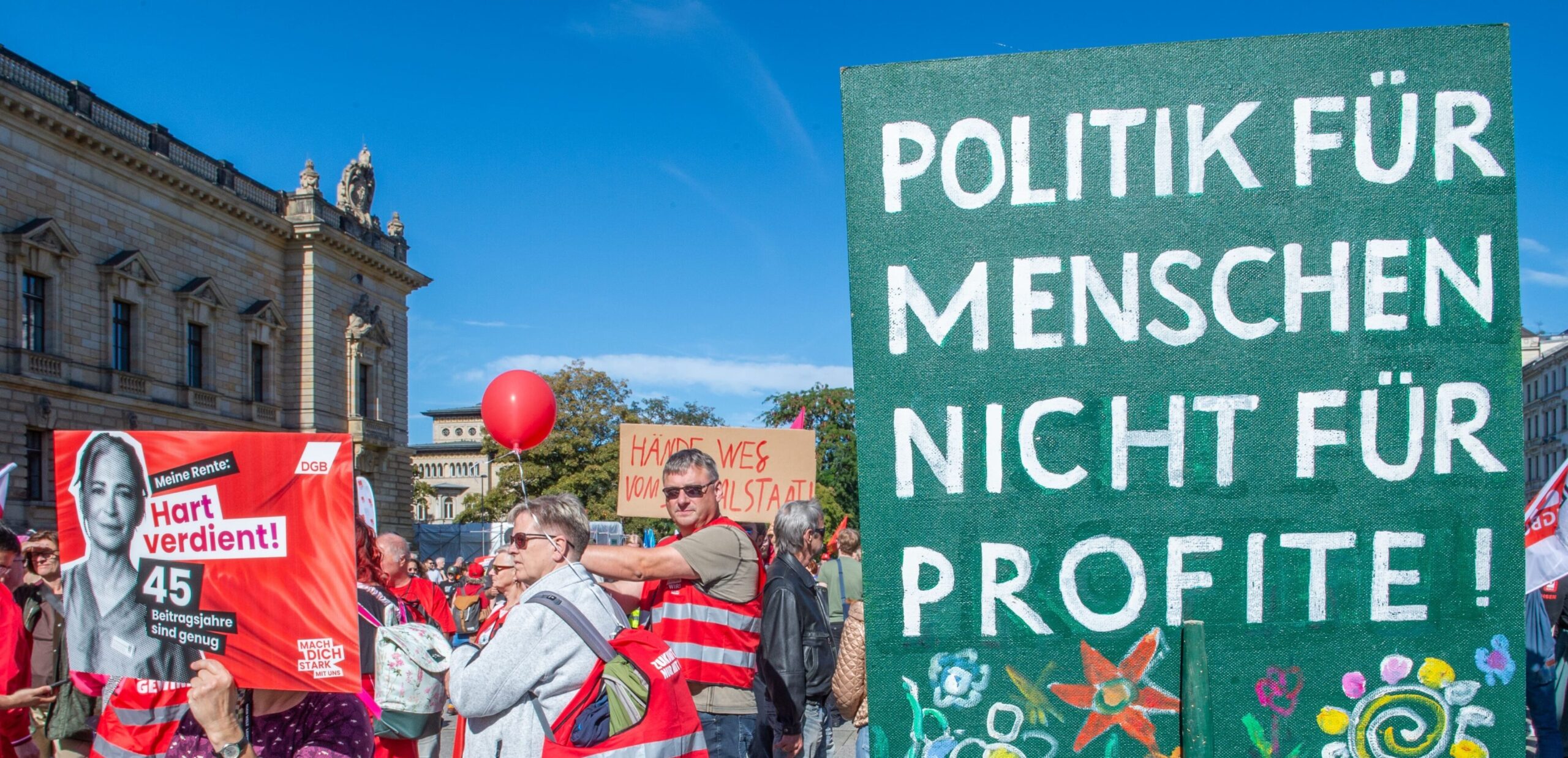
Two elections, one ocean apart, told the same story within nine months of each other.
Read more Bank on It: Elissa Slotkin Was Speaking for the Entire Democrat Party
In February 2025, Germany’s Die Linke—the direct legal successor of the East German communist party—became the strongest party among voters under 25, taking 27.3 percent of their votes. In November 2025, Zohran Mamdani, a self-described democratic socialist, won the mayoralty of New York City with three-quarters of voters under 30, carrying renters by wide margins and winning six in ten voters who named the cost of living as the city’s biggest problem.
Commentators on both sides of the Atlantic reached for the usual explanations: TikTok, charisma, a tired establishment, the housing crisis. All true, all insufficient. Because the same pattern is showing up in countries with different housing markets, different media, and different politicians. Something deeper is at work, and it has less to do with what the young are being told than with what they have never had to learn.
The world as a finished product
Electricity comes from the wall socket. Money comes from the ATM. Food comes from the store, the pension from the government, the apartment from the landlord. The water runs, the heat works, the ambulance arrives. Nothing about this needs to be understood in order to be used. You are born into it, and it is simply there.
That is the greatest achievement of the modern affluent society and its most dangerous weakness. What has always been there is taken for granted. What is taken for granted seems available. What is available merely needs to be fairly distributed. And whatever does not flow equally to everyone is a scandal.
In that short chain of assumptions sits an entire political worldview. It belongs to a generation that encounters a finished world and sees in it mainly the gaps: the unaffordable apartment, the unequal wealth, the poverty in a rich country. The questions are legitimate. The answer that follows with great regularity is wrong. It says, “all that is missing is political will.”
The better a society works, the less its members have to think about how it works. Nobody has to understand supply chains to buy a phone. Nobody has to know how a power grid is kept stable to switch on a light. This invisibility is a civilizational accomplishment; the division of labor frees the individual from knowing all the preconditions of his own life. But invisibility breeds illusion. What works reliably looks like nature. What has always been there will always be there. And what is there need only be shared out.
So prosperity becomes a pile to be divided. The question “how does this come into being?” disappears behind the question “why doesn’t everyone get the same amount?” And with it disappears the half of reality on which the other half stands.
Nothing in that pile is unconditional. Behind it stand generations of work, invention, investment, and capital formation. It rests on property that can be pledged, contracts that hold, firms that take risks, markets that signal scarcity, and an energy supply without which no industrial division of labor exists. Wealth is produced inside a legally ordered world. It does not fall from the sky.
The same is true of the welfare state, which in both countries is treated as a spring from which claims flow rather than a machine that has to be fed. The arithmetic is simple and merciless. Money can be redistributed; goods and services have to be produced. A legislature can raise pensions, but the economy still has to produce the nurses. It can borrow, but scarcity does not vanish; it is merely moved into the future. A city council can freeze rents, but it cannot freeze the cost of building, and the apartments that are never built do not appear on any ballot.
Whoever does not know these preconditions cannot protect them. He can tax capital until nobody invests, price energy until industry leaves, regulate construction until nothing gets built—and remain convinced, at every step, that he is creating justice. For him the pile he is dividing is a stock that cannot shrink.
From dignity to entitlement
Here the illusion joins forces with the strongest moral sentence either country possesses. In Germany it is the first article of the constitution: human dignity is inviolable. In America it is the proposition that all men are created equal, endowed with unalienable rights. Both sentences are unconditional, and they must be. They do not depend on origin, merit, or usefulness.
But now the decisive confusion takes place. The unconditionality of dignity becomes the unconditionality of the claim. If all human beings are equal in dignity, why should they not all share equally in everything this society has produced? The question sounds morally unanswerable. It is not. It quietly assumes what would have to be proven: that prosperity is as unconditional as the dignity from which the claim is derived.
Americans know this move under a different slogan: “Housing is a human right.” Health care is a human right. A living wage is a human right. The slogan borrows the moral force of the Declaration and attaches it to a good that has to be built, staffed, and paid for. Dignity is unconditional. The material realization of a dignified life is not. Between the floor a decent society owes everyone and the full inventory of what an affluent society produces lies a wide field of political choice, priority, and financing. In that field there is no unconditionality, only trade-offs. Dignity obliges the state. It does not make the state omnipotent.
Read more Supreme Court to Review 158-Year-Old Federal Ban on Making Liquor at Home
Whoever flattens that distinction turns the ideal of justice into a secularized vision of paradise. Paradise knows no scarcity, no demographics, no conflicting goals, no side effects. Everything is there, and nobody has to explain where it comes from. In the real world, scarcity is not a moral failure. It is the basic condition of all economic life. The achievement of a modern society is not to have abolished scarcity but to wrest ever more from it through knowledge, work, and institutions, without ever eliminating it.
The afterlife of 1989
This is where the story of the young connects to an older story, one that Americans tend to think ended in 1989.
When the Berlin Wall fell, more than a state collapsed. A promise collapsed: that history had a direction, that the overcoming of capitalism would redeem mankind, that politics was the execution of a historical necessity. Real socialism delivered shortage instead of plenty, walls instead of freedom. The West won the contest of systems not narrowly but overwhelmingly. Francis Fukuyama called it the end of history.
But a movement whose promise of salvation has collapsed does not necessarily give up its claim to moral leadership. It changes the justification. The old doctrine promised paradise after the revolution. The new one has brought paradise down to earth and declares it already present, merely misallocated. It is no longer capitalism that must be overcome, but scarcity, and by resolution. Every limit—on immigration, on social spending, on the size of the state—then appears not as an answer to scarcity but as a betrayal of dignity. Whoever demands such a limit no longer has to be refuted on the merits; he is simply on the wrong side of history.
That is the mechanism common to Berlin and New York. Mamdani’s program—rent freezes, city-run grocery stores, free buses, taxes on the rich to pay for it—and Die Linke’s program—rent caps, expropriation of large landlords, wealth taxes—are not the same policies, but they share a grammar. Both treat the city’s wealth as a given stock and politics as the act of distributing it. Both answer the question “how is it paid for?” with a moral category rather than an economic one. And both are attractive precisely to those who have grown up inside the finished product and have never had to watch it being made.
It would be cheap to blame the young for this. The Shell Youth Study, Germany’s largest survey of young people, shows a generation that wants above all security: 91 percent call a secure job important, and more than 90 percent name family, friendship, and a reliable partner. In New York, six in ten voters said affordability, not ideology, drove their choice. These are not revolutionaries. They are people looking for solid ground, and they are offered a doctrine that promises it by decree.
A German answer: Spare the world
No German philosopher of the late twentieth century formulated a sharper reply to the redeemers than Odo Marquard, a skeptic of the Ritter school who taught at Giessen for nearly three decades and remains largely unknown in America. Marx had written in 1845 that philosophers had only interpreted the world in various ways; the point was to change it. Marquard turned the sentence on its head in 1973: the philosophers of history have only changed the world in various ways; the point is to spare it.
Behind that aphorism lies a simple insight that American conservatives will recognize from Burke and Hayek: man is finite. He does not survey the interdependencies of a complex society. He learns the consequences of his interventions mostly after they have occurred. And he remains fallible precisely when he is most convinced of the purity of his intentions. The burden of proof therefore reverses. It is not the existing order that must justify itself for failing to match an ideal. It is the proposed change that must show it is suitable, proportionate, and defensible in its side effects.
This is not a philosophy of inaction. It is a philosophy of limits. It does not demand that injustice be tolerated. It demands that even the fight against injustice submit to the conditions of human fallibility—and that applies to markets as much as to the state. Neither can be made the object of a final certainty.
For the young, Marquard’s answer has two practical consequences. The first is education, not for employability but for judgment. Whoever knows how an apartment comes into being argues differently about housing policy. Whoever understands how a pension is financed talks differently about justice between generations. The second is a politics that delivers ground rather than redemption: attainable ownership, simpler building, cheaper family formation, a trade education that is respected. The young voter who calculates before he commits is not selfish. He has become cautious, because permanence itself has become a scarce good.
A society that teaches its young only what is unjust about the world hands them half of reality. The other half is the question of what made the achieved possible.
Human dignity is an unconditional right. Prosperity is a conditional achievement. Politics must honor the first without destroying the preconditions of the second.
Perhaps, then, we must spare the world not only from its self-appointed saviors. Perhaps we must also spare it from those who take its achievements so much for granted that they can no longer see what they rest on.
Read more California Billionaire Tax Struggles to Gain Majority Support as Voters Fear Expansion