





The Reflex
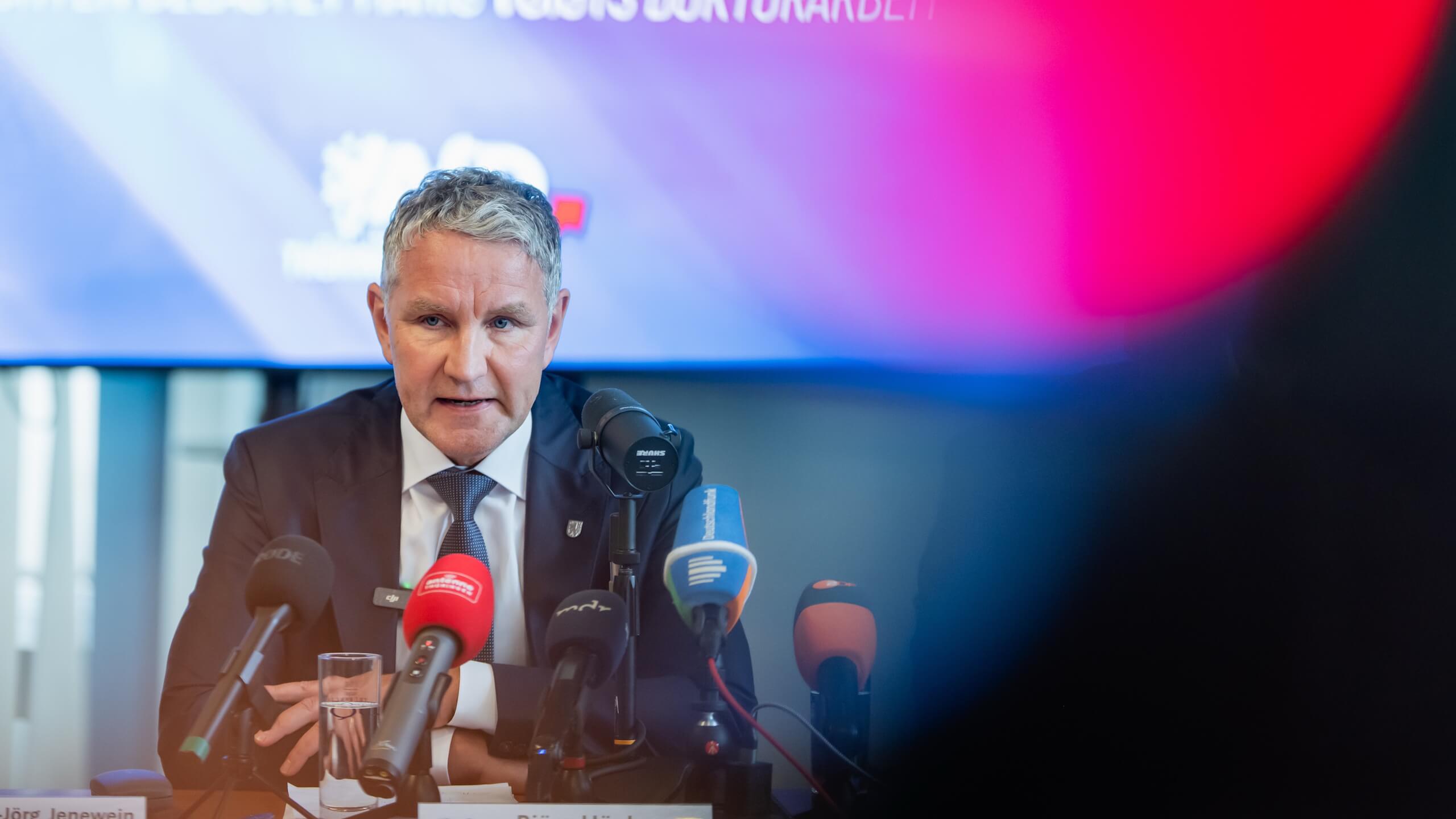
In late April of 2026, a German podcast called “Ungeskriptet” (Unscripted) released a four-and-a-half-hour episode featuring a conversation between the journalist Ben Berndt and Björn Höcke, the most controversial politician in Germany’s largest opposition party. Within days, it had been viewed several million times. And within those same days, a pattern of reaction set in that one could have predicted almost word for word.
Read more Part II: The Politicization of the Federal Courts During the Second Trump Presidency
Saskia Esken, until 2025 the co-leader of the Social Democratic Party—a party that today governs Germany in coalition—posted a video from inside the federal parliament, calling on companies to starve the program of advertising revenue. “Blacklisting helps,” she said. Der Spiegel, the country’s most prominent newsweekly, devoted a profile to the host whose intent was clear from the headline alone: Who, it asked, is the man who hands Höcke “a stage”? A well-known television satirist called the conversation “court reporting and bootlicking” and the guest a “certified fascist.” A Social Democratic member of parliament called the program “an imposition of intellectual ignorance.”
What is remarkable about this choreography is not its sharpness. What is remarkable is how little it concerns itself with what was actually said over those four and a half hours. The object of outrage was not, in the first instance, any particular statement. It was an event: an opposition politician had been allowed to speak at length, calmly, without constant pedagogical supervision. That is why the furor over the Höcke podcast finally tells us less about Björn Höcke than about the condition of the political public sphere in Germany. That condition—not the man—is the subject of this essay.
A Necessary Orientation
Several features of this story require explanation for an American reader, because they have no exact counterpart in the United States. Without them, the intensity of what follows cannot be understood.
The Alternative für Deutschland, founded in 2013, is today the strongest party in German national polling, drawing roughly a quarter of the electorate and running ahead of the Christian Democrats who lead the federal government. It is, in plain terms, the principal opposition party. Yet it is treated by every other party through an arrangement Germans call the “Brandmauer” (the firewall). The firewall is a cross-party understanding that no other party will govern with the AfD, form coalitions with it, or, in many cases, so much as negotiate with it, at any level, federal or local. An American analogy would require imagining that every other party in Congress had jointly and publicly pledged never to co-sponsor a single bill with the largest opposition party in the country.
Björn Höcke leads the AfD in the eastern state of Thuringia. A former high-school history teacher, he is the party’s most radical and most contested figure—admired by one part of its base, regarded warily by another, and treated by the German political mainstream as the embodiment of everything it fears. He is not a marginal figure. In the 2024 Thuringian state election, his party finished first.
Germany also possesses an institution with no American equivalent: the Verfassungsschutz, the “Office for the Protection of the Constitution,” a domestic intelligence service that monitors organizations, including political parties, which it judges hostile to the constitutional order. In May 2025, the federal office classified the entire AfD as “confirmed right-wing extremist.” A court suspended that designation in February 2026 pending full litigation, and the party is, for now, observed as a “suspected case.” Höcke’s own Thuringian branch, however, is classified as a confirmed right-wing extremist, and that classification is considered the final word, legally speaking. An American reader should simply reckon with this fact: the domestic intelligence service of a Western democracy monitors the party that leads in national polling.
But one additional fact is needed. In Germany, it is a criminal offense, under Section 86a of the penal code, to use the symbols or slogans of unconstitutional organizations publicly. Höcke has twice been convicted—and the convictions were upheld in 2025 by the Federal Court of Justice—for using the phrase ”Alles für Deutschland“ (“Everything for Germany”), once a slogan of the SA, the Nazi paramilitary. He maintains that the phrase long predates the SA and that the prosecution criminalizes ordinary speech; the courts rejected this. The legal facts stand, and I do not dispute them here. I record them because they are part of the context that an American cannot supply on his own.
Finally, memory. The postwar Federal Republic built its political identity around responsibility for the crimes of National Socialism. Certain words—and several will appear below—touch that nerve directly, and in Germany, they resonate in a way they would not elsewhere. This is not a pathology; it is a serious inheritance. But it means that German debate often argues about words at a pitch that obscures the conditions the words were reaching for.
The AfD is the most contested party in the Federal Republic, and its critics point to precisely the kinds of statements this essay examines. Yet the existence of such statements does not absolve a serious society from the obligation to inquire into the anxieties, perceptions, or social realities from which such language emerges. Indeed, it is precisely because these statements appear extreme that it would be intellectually convenient to file them away as mere outbursts—and never to ask what real condition they are meant, if perhaps in overheated and compressed form, to describe. To scandalize a phrase without examining the matter behind it is not to enlighten; it is to determine rigidly what is and what is not permissible thought. My argument is not that the criticism is baseless. My argument is narrower and, I think, harder to dismiss: that the reflex—boycott, exclusion, the refusal to listen at all—is the wrong response and that it reveals something about the accuser and about the health of the public sphere and not only about the accused.
What Höcke Actually Said
“Ungeskriptet” is not a conventional interview. It is a long-form conversation: no cuts, no continuous interruption, none of the familiar three-beat rhythm of question, objection, and moral framing. Over eight chapters, Berndt led Höcke through his biography, his family history, the founding and the internal struggles of the AfD, the question of migration, his view of the intelligence service and the courts, and his political vision. It is the form itself that unsettles. A long conversation cannot be reduced to a clip as easily as a three-sentence soundbite.
From those four and a half hours, German reporting—the daily Die Welt first and foremost—lifted out a handful of phrases and placed them at the center of the ensuing outrage. They are best examined one by one. In each case, the task is to distinguish between the semantic violence of the expression and the political content it is meant to carry. The two do not coincide.
“Gewollter Selbstmord” and “Mordkomplott gegen das deutsche Volk” (Deliberate Suicide and a Murder Plot Against the German People)
This is the hardest and most indefensible phrase in the entire conversation, and honesty requires saying so without qualification. Höcke described the migration and citizenship policy of the established parties as “ein gewollter Selbstmord” (a deliberate suicide), and then, escalating, as “ein großer Mordkomplott gegen das deutsche Volk” (a great murder plot against the German people). The words are saturated with criminal and existential charge. “Murder” implies annihilation; “plot” implies intent and coordination. It is entirely understandable that the phrase provokes revulsion. It is the point at which Höcke hands his opponents their widest target, and no contextualization makes it measured.
Read politically, however, the phrase does not assert a criminal conspiracy in any literal sense. It advances a thesis: that the migration policy of recent decades is not merely an error but a course knowingly pursued against the demographic, cultural, and security interests of the country itself. The exaggeration lies in the imputation of intent. The sober question underneath—a question one can ask with no drama at all—is this: Why do political elites hold to a course whose consequences, for public safety, for the integrative capacity of cities, for the welfare state, have been visible and named for years? From the perspective of an opposition that warns, is defamed, and then watches the problems worsen, there eventually arises the temptation to speak of more than an oversight. One need not yield to that temptation—I do not—but one should understand the experience from which it grows. The same applies to the related word “Islamisierung” (Islamization), which, precisely stated, is not aimed at the individual Muslim citizen who works, pays taxes, and carries this country with the rest of us, but at the political question of whether illiberal, religious-political parallel societies are forming in which the secular constitutional order comes under pressure. To scandalize the term while refusing to discuss the matter does not protect enlightenment. It protects denial.
“Kulturelle Kernschmelze” (Cultural Meltdown)
“Kulturelle Kernschmelze” (cultural meltdown), in the precise sense of a nuclear core meltdown, is a catastrophe metaphor. A meltdown is a loss of control at the innermost point of a reactor, irreversible or containable only at enormous cost. Transposed, the phrase says this is no longer about isolated failures in isolated policy areas but about the stability of the inner order of the commonwealth itself.
The phrase is scandalized because it describes social change not as “diversity” or “transformation” but as “disintegration.” Yet it reaches for a perception that many citizens already hold and that can be stated soberly: that schooling, public safety, language, the texture of cities, trust in the press, and the authority of the state are under pressure not separately but at the same time. Where conflicts were once fought out within a shared frame, the frame itself is now increasingly in dispute. Stated without metaphor, the matter is cultural disintegration, institutional overload, and the waning binding force of the commonwealth. The overheating is in the tone. The process the tone is reaching for is real.
“Historischer Zivilisationsbruch” (An Historical Rupture of Civilization)
This phrase is especially delicate, and it demands precision. In German intellectual discourse, the term “Zivilisationsbruch” (a rupture of civilization) is bound tightly to the Holocaust; historians use it, as a rule, in exactly that connection. To apply it to the present is to leave the register of ordinary political criticism and to claim an epochal category. That is reckless, and it is fair to attack it as such.
What is meant by it, contextualized, is not the claim, “This government is making mistakes.” What is meant is the far more sweeping claim that a political class is breaking with foundations that carried the European state over a long span: the rule of law, internal security, cultural continuity, the notion that a state is obligated first to its own citizens. Stated more soberly, it is the thesis of a deep rupture between an older European understanding of the state and a newer politics of de-bordering and self-relativization. One may hold that thesis to be wrong. One may hold the word to be irresponsible. But one should keep the two levels apart—the historical weight of the term and its present-day political content—rather than playing the one against the other to avoid the second entirely.
Read more Jim Crow and the Blame Game
“Deformierter Rechtsstaat” and “partiell ein Unrechtsstaat” (A Deformed State under Law and Partly a State of Injustice)
Unlike the cultural metaphors, these phrases—“a deformed state under law” and the country as “partly a state of injustice”—are bound most directly to an experience, and they are therefore the hardest to clear away with mere indignation. The matter here is not a feeling but a concrete situation. A party is elected; its seats are real; its voters are real; its parliamentary existence is real. And yet its representation is repeatedly placed under a special reservation.
Höcke’s claim, sharpened, is this: the democratic forms persist—there are elections, there are courts, there are parliaments—but they are applied so that a particular opposition may take part while receiving as little institutional normality as possible. It may stand for office, but its candidates have for years failed to win posts that would be normal parliamentary practice, from a vice presidency of the federal parliament to the chairmanships of committees. “Partiell ein Unrechtsstaat” (Partly a State of Injustice) sharpens this once more into a fighting thesis: that certain state procedures—observation, stigmatization, unequal treatment—are no longer experienced by the opposition as the fair exercise of democratic order but as politically motivated exceptional treatment.
One must be careful here, and that caution applies to Höcke as well: courts have examined a number of these complaints and rejected them. The rule of law has not been abolished. But politically, the impression of an asymmetric application remains, and it is from that impression—not from nowhere—that the sharpness of the language arises. A movement with millions of voters, whose ballots are counted but whose representatives are to be kept under permanent quarantine, will at some point cease to describe its own position as ordinary democratic competition. That is not a justification of every phrase. It is an explanation of where the phrases come from.
The Technique of Scandalization
Here, the real point comes into view. The great machinery of outrage shows a striking lack of interest in the lived reality from which such phrases arise. It is interested in the word, not the finding; in the moral marking, not the political cause. The expression is lifted out of its context, labeled, and then used as proof that the underlying reality need no longer be discussed at all.
This is the technique of the supervised public sphere: the language is delegitimized so that the experience from which it springs need not be acknowledged. The result is a peculiar asymmetry of outrage. It is not the erosion of the state’s protective functions that is scandalized, but the sharp naming of it. It is not the social fragmentation visible in many cities that stands at the center, but the metaphor that overstates it. It is not the refusal of representation to a major opposition that is treated as the problem, but that opposition’s angry reaction to the refusal.
The technique is best recognized in a single word: the charge of “normalization.” At its core, it means: this opposition may exist, but it must not appear normal. Its voters may be counted, but its representatives are to be kept under communicative special supervision. It may speak in parliament, but outside parliament every longer, freer conversation is to be marked at once as a danger. That is not a sovereign way of handling opposition. It is a public sphere that distrusts its own citizens’ capacity for judgment.
A Demonization with Method
The reaction to the podcast is not an isolated case. It is the latest application of a pattern rehearsed for a decade. Anyone who misses this will not understand the vehemence of the response. Over the years, a genuine infrastructure of demonization has been built—and each of its building blocks is then used to declare a substantive argument unnecessary.
The first building block is the word “fascist.” In 2019, a German administrative court, in a narrow emergency proceeding concerning a counterdemonstration, ruled that Höcke could be called a “fascist” in that particular context—as a value judgment resting, in the court’s words, on a verifiable factual basis. What became of this in public usage is instructive. A tightly limited single-case decision about the permissibility of a particular characterization was transformed into the formula of the “judicially confirmed,” indeed “certified,” fascist. That a later court—a Hamburg regional court—expressly clarified that the 2019 ruling had not “declared Höcke a fascist” but had only adjudicated one concrete utterance in one concrete context, never reached general awareness. This compression—turning a limited finding into a blanket label—is the scandalization technique in miniature. The satirist’s phrase, the “certified fascist,” lives off it.
The second building block is the pair of convictions for the slogan “Alles für Deutschland.“ As noted above, Höcke was convicted twice, and the Federal Court of Justice rejected his appeals in 2025; the judgments are final. That is the legal situation, and it stands. But here too the pattern shows itself: a final criminal judgment is treated not as what it is—the punishment of a specific act—but as a master key that renders every further substantive engagement superfluous. A legal fact is converted into total moral dismissal.
The third building block is memory politics. Höcke’s 2017 speech in Dresden, in which he spoke of the Holocaust memorial in Berlin as a “monument of shame” and called for a “180-degree turn” in the politics of remembrance, has ever since been the fixed reference point that frames every utterance he makes in advance. Here too: one may criticize that speech sharply, and many do so for good reasons. But it is treated not as the object of a debate but as an exhibit in a proceeding whose verdict is already settled. So the blocks fit together: the label, the criminal judgment, the speech. Out of them, a closed frame is built, and that frame makes it possible not to listen to any new conversation at all—even a four-and-a-half-hour one. One already knows, after all, what it contains.
This is what I mean by a demonization with method. Not that there is nothing to criticize—there is. But that criticism has been replaced by a procedure in which the result of the examination precedes the examination. A democracy that handles an opposition party chosen by millions in this way does not discipline that party. It disciplines itself.
The Loss of Control, and the Real Scandal
Why does the old choreography no longer work? Because its technical precondition has dissolved. Once, the leading media could decide who became visible, for how long, in which excerpt, and within which moral frame. Three sentences, a cut, a headline, a commentary—and the picture was finished. Today, an opposition politician can speak for four and a half hours, and millions of citizens can listen for themselves. That is the real loss of control.
The Neue Zürcher Zeitung, the venerable Swiss daily and no friend of the AfD, described the point soberly: one no longer needs to offer any politician “a stage” in order to give him public attention. The stage is no longer the prerogative of editorial offices. Whoever wants a public no longer strictly needs the blessing of Der Spiegel or of public broadcasting; he needs a format, a platform, an audience. The reproach that Berndt gave Höcke “a stage” is therefore an anachronism. It comes from a time when a stage was something the leading media allotted. That time is over.
Against this background, Esken’s call for an advertising boycott acquires its true meaning. When interpretive control can no longer be exercised through controlling visibility, what remains is the attempt to starve the format financially. It is telling that even the Neue Zürcher Zeitung saw in this an authoritarian path and spoke of fantasies of prohibition. Where the argument is missing, the spigot of money becomes the instrument of discipline. That is not the sovereign answer of a democracy to speech it finds uncomfortable. It is the opposite.
The democratic answer to the Höcke podcast would be an entirely different one. It would not be a boycott but better counter-speech. Harder analysis. More precise criticism. Where a politician exaggerates, one must expose the exaggeration—and with the phrases this essay has examined, that can be done without difficulty. When he identifies real problems, one must take them seriously instead of scandalizing the identification. Whoever, by contrast, merely shouts that the man was allowed to speak at all has lost the argument before it has begun.
The real scandal, then, is not that an opposition politician uses drastic terms. Drastic terms are open to attack, and they ought to be attacked—with arguments. The real scandal is a political public sphere that answers drastic terms with a reflex of exclusion but will no longer honestly discuss the conditions from which those terms draw their force. The Höcke podcast did not damage German democracy. It made visible how much of the old public sphere has come to fear free, long, uncurated speech—and how that fear has grown larger than its confidence in its own ability to answer back. For a country that presents itself to the world as a model democracy, that is the finding worth investigating. It should concern Americans too, because the temptation it reveals—to manage a public rather than trust it—is not a German peculiarity. It is the standing temptation of every political class that has lost the habit of winning an argument.
* * *
Frank-Christian Hansel is a member of the Berlin state parliament (Abgeordnetenhaus) for the Alternative for Germany (AfD). He writes on German political theory, European order, and the property-economic tradition of Gunnar Heinsohn and is completing a book-length essay on the post-liberal interregnum.
Read more Book Review: ‘Two Paths to Prosperity: Culture and Institutions in Europe and China, 1000–2000’