




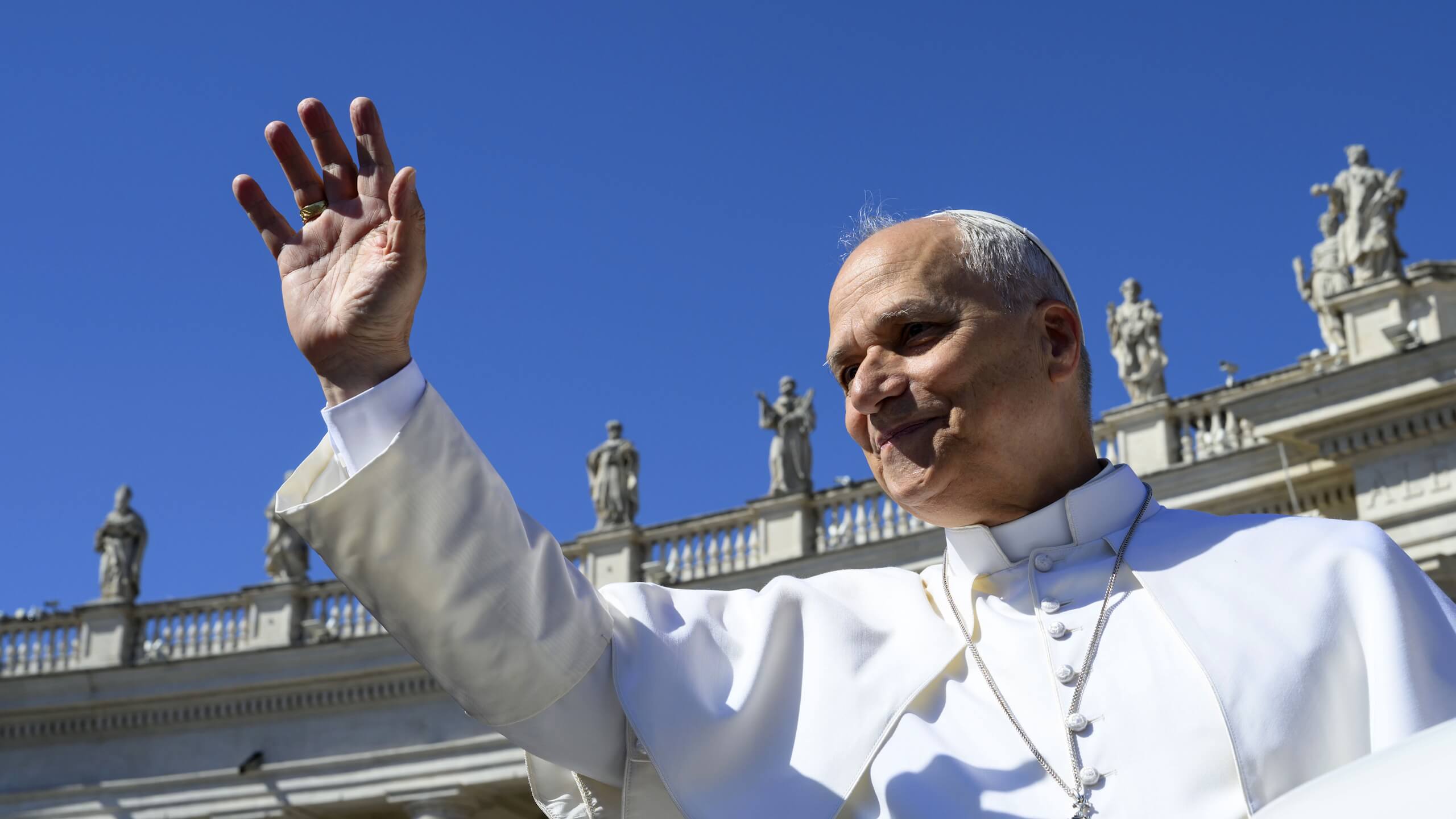
The Italians have a venerable national tradition of commenting on papal controversies. This month, the Italian journal of geopolitics, Limes, has weighed in. They interviewed me on the recent exchanges between Pope Leo XIV and President Donald Trump.
Read more America Is Not Caught in a ‘Thucydides Trap’!
Church commentary always sounds better in Italian, so I encourage you to read the interview on their website.
However, for the one or two of you out there who don’t know Italian, my lightly edited English translation of the interview follows below.
LIMES: Is Robert Francis Prevost an American pope or an American that happens to be the pope? In other words, is he a Roman pontiff or a patriot using his ministry to serve his own country?
PINKOSKI: It’s undeniable that Pope Leo XIV knows more about the inner dynamics of American politics than his predecessors. Perhaps this gives him an additional incentive to intervene on the internal dynamics of American politics, and he is doing so more than his predecessors did. That said, many of the positions Pope Leo is taking are in line with the trend of his predecessors. His statements on just war are sweeping ones, seemingly designed to operate in a prophetic register of exaggeration to win an effect. If taken analytically, they resemble endorsements of pacifism (for example, God “does not listen to the prayers of those who wage war”). But popes have been critical of armed intervention for most of the postwar period. The Vatican has increasingly opined that modern warfare does not meet the conditions of just war. So, Leo’s theological positioning reflects the trend of Vatican thinking. Yet his familiarity with American issues brings additional scrutiny upon the foreign and domestic politics of the United States.
LIMES: When he comments on the Trump administration’s ideas about Ukraine, Prevost sounds more like a papal American—indeed, an old-fashioned liberal internationalist. For instance, he criticized recent statements by the American president about Europe, accusing him of “trying to break up what I consider a very important alliance today and for the future.”
PINKOSKI: On the surface, this shift can sound very American. Prevost was a registered Republican of the 1980s, when the great conservative cause in foreign policy was transatlanticism. In that framework, NATO mattered more than the UN.
The postwar papacy, however, did not fit so easily into that transatlanticist framework. In their social encyclicals, European popes have sung the praises of the United Nations in ways that even Democratic President Jimmy Carter would have balked at. Pope Francis continued that trend, but he accentuated it with Latin American, left-leaning idiosyncrasies—he brought his prejudgments against the United States to bear. There was another important distinction from the transatlanticist stance. After Russia invaded Ukraine in 2022, transatlanticism received a burst of fresh energy. But in addressing the Ukraine conflict, Francis’s calls for peace required Ukraine to concede the permanent loss of some of its territories. For this reason, some commentators accused Francis of being insufficiently pro-Ukrainian. I think it was better to understand him as insufficiently transatlanticist, at least by their standards.
Now we see a change. Pope Leo is clearly more pro-Ukrainian than Francis. He is not calling for an immediate end to hostilities. That attitude aligns with the transatlanticist position, which continues to hold out hope for Ukraine’s victory and recovery of the territories lost in 2022 and even 2014. But is this an American attitude, or is it simply a reflection of changing attitudes amongst European elites? The Ukraine war has been excellent for the European Union. It has given its stagnant institutions a common enemy and a renewed sense of purpose, which justifies greater federalism.
Social context matters for what positions elites take, even church elites. The Vatican swims in the entourage of the European establishment. That mingling is probably driving the agenda. To the extent Francis did not fit into this, it was because he brought a kind of “Yankee, go home” prejudice from Latin America. With his passing, liberal Atlanticism can sweep the Vatican’s institutions.
LIMES: According to the Catholic Church, American soldiers must not carry out “immoral” and “inhumane” orders. Are those proper claims?
PINKOSKI: It’s correct and important to insist that no soldier should violate absolute moral impermissibles. And they should not be ordered to do so. However, we should draw attention to the precise kinds of actions that are morally wrong. Bombing civilian infrastructure, such as a bridge or power plant, may be generally wrong. However, it may be permissible in some circumstances to strike such targets. The laws of war and our discussions about them should concentrate on identifying what the threshold is for expanding military strikes to such targets and then arguing either that the threshold has been met or has not been met.
LIMES: The US president as the Messiah, the pope as the Antichrist. Does Trump’s messaging work? If so, what does it tell us more deeply about the American soul?
Read more The Supervised Public Sphere
PINKOSKI: When the most powerful temporal leader in the world and the most important spiritual leader in the world are citizens of the same country, tensions are bound to arise. Both gravitate toward the same issues and conflicts. Over a decade since DJT descended the escalator, it’s no surprise to see another outburst of his brass-knuckle tweeting, punching around the arena against unholy and holy subjects. This is nothing new. What’s novel is how the new pope has responded to this war of words. As Julia Yost has recently argued in Compact magazine, Pope Leo weighs in on American politics not as a foreign monarch but in a democratic style. His criticisms of Trump sound “like your politically opinionated neighbor chatting in the grocery aisle. He relates to Americans as an American.” Ironically, to dispel the sense that he is stepping outside his proper authority and unduly intervening in American politics, it may help him if he were to adopt more of the style of a foreign monarch rather than that of a republican citizen.
LIMES: What attracts so many Americans to Catholicism? Do they know it is not a Christian sect like any other but a universal ideology deeply rooted in the word of God?
PINKOSKI: Every convert has his own vocation, but we can identify general trends. First, the idea that the choice between civilization and barbarism is really a choice between Catholicism and barbarism. Second, the conviction that in a materialistic and commodified world, the Church is the only institution that isn’t trying to sell you something. Third, intellectual or aesthetic attractions accessible to millions through digital media. In a post-literary culture, Catholic aesthetics have an advantage, especially when captured in a short video. That said, it’s worth remembering that in the New World, including America, the Catholic Church has lost members to evangelical and Pentecostal movements—or simply to people who stop practicing. Conversions are real, but so is the flow in the opposite direction.
LIMES: What do American conservative Catholics criticize about the Vatican?
PINKOSKI: The real Francis effect in the United States was to rekindle an old skepticism toward Rome. Many conservatives now think the Vatican represents ideas indistinguishable from other globalist NGOs. The deeper you go into conservative Protestant circles, the more you encounter such sentiments. We should remember that the US only normalized relations with the Holy See recently—formal diplomatic ties were only established in 1984. John Paul II and Benedict XVI didn’t fit perfectly into the American conservative mold. But they were brilliant, orthodox theologians. When fractures emerged, conservative Christian intellectuals were willing to look away or blame “bad ministers” for misleading the “good monarch”—as with the papacy’s stance on the first and second Gulf Wars. With Francis, that posture could no longer hold. Catholics tried to interpret his ambiguous statements and provocations as best they could: “What he really meant was . . .” Increasingly frustrated, American conservatives (including Catholic ones) became convinced that the Vatican was hostile to them and their ideas. That destroyed the trust built up since the 1980s. We’re living through a phase that flows directly from that rupture.
LIMES: Is it possible to open a dialogue with the Vatican on post-liberalism?
PINKOSKI: In this environment, it’s unlikely that Vatican officials will seriously engage with theses of conservative or right-postliberals or those of “political Catholicism.” We should also remember that debates about or against post-liberalism are quite insular and cerebral. They unfold on the margins, overshadowed by far more powerful social trends or Church disputes. The doctrinal ambiguity of Pope Francis was far more consequential than the question of what kind of regime the encyclical Immortale Dei requires of Catholics.
LIMES: Are Americans aware that the Catholic Church is a geopolitical actor?
PINKOSKI: In the Middle Ages, the mantra was Roma locuta est, causa finita est—Rome has spoken, the matter is closed. With the French Revolution, it became Roma locuta est, causa contra Roma—open defiance of the papacy. Everyone expected that in late modernity it would become Roma locuta est, causa non audita est—Rome speaks without being heard. Instead, today we see Roma locuta est, causa inchoata est: when Rome speaks, the matter heats up. In an era of political and ethical fragmentation, Rome signals a kind of moral authority unknown elsewhere. This doesn’t mean everyone listens—not at all. We see concerted efforts to co-opt Rome’s statements for other causes and indignant attempts to oppose that co-opting. But the liberal idea of a secular public square, which should lodge a protest every time a theological commitment is raised, has faded.
Our public square is informed and shaped by theological commitments—politicized and weaponized, certainly, but rooted in properly theological concepts and debates. We saw this during the Biden years, beginning with his inaugural address, invoking Saint Augustine, as he tried to tie his presidency to Catholicism—aiming to borrow Catholic thought for progressive causes, or more cynically, to subordinate it to progressivism. I would say that Protestant conservatives’ objections to the pope’s current interventions in American politics have more to do with the feeling that his theology is wrong—the Francis effect—than with the idea that he is breaking the rules of the temporal sphere, where religious declarations are not permitted. That would be a more Rawlsian or liberal Protestant objection. Theology shapes the current battlefield. And battles are often fought on questions that John Paul II would have understood perfectly. When popes speak ambiguously about sexual morality, conservative American Protestants respond from positions that reflect interpretations of Christian anthropology dear to Wojtyła.
LIMES: Does the American creed still exist?
PINKOSKI: We live in a time in which the unity of American creedalism, built up during the Cold War and the civil rights era, is crumbling. Atlanticism is being invoked against Russia, but many Americans have no interest in providing unlimited financial aid to Ukraine—and certainly no boots on the ground. The civil rights revolution was designed for a biracial society, in which the white majority was meant to have special obligations toward the black minority. “White America must accept responsibility,” Lyndon Johnson said in 1965. But that same year, the president signed the Hart-Celler Act—the law that removed strict limits on immigration—which effectively condemned biracial America to death. Forty years later, the civil rights revolution evolved into multiculturalism. In the new context, it meant that a shrinking white majority had special responsibilities toward all non-white people. Elites did everything to turn this idea into the new American creed of the 21st century. But its cost and its inequity have become too obvious to ignore. Many still believe in it, of course—that creed is deeply rooted among boomers, who see it as the continuation of the Cold War context and the civil rights struggles of the 1960s. But the dissenters are too many to claim the entire nation identifies with it. And no one knows what will replace it when the boomers lose political power. We will see new fractures, probably accompanied in the short term by greater redistribution of wealth to keep factions in check.
LIMES: Is an American version of the Anglican Church possible?
PINKOSKI: America is very far from becoming a confessional state. If anything, what is falling apart is the interpretation of church–state separation established by the Earl Warren Supreme Court in the 1950s and 60s. According to the high court, the state can never promote any religious creed. Praying in public schools, even without explicit reference to a specific denomination, is unconstitutional. Displaying the Ten Commandments may or may not be, depending on location. And yet the state is authorized or encouraged to support other religions. There are Pride parades, Pride months, rainbow flags on public buildings, squares, and roadways. There are land acknowledgments before public events. Many people think our public square is obviously religious—it just prohibits the expression of Christian faith. The Warren Court precedents created an illusion of neutrality. That illusion is fading.
LIMES: Is it possible to apply Catholic social doctrine to today’s fractured, neo-feudal America?
PINKOSKI: That doctrine was designed to address the political and social challenges of the 19th and early 20th centuries. But it presupposes a church united in theological and philosophical purpose. It’s impossible to understand the Leonine project without grasping that it was based on the recovery and proliferation of Thomistic thought. This enabled continuity between Leo XIII down to his successor Pius XII, all educated in the same intellectual milieu. But by the mid-20th century, the clergy began to fragment, producing the tragedy that followed the Second Vatican Council. Instead of expressing the Church’s shared sense of the faith, from that point on, ecclesiastics could no longer agree on how to interpret the Council’s words. The philological crisis was, at its root, a philosophical and theological crisis. The same words and concepts no longer held the same meaning for different parts of the Church. From that moment, social doctrine became more confused, harder to follow, and more open to political and ideological co-optation. John Paul II and Benedict XVI did what they could to restore the coherence of the magisterium—consider the encyclical Veritatis Splendor. But they were often fighting against an episcopate that was winking in other directions. This has made it harder to offer a social doctrine calibrated to the challenges of the 21st century, including social fragmentation and neo-feudalism. To replicate the success of the 19th-century Leonine project, what’s needed first and foremost is a coherent philosophical and theological practice transmitted through seminaries and then to the episcopate. We’re not there yet.
* * *
This article was originally published in Italian as “Un monarco, non un cittadino: Conversazione con Nathan Pinkoski, saggista e Senior Fellow al Center for Renewing America,” Limes—Rivista Italiana di Geopolitica, Lo scisma d’Occidente, no. 4 (2026): 127–32. The translation was originally published on Substack on May 19, 2026. You can follow Nathan Pinkoski at his page, Lament for the Nations, there.
Read more Part II: The Politicization of the Federal Courts During the Second Trump Presidency