







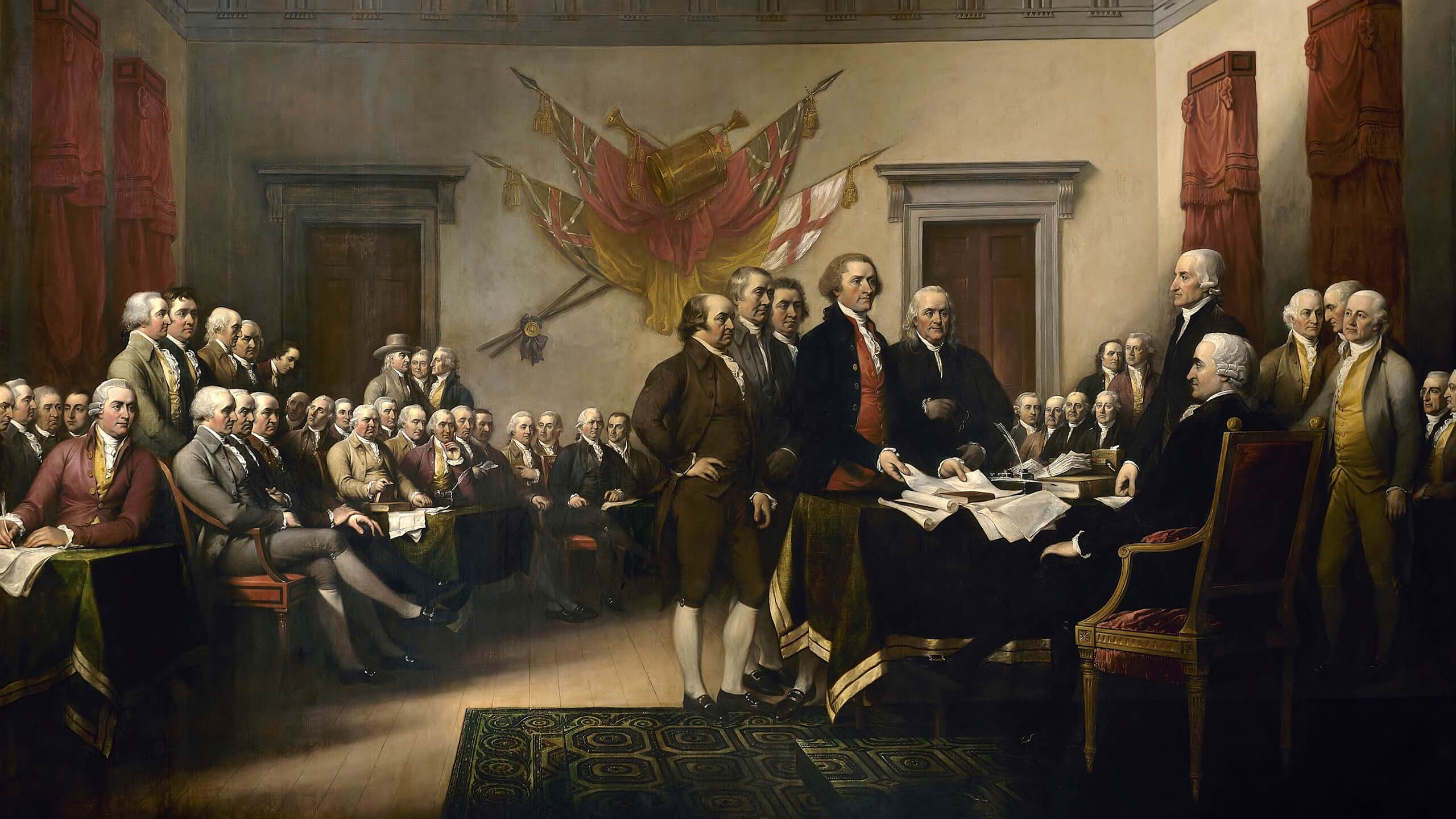
A couple of weeks ago, at the dedication ceremony for his presidential library, Barack Obama made a speech in which he addressed the Founding Fathers. “In forming our union,” he said, “the founders fell terribly short of the Declaration’s promise, leaving slavery intact, allowing states to restrict the franchise to white men who owned property.” Fortunately for us, however, “in drafting a Constitution and a Bill of Rights, they did have the foresight, the genius, to provide us with a framework that allows each generation to make our union more perfect.”
Read more SCOTUS Rejects Trump on Birthright Citizenship? Phooey!
Needless to say, not everyone was thrilled with Obama’s comments. Conservatives on Twitter/X thought he had insulted or taken a “swipe” at the Founders. Fox News said that he had “knocked” them, noting the supposed irony of the statement coming “just days before America celebrates its 250th anniversary on the 4th of July.”
I don’t have any idea if Obama intended his remarks to be insulting, although I doubt that he did. He could have made his point about the nation’s origins and its struggles a little differently, I suppose, but the bottom line here is that what he said is absolutely true. The Founders did fall terribly short of the promises they themselves made. This is inarguable, and four score and seven years later, nearly three-quarters of a million Americans were compelled to give their lives to rectify that mistake.
Obama’s real offense here wasn’t mischaracterizing or slandering the American founding but misunderstanding it. In commenting on the Founders’ shortcomings, the 44th President of the United States got the facts right but their significance wrong. As has been his wont on a variety of topics over the years, Obama inverted the cause and the effect, and because he did, he also misconstrued this nation’s uniqueness and greatness.
Part of this is Obama’s lived experiences. He is, after all, a black American man, which means that he has been made acutely aware of the racial issues in this country for his entire life. A bigger part of it, though, is the general Progressive milieu of which he is a part, which both denies the importance of the differences in cultural heritage and, consequently, dismisses the criticality of Western cultural development as a matter of intellectual principle.
To that end, it is worth reiterating that during the last five hundred or so years before the birth of Christ, the peoples of the Mediterranean—Greece, Rome, Israel—were the incubators of ideas that were among the most radical in human history. The Hebrew Bible, the plays of Sophocles and Aeschylus, the writings of Cicero and Marcus Aurelius, and other similar metaphysical milestones in the saga of Western Civilization offered a novel perspective on man and his place in the cosmos, one that would, in time, become the philosophical and moral cornerstone of the West. These foundational works eventually found a cohesive, amalgamated expression in Christianity. In his widely celebrated homily on the Solemnity of the Epiphany in 2013, Pope Benedict XVI noted that Christianity was the world’s first religion for all people, the first great cultural force to offer itself to “men and women of every place, of every continent, of all the different cultures, mentalities and lifestyles.”
The late, great James Q. Wilson, one of the giants of American political science, called this force the “universal aspiration,” and, in his classic tome The Moral Sense, described it as follows:
The most remarkable change in the moral history of mankind has been the rise—and occasionally the application—of the view that all people, and not just one’s own kind, are entitled to fair treatment. Americans are so familiar with the passage in the Declaration of Independence asserting that “all men are created equal” that they forget how astonishing and, in a sense, unnatural that claim is. . . .
However common the savagery, bloodletting and mendacity in contemporary life, a growing fraction of mankind lives under the claim that men and women are entitled to equal respect. The spread of that claim is extraordinary; even more extraordinary is the fact that so many people sometimes obey it. We are appalled by occasional stories of torture, but at one time thoughtful people approved of its routine use. We are angry at terrorists who take hostages, but once diplomacy was largely conducted by the mutual seizing of hostages, and hardly anyone save their immediate families thought their fate was of the least interest. People are inclined to treat equals equally, but where once people were thought to be equal only if they were of the same sex, age, class, and religion, today people are often thought to be equal regardless of their rank or station provided only that each has made the same contribution of time and effort to some joint endeavor. People have a natural capacity for sympathy, but where once sympathy extended to those closest to us, today it often extends to people whom we have never met and animals that are not our pets.
Read more Communist China Is a Pariah, It’s Time to Treat It Like One
Readers should note here that Wilson does not make the mistake of confusing this universal aspiration with its universal application. In other words, he acknowledges that this ideal stipulation that “all men are created equal” has only “occasionally” been applied. As Obama pointedly observed in his library dedication speech, we, the people of the United States, have struggled with this application throughout our history. Indeed, there is considerable irony in the fact that the man who penned the document insisting that all men are created equal was himself a slaveholder, someone who shared at least some culpability in the nation’s “original sin.”
At the same time, it is vital to recognize that no nation on earth has ever striven so hard and so long to mend its shortcomings and thereby to fulfill the universal aspiration. In addition to fighting a long and bloody civil war over the matter, the country and its people have worked, over the 160 years since that war, to resolve the issues left unchanged; that is, to make its de jure equality de facto as well. The Civil Rights movement proved to be a watershed in American—and Western—history, the point at which the promise of the universal aspiration began to be transformed into reality.
Obama’s claim that the “genius” of the Founders was their creation of a Constitution that enabled subsequent generations to fix their predecessors’ mistakes is consistent with his repeatedly expressed belief in man’s inevitable moral improvement. For decades now, he’s insisted that there is a right side and a wrong side of history and, more emphatically, that “the arc of the moral universe is long, but it bends towards justice.” He supposes that each generation will be smarter, better, and more morally righteous than its predecessors, simply by witnessing their errors. This is historically and morally illiterate. Man’s temporal moral condition can never be perfected, and it may be improved, but only through the constant application of virtue in a consistent and cohesive cultural environment. It does not happen by accident. It happens only rarely and only under very limited conditions, when historically significant virtues are appreciated, taught, and practiced. When those virtues are universally appreciated, progress is possible. When they are not, and when they are absent, society fragments.
The genius of the Founders wasn’t in enabling their descendants to fix their mistakes. Rather, it was to fashion a system that strived to be righteous in the first place. Obama is, of course, correct that the American Founders were far from perfect. They engaged in chattel slavery, the wholesale theft, bondage, and retailing of human beings. They also discriminated against women, denying them their equal rights under natural law and keeping them in virtual servitude. They made a great many mistakes and committed a great deal of sins. But in this, they were no different from any other people in the history of the world.
What made them different was their acknowledgment of their sins, their recognition that they could and should strive to create something better—and not just by enabling their offspring to atone for those sins. They chose to embrace the universal aspiration, not because they thought they were perfect but because they knew that they weren’t.
This weekend, we, the inheritors of the Founders’ vision, will celebrate its 250th anniversary. As we do, we should recognize that the brilliance of that vision resides in its willingness to embrace lofty ideals, even knowing that failure to live up to those ideals is inexorable. That is the beauty of this country. That is what makes it exceptional in world history. It is premised on the notion that man is not perfect, that he is weak and self-absorbed, and prone to failure. It is built on the inevitability that man will heed the serpent’s exhortations and will take a bite of the apple, every single time, yet that should hardly be an excuse not to strive to do better. The United States is the only nation in the history of the species to be created under the presumption that it is, indeed, “self-evident, that all men are created equal . . .”
America is not great because its Founders “provided us with a framework that allows each generation to make our union more perfect.” It is great because its Founders even thought that a more perfect union was possible.
Read more Movie Review: ‘Disclosure Day’